

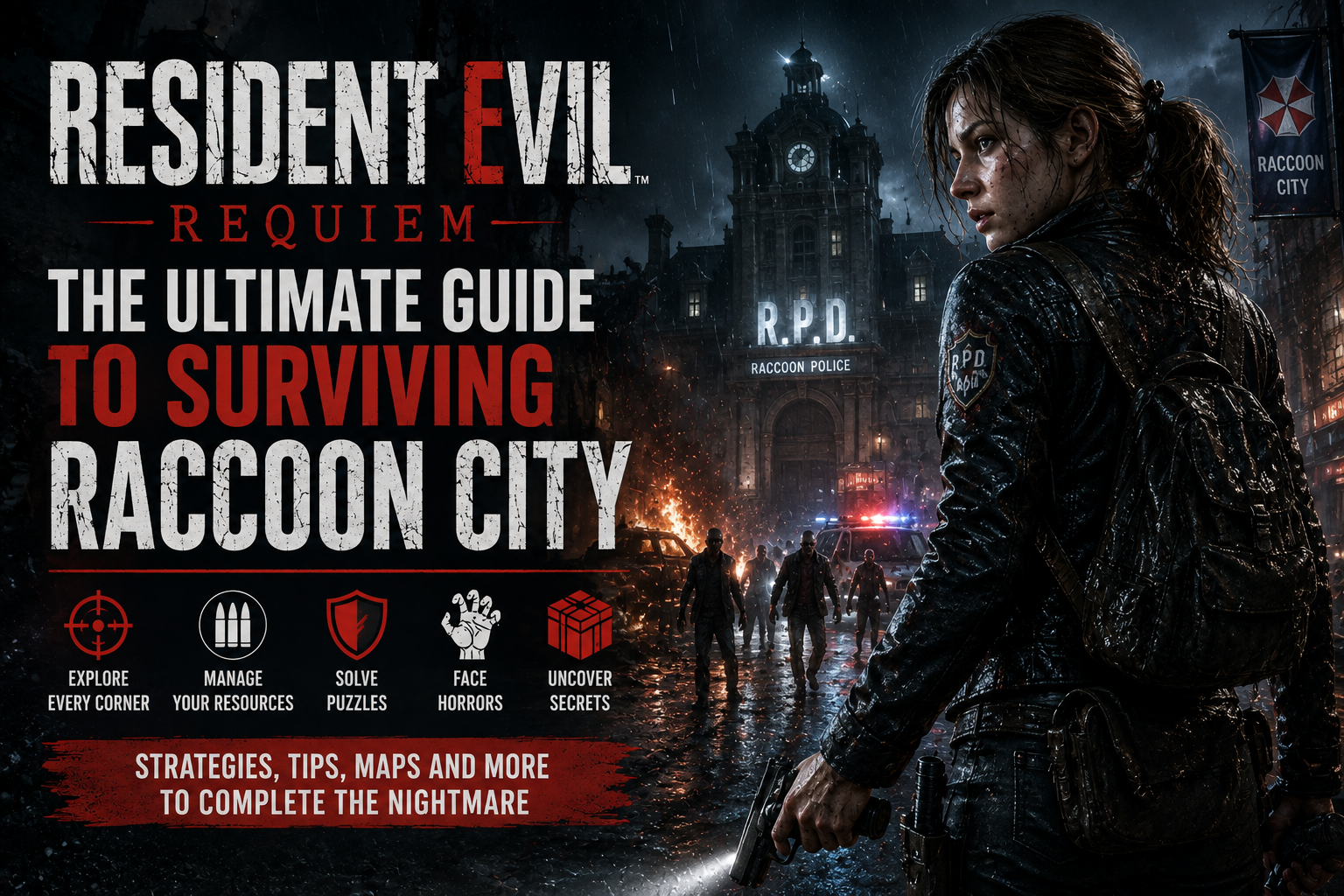
Complete Guide · Survival, Bosses, and Tips
Resident Evil Requiem: The Definitive Guide to Surviving Raccoon City
Everything you need to beat the game: how to avoid the Girl, the solution to every puzzle, strategies against all eleven bosses, and the resource-management tricks that make the difference between surviving and becoming just another victim of Raccoon City Syndrome.
Fact Sheet
| Developer and publisher | Capcom |
| Engine | RE Engine |
| Release date | February 27, 2026 |
| Platforms | PlayStation 5, Xbox Series X|S, PC, Nintendo Switch 2 |
| Genre | Survival horror |
| Mode | Single player |
| Director | Koshi Nakanishi |
| Producers | Masachika Kawata and Masato Kumazawa |
| Screenplay | Haris Orkin |
Nine mainline entries after the original Resident Evil defined survival horror as we know it, and helped establish the very grammar of the genre for everything that came after, Capcom has decided to close a narrative circle that had been left open for nearly three decades. Resident Evil Requiem takes place in October 2026, twenty-eight years after the destruction of Raccoon City, and follows an FBI analyst named Grace Ashcroft as she investigates a wave of inexplicable deaths among survivors of the original disaster, all of them linked to a phenomenon now dubbed Raccoon City Syndrome. Her investigation crosses paths with Leon S. Kennedy, the DSO agent that series veterans have recognized since 1998, who returns to the front lines after years away from a lead role and who, to make matters worse, is himself suffering the symptoms of that very same illness, a wrinkle that turns what could have been a routine case into something far more urgent and personal for him.
What sets Requiem apart from every other entry isn’t just its story, but its gameplay structure: for the first time in the mainline series, two characters with completely opposing design philosophies share the weight of the campaign, trading control back and forth as the investigation unfolds rather than confining each protagonist to a separate, self-contained scenario. Grace offers pure first-person terror, with scarce resources, an ink-ribbon save system on the higher difficulties, and an invulnerable threat that can only be avoided, never confronted. Leon, meanwhile, brings the third-person action that defined titles like Resident Evil 4, complete with parries, an axe as a melee weapon, and far more abundant ammunition. This guide brings together everything you need to survive both halves of the game: from how to evade the creature known as «the Girl» to the exact strategy for each of the eleven bosses, along with solutions to the game’s most intricate puzzles and the resource-management tricks that mean the difference between breezing through the game with resources to spare and running out of ammo at the worst possible moment, deep inside hostile territory with no easy way back.
It’s also worth placing this release within Capcom’s own trajectory: following the critical and commercial success of the Resident Evil 2, 3, and 4 remakes, and after Resident Evil Village consolidated the first-person horror formula introduced in the seventh entry, the company faced a difficult question: where does a numbered mainline series go once it has already explored both pure horror and unrestrained action at different points in its history? Requiem’s answer — not to choose between the two formulas, but to offer both simultaneously through two distinct protagonists — is the boldest design bet the franchise has made in years, one that could easily have collapsed under its own ambition, and this guide is built specifically to help you navigate that duality without dying more times than strictly necessary.
Before continuing, a practical warning: this guide includes concrete puzzle solutions and detailed boss strategies, so it inevitably contains some progression details (not major plot details, which are deliberately kept out of scope except where strictly necessary to understand the context of each zone). If you’d rather discover the game with no preconditions, the sections on technical requirements, editions, and critical reception are completely safe to read without fear of spoilers.
From an Abandoned Online Shooter to the Ninth Mainline Entry
Few Capcom productions have changed direction as dramatically during development as Resident Evil Requiem. The project originally started out as an open-world multiplayer title built around an online model, a direction the studio itself eventually abandoned in 2021 after concluding, in the words of its development team, that it «wasn’t what fans wanted» from a new numbered entry in the series. That pivot forced the team to rebuild the project almost from scratch, discarding significant amounts of prior work in the process, in a development process that ultimately stretched across six full years from that reset to launch.
During that rebuild, the team led by Koshi Nakanishi — a director who had already helmed Resident Evil 7 and understood better than most what it takes to reinvent the series’ tone — experimented with the idea of turning Requiem into «a genuine horror game starring Leon Kennedy» before settling on the final formula: two protagonists with deliberately opposed play styles, united by a single story that ties their individual investigations together. That design decision explains why Requiem feels, in practice, like two distinct games stitched together with extreme narrative care, rather than a single homogeneous experience trying to please everyone at once.
The game was produced by Masachika Kawata and Masato Kumazawa, while the screenplay was handled by Haris Orkin, who spent two and a half full years shaping the final script alone before the wider writing team refined it further. Motion capture took place between 2023 and 2025 at Imaginarium Studios, working in three-week shooting blocks followed by full month-long breaks to let the cast and crew recover before the next stretch — a production rhythm that helps explain both the technical ambition of the final result and the sheer length of development.
Key Fact
Resident Evil Requiem is the first entry in the series designed exclusively for ninth-generation consoles, which has allowed Capcom to incorporate graphics technology that wouldn’t have been viable on previous hardware, including native path tracing in its PC version.
That generational leap also shows in design choices that would have been unworkable on the previous console generation: the strand-by-strand hair rendering system, the density of detail in the Care Center’s interior settings, or the dynamic lighting simulation that turns light itself into a core gameplay element — remember, it’s literally the main survival tool against the Girl — would all have been prohibitively expensive to implement on PlayStation 4 or Xbox One. Capcom has been explicit that this technical freedom was one of the factors that finally tipped the balance toward the game’s final structure, with two protagonists and two different camera perspectives running on the same engine without compromising either one’s performance, something that would have demanded painful compromises just one hardware generation earlier.
The game’s very name, Requiem, wasn’t a casual choice: according to the development team, it reflects the narrative intent of closing a cycle the series had been carrying since the very first Resident Evil, finally giving closure to the human and biological consequences of the Raccoon City disaster nearly thirty years after it occurred within the fiction’s own timeline. It’s a title that promises an ending, and the game’s marketing has leaned into that promise at every turn.
Plot, Setting, and Characters (no plot spoilers)
The action is set in October 2026, twenty-eight years after the biological disaster in Raccoon City forced the U.S. government to wipe the city off the map. The main protagonist is Grace Ashcroft, an FBI analyst and daughter of Alyssa Ashcroft, a character longtime series fans will remember from Resident Evil Outbreak. Grace finds herself pulled into investigating a series of deaths that appear unrelated at first glance but share a common thread: every victim is a survivor of the original Raccoon City incident, and all of them show mutations linked to the T-virus that the investigation comes to call Raccoon City Syndrome, a name that only starts to make grim sense once the scope of the case becomes clear.
That investigation leads her to cross paths with Leon S. Kennedy, an agent of the Division of Security Operations (DSO) making his biggest return to the series since Resident Evil 6 in 2012. Leon himself is suffering the symptoms of the syndrome Grace is investigating, which makes his involvement far more personal than a simple official assignment handed down from above. As the story progresses, both characters discover that the trail of deaths leads directly back to Umbrella Corporation and to a biological weapon codenamed Elpis, whose exact purpose is revealed gradually over the course of the campaign rather than dumped on the player all at once.
Grace Ashcroft: The New Face of Pure Horror
Played by Angela Sant’Albano, Grace is the protagonist of the sections closest to classic survival horror, the ones where resources genuinely run thin and every bullet counts, and every decision about where to spend a healing item carries real weight. Her status as the daughter of a character already known to longtime fans — Alyssa Ashcroft, from Resident Evil Outbreak — adds an extra layer of continuity for those who’ve followed the franchise since its earliest entries, without that connection being necessary to enjoy her story as a new character in her own right.
Leon S. Kennedy: The Veteran’s Return
Voiced once again by Nick Apostolides, Leon returns with a visual redesign deliberately meant to reflect the passage of time since his previous appearances, aging the character just enough to feel earned rather than jarring. His campaign sections are built around direct action: firefights, melee executions, and a much more unrestrained pace than Grace’s, in the vein of what made Resident Evil 4 one of the most influential action games of its generation. For players who have followed this character since his debut in the series’ second entry, his return after more than a decade away from a lead role is, on its own, one of Requiem’s biggest draws, and the design of his sections seems deliberately built to live up to that years-long buildup of expectation rather than coast on nostalgia alone.
An Enemy That Isn’t a Monster: Time Itself
One of Requiem’s most interesting narrative ideas, and one that helps explain the campaign’s overall tone, is that the central threat isn’t simply a new T-virus variant, but the late, almost-forgotten consequences of a disaster the world considered closed nearly three decades ago. Both Grace and Leon, each in their own way, confront the idea that Raccoon City’s past was never truly resolved, and that its effects keep resurfacing in new, unpredictable ways in the present, refusing to stay buried no matter how thoroughly the world tried to move on. That sense of unfinished business with the past is, according to the writing team, the reasoning behind the game’s title, and it’s constantly reflected in small environmental and documentary details scattered across every location, rewarding players who take the time to read what they find.
The Rest of the Cast
Orbiting around Grace and Leon is a supporting cast that ties Requiem into a good portion of the series’ recent history: Sherry Birkin returns to the story, alongside new characters like Emily, Victor Gideon, and Zeno, as well as the reappearance of Oswell E. Spencer, a historical figure tied to the very origins of Umbrella Corporation. This mix of new faces and historical names is, according to much of the critical response, one of the elements that best connects Requiem to the rest of the franchise without requiring the player to know every detail of prior entries, striking a balance that isn’t easy to pull off in a series with this much accumulated lore.
Raccoon City Syndrome and the Elpis Weapon
Much of Requiem’s central mystery revolves around two elements worth understanding up front, without spoiling any major story turns. The first is Raccoon City Syndrome itself, the name Grace’s investigation eventually gives to the late-stage T-virus mutations that begin appearing in survivors of the original disaster, almost three decades after it happened, long after most of the world had stopped thinking about the consequences of that night. The second is Elpis, the biological weapon whose development is linked to Umbrella Corporation and which grows increasingly central to the narrative as both investigative threads — Grace’s and Leon’s — converge. Understanding this conceptual groundwork helps frame the context of each new zone without the guide needing to explicitly reveal the story’s specific twists.
Two Ways to Play: Grace’s Horror and Leon’s Action
Requiem’s most important design decision, and the one that most shapes how you should approach each section of the game, is that Grace and Leon don’t just have different personalities: they run on practically opposite gameplay systems, including the camera perspective itself. Grace plays in first person by default, a choice that heightens the sense of vulnerability and turns every dark corner into a potential source of tension, forcing you to peek around obstacles rather than simply reading the room from a safe distance. Leon, by contrast, is controlled in third person, the classic perspective the series has used for modern action since Resident Evil 4, giving you a wider field of view better suited to reading multiple enemies at once.
That camera difference isn’t cosmetic: it comes paired with a radically different resource philosophy. Grace’s sections are built around genuine scarcity, with a limited inventory that forces constant decisions about what to carry, environmental puzzles that need to be solved calmly, and, on the higher difficulties, an ink-ribbon save system that revives one of the genre’s most classic — and most feared — hallmarks, turning every save into a deliberate, weighed decision rather than a reflex. On top of that, Grace is pursued for much of her campaign by an invulnerable entity known as «the Girl,» a threat that cannot be defeated with any weapon and can only be evaded with stealth, light, and patience (the next section of this guide is dedicated entirely to her).
Leon’s sections, by contrast, prioritize sustained action: he has access to a much more generous firearms arsenal, contextual melee executions, and an axe as a secondary weapon that lets him parry enemy attacks with the right timing. His inventory works through an expandable case, and his encounters include large-scale boss fights that have no equivalent on Grace’s side of the game. Leon can also invest in upgrades for BSAA containers, a progression system that rewards exploring his levels in much the same way crafting rewards exploration during Grace’s sections, giving both halves of the campaign a comparable incentive to wander off the beaten path.
Pro Tip
When switching characters between sections, mentally reset your play style before entering the first room: carrying Grace’s caution into Leon’s sections just slows you down more than necessary, while carrying Leon’s aggression into Grace’s sections is the fastest way to run out of resources at the worst possible moment.
Essential Survival Tips
Combat: Shoot the Legs Before the Head
The single most cost-effective combat trick in the entire game, and it applies to both Grace and Leon, is aiming for enemies’ legs first instead of going straight for the head. A well-placed leg shot trips up an infected enemy, opening a window for a melee finisher or a clean escape without spending more ammo, and it’s generally far more efficient than emptying a magazine chasing the perfect headshot in the heat of the moment. Save headshots for moments when you need to eliminate an enemy immediately and can’t spare the extra time a melee execution takes. This priority flips only against armored enemies or ones with visible protection on the lower body, where going straight for an exposed weak point — usually on the head or a clearly lit mutated area — is more efficient than persisting with leg shots that simply won’t connect.
With Leon, practice the axe parry timing on regular zombies before tackling the early bosses: the parry window is demanding but consistent once you internalize its rhythm, and mastering it early makes a massive difference in later encounters where that parry becomes practically mandatory rather than merely helpful. The combo of shoot-then-strike — shoot to interrupt the attack, strike to finish it off — is the foundation of nearly every fight in his sections, especially when facing multiple enemies at once and needing to break their attack rhythm before they surround you and cut off your options entirely.
Crafting and Resource Management
Grace and Leon’s progression systems are as different as the rest of their gameplay. Grace relies on a traditional crafting system: always pick up scrap and green herbs, since they form the basis of the ammo and healing items she’ll craft throughout her campaign, and running short on either one late in a zone can leave you badly exposed. Grace also has her own particular mechanic: infected blood collected from certain enemies and environments works as a special crafting component, and analyzing those blood samples unlocks new ammo, healing, and tactical-tool recipes as the story progresses. It’s worth analyzing every sample as soon as possible rather than letting them pile up unused, since those recipes often make later stretches significantly more manageable.
Leon, on the other hand, doesn’t craft consumables the same way: instead, he spends credits earned from eliminating enemies to buy upgrades directly. The recommended priority is to invest first in weapon damage and stability upgrades before cosmetic or secondary ones, since those two stats have the biggest impact on the real difficulty of his fights, especially against the larger bosses where every point of extra stopping power counts. The BSAA containers mentioned earlier work as a parallel progression system: each upgraded container permanently boosts one of Leon’s capabilities, whether inventory space, stamina, or effectiveness with a specific weapon type, so it’s worth checking every zone for these containers before pushing on to the next story beat, especially in combat-heavy locations like East Raccoon City where the extra capacity pays for itself almost immediately.
Inventory and Items
Grab Grace’s hip pouches the moment you get the chance: her starting inventory capacity is small, and these expansions noticeably improve resource management for the rest of the campaign, easing a bottleneck that otherwise forces uncomfortable choices early on. As for ammo, save shotgun shells for genuinely dangerous encounters — bosses or large groups — rather than burning them on lone zombies that can be handled with your primary weapon or melee. The documents scattered throughout the environment usually contain narrative context, but also safe combinations and puzzle clues: read them as soon as you pick them up and don’t worry about holding onto them afterward, since their information is logged automatically and stays accessible whenever you need to reference it again.
One inventory-management nuance that tends to go unnoticed on a first playthrough: both Grace and Leon can manually rearrange the layout of their items within the available space, and making good use of that layout — grouping similarly sized items, leaving small gaps for loose ammo — lets you carry more resources than it first appears possible at a glance. Before any stretch you know will be especially demanding, like entering a clearly hostile new zone, it’s worth taking a moment to reorganize your inventory instead of just discarding items at random once it fills up, which often means losing something you’ll wish you’d kept a few rooms later.
General Tips for Beginners
Watch enemy behavior before deciding how to approach them: infected enemies follow consistent patrol patterns that can be exploited to avoid them entirely or to plan a more reliable surprise attack rather than walking blindly into a room. Check the map frequently to spot locked doors and mentally flag them, so you can come back once you’ve picked up the right item instead of wasting time hunting for them from memory later on. Finally, completing the game’s optional challenges awards skill points that unlock bonuses and additional weapons for a second run in New Game Plus, so don’t ignore them even though they aren’t required to progress the story — the long-term payoff is substantial.
Difficulty Settings: What to Expect at Each Level
Requiem offers several difficulty levels that affect Grace’s and Leon’s sections differently. On the lower settings, both characters have access to more generous resources and the save system remains automatic or unrestricted manual saving, which makes the experience feel closer to an action thriller with horror touches rather than a full-blown survival-horror gauntlet. From the intermediate levels up, Grace’s sections introduce the ink-ribbon save system, forcing you to carefully decide exactly where it’s worth risking a save rather than saving reflexively at every opportunity. If this is your first time with the game, an intermediate difficulty is recommended: demanding enough to feel the tension of limited resources, but without the added pressure of ink ribbons until you’ve mastered the basic combat and evasion systems that everything else in the game builds on.
Estimated Length and Replayable Content
A playthrough focused on the main story, alternating naturally between Grace’s and Leon’s sections without straying too far into optional content, runs between ten and fifteen hours. Hunting down every document, completing the side challenges, and thoroughly exploring each zone for inventory upgrades can extend that considerably, especially during Grace’s sections, where meticulous exploration has a direct impact on how many crafting recipes become available to her later in the story. New Game Plus reuses skill points earned from optional challenges to offer bonuses and additional weapons from the very first minute, which makes a second run a noticeably different experience from the first, especially in terms of combat pacing and how quickly you can push through encounters that felt tense the first time around.
How to Survive the Girl
No threat in Resident Evil Requiem generates as much anxiety among players as «the Girl,» the entity that pursues Grace through much of her sections in the Care Center. It’s worth stating this clearly up front, because it changes how you should approach every encounter with her: the Girl is completely invulnerable to any weapon Grace has at her disposal. There is no viable combat strategy against her, and any attempt to shoot her is, at best, a waste of ammo and, at worst, a surefire way to draw her attention straight to your position. All interaction with this creature boils down to avoidance, and this guide brings together the tactics that work best for pulling that off consistently.
Light Is Your Best Tool
The Girl actively avoids well-lit areas, to the point of retreating the moment she reaches the threshold of a doorway leading into a lit room, almost as if the light itself were a physical barrier she can’t cross. Using the lit stretches of the environment as temporary shelters is, by far, the most reliable tactic in the entire game: if the chase starts going badly, head for the nearest light source you remember instead of trying to lose her in the dark, where the odds are firmly stacked against you.
The Bait Tactic
A surprisingly effective strategy is to deliberately trigger her pursuit by getting close enough to activate her, then use that momentum to your advantage: lead her away from your real objective and, at the right moment, steer her back toward the Nurses’ Station area so you can slip down the hallway while she’s still focused on the spot where she thinks you still are. In practice, this bait tactic tends to be faster than pure stealth, especially if you make a mistake and need several attempts to clear the section, since it doesn’t rely on perfect positioning every single time.
The Hiding Tactic
If you’d rather take a stealthier approach, wait for the creature to move toward the far end of the hallway and use that moment to duck into a gap partway down the corridor. According to several community guides, the Girl doesn’t detect Grace in that particular hiding spot, allowing a safe path to Room 201 once she’s moved far enough away and lost interest in the area. It’s a slower tactic than baiting, but also a safer one if you’d rather minimize the risk of direct contact and don’t mind waiting a little longer for your opening.
After Getting the Fuse: Don’t Stop Moving
Once you retrieve the fuse from Room 201, the Care Center’s lights go out and the Girl becomes active again immediately, with no grace period to plan your next move. At that exact moment, head straight to the right, toward the gate where you need to install the fuse, instead of exploring or taking detours: any detour during this stretch usually turns into a much longer chase around the entire Nurses’ Station area, and every extra second spent exploring is a second she can close the gap.
What to Do If She Catches You
Even if you follow every tactic above, it’s common for the Girl to eventually catch you, especially during your first attempts at a new area. If that happens, your absolute priority is heading for the nearest known light source rather than trying to circle around her or lose her on a route you don’t know well yet; pushing forward on an unfamiliar path under pressure usually ends in more direct contact, not less, since unfamiliar terrain tends to punish improvisation. Healing items should be saved for after you’ve escaped her pursuit radius, not used while she’s still active, since using them mid-chase just delays the moment you’ll have to face the same problem again with fewer resources on hand than before.
The Final Confrontation with Her: The Water Treatment Plant
The Girl reappears in a different context during the final stretch of the Water Treatment Plant, where you need to activate three power distribution units while continuing to actively avoid her the entire time. In this specific sequence, sunlight filtering through certain points of the environment can be used to briefly stun her before firing, the closest thing to an «attack window» this threat offers in the entire game — though it’s best not to get overconfident, since she remains, at her core, a creature to be managed with caution, not confronted head-on, and a single misjudged moment can undo all the progress you’ve made.
Common Mistake
Shooting the Girl in an attempt to buy time is counterproductive: not only does it not hurt her, it usually speeds up her pursuit. If you find yourself face to face with her, the correct reaction is to run for the nearest light, never to draw your weapon.
Zone-by-Zone Guide: The Complete Walkthrough
Rather than dividing the campaign into standard numbered chapters, Resident Evil Requiem organizes its progression around ten major locations, each with its own gameplay identity and its own balance of exploration, puzzles, and combat, shifting tone noticeably as you move from one to the next. Below is a summary of what each zone offers, along with solutions to its most important puzzles.
Wrenwood Hotel
The introductory zone sets up Grace’s initial investigation of the crime scene that kicks off the entire story. It functions as an extended tutorial for exploration mechanics and the first narrative hints of Raccoon City Syndrome, with a deliberately slow pace before the game starts showing its teeth in earnest.
Wrenwood Streets
A chase sequence through the streets near the hotel that serves as a transition into the core of Grace’s campaign. The pace picks up noticeably compared to the previous zone, with the first active threats chasing the protagonist through open spaces where cover is scarcer than it will feel later on.
Care Center: The Fuse Box Puzzle
The Care Center serves as the campaign’s major puzzle hub for Grace, and it’s also the zone where the Girl makes her longest and most sustained appearance. The section’s main puzzle revolves around restoring the building’s power supply and is solved in three concrete steps: first, find a screwdriver at the Nurses’ Station; then use it to retrieve a missing fuse from the closet inside Room 201 — a room protected by the so-called Cherub Key, a key item you need to locate before you can get in — and finally, install that fuse in the corresponding box to restore power and unlock new routes forward. As explained in the previous section, the moment you grab the fuse, the lights go out and the Girl starts chasing you again, so make sure you know your route back to the gate before you pick it up, since there’s no time to figure it out once she’s already active.
Care Center Basement
A far more claustrophobic stretch than the rest of the building, with narrow corridors and constant tension from nearby threats that can appear from multiple directions at once. Exploration here rewards slow, methodical progress over trying to sprint straight to the next objective, since rushing tends to walk you straight into trouble you could have avoided.
Care Center Courtyard
A more open transitional zone that offers a relative breather between the basement and the next major location, with fewer threats but several optional items relevant to Grace’s crafting system scattered around its edges. Use this breather to analyze any infected blood samples you’ve accumulated and catch up on crafting recipes before heading into the Water Treatment Plant, a notably more resource-demanding zone where you’ll want every recipe already unlocked.
Water Treatment Plant
Introduces more technical, mechanism-based puzzles built around industrial equipment scattered throughout the facility, and culminates in the final confrontation with the Girl described earlier: activating the three power distribution units while evading her, using filtered sunlight to buy the few precious seconds of margin this section offers before she closes in again.
East Raccoon City
With Leon’s entrance into the spotlight now firmly underway, this zone shifts the game’s pace toward combat-focused outdoor exploration, with much more direct encounters than in Grace’s earlier sections and greater access to ammo and upgrades to match the change in tempo.
Downtown Raccoon City
Takes you through the police station and the surrounding urban areas, in an obvious nod to the setting of the series’ earliest entries that longtime fans will recognize immediately. It combines open combat with more relaxed exploration sections inside the city’s public buildings, alternating tension and breathing room in equal measure.
Orphanage
A stretch marked by suspense and careful navigation, with an atmosphere that recaptures some of the more measured tension of Grace’s sections even in stretches that technically belong to Leon. It’s worth moving slowly and paying attention to your surroundings before entering each new room, since the zone rewards caution far more than its combat-heavy neighbors do.
How to Make the Most of Each Zone Before Moving On
A pattern that repeats across the game’s ten locations is that each one rewards an initial exploratory pass before you chase down the main objective marked by the story. This is especially true of the Care Center and Downtown Raccoon City, the two zones with the highest density of secondary rooms and optional items worth tracking down. Before triggering the next story beat in either of these two locations, check the map for areas still unmarked as explored: it’s common for a locked door that seemed inaccessible early in the zone to open later with a key or tool found in a different room, so don’t write off any locked door until you’ve fully explored the zone and exhausted every other option.
ARK Facility: The Final Stretch
The game’s last major location packs in a good portion of the campaign’s most demanding boss fights, including the final confrontation with Victor Gideon that closes out the whole story. This is where Grace’s and Leon’s narrative threads finally converge, and it’s worth arriving with as much healing and reserve ammo as possible, since the final stretch of the game doesn’t offer many chances to restock once you’ve committed to it.
Pro Tip
A standard playthrough focused on the main story, without straying too far into optional content, runs between ten and fifteen hours. If your goal is to complete every challenge and maximize your resources ahead of New Game Plus, set aside extra time to thoroughly comb through each zone before moving on to the next.
Common Enemies: How to Handle Them Before Reaching a Boss
Before getting into the details of each boss, it’s worth dedicating a section to the regular enemies populating every zone, since managing these encounters efficiently is, in practice, what determines whether you reach each boss with resources to spare or completely drained and scrambling. The basic infected you encounter in the early zones follow predictable movement patterns and rarely pose a real threat when approached calmly, but their true danger emerges when they group up: a lone infected enemy is handled with a couple of leg shots and a melee finisher, but a group of three or four can quickly surround either protagonist if allowed to close the distance unopposed, turning a manageable fight into a desperate scramble for space.
In the more advanced zones of the game, mutated variants start appearing with more erratic attack patterns, capable of moving faster or launching ranged attacks that force you to break the shoot-then-strike routine that works against basic infected. Against these variants, patience is once again the most valuable tool: retreating into a narrow corridor where they can only reach you one at a time tends to be far more effective than trying to hold your ground in an open room where they can easily surround you and attack from multiple angles simultaneously. As a general rule, any new room deserves a quick glance before fully committing to it: identifying the available exits and the spots where you could get cornered ahead of time makes a huge difference in how an unexpected encounter plays out, and that small habit pays for itself again and again over the course of a full playthrough.
Resident Evil Requiem Bosses: How to Beat All Eleven Encounters
Spoiler Warning
This section details concrete strategies against every boss in the game, including the final battle. If you’d rather go into these encounters unprepared, you can skip straight to the technical requirements section further down.
The campaign splits eleven boss fights between the two playable storylines, with one notable imbalance: the vast majority belong to Leon’s sections, consistent with his action-focused design, while Grace mainly deals with the already-described threat of the Girl and a single optional boss. This distribution isn’t accidental: it reinforces each campaign’s identity, letting evasion-based terror define almost the entirety of Grace’s experience while Leon lives out the series’ more classic action fantasy through a string of increasingly demanding confrontations that escalate steadily as the story approaches its climax.
The Girl (Care Center, with Grace)
As already explained in detail, this encounter isn’t won through force: it’s overcome by completing the objectives of the Care Center puzzle while actively avoiding the creature, using the light and the bait or hiding tactics described earlier in this guide.
Chunk (Care Center East Wing, optional with Grace)
An optional encounter that appears in a secondary area of the Care Center, tucked away from the main path. Since it’s non-mandatory content, it’s only worth tackling if you have plenty of healing items and ammo to spare, as it’s not required to complete Grace’s campaign and offers no strict progression benefit.
Chunk (Care Center Attic, with Leon)
The same threat reappears later on, this time mandatorily within Leon’s campaign, in the building’s attic. The same combat fundamentals apply here as in his other fights: shoot exposed areas to open up melee windows and avoid running out of ammo too early in an encounter that can drag on if mismanaged.
Blister Borne (Care Center Chapel, with Leon)
This boss has four orange cysts spread across its back and chest that need to be destroyed while you manage a constant stream of additional mutated zombies and make use of the explosive cylinders available in the environment. Its charge attack cannot be parried with the axe: the moment you see the animation begin, the only correct response is to sidestep immediately rather than trying to block it, since attempting to parry it will simply get you hit.
Emily (Water Treatment Plant, with Leon)
A fight that makes use of the plant’s own industrial setting to full effect. Keep your distance and use the environment to break line of sight when you need to reposition or reload without taking unnecessary damage. The pipes and metal structures scattered around the room offer useful temporary cover, but keep in mind none of it survives a prolonged direct hit, so rotate position frequently instead of staying holed up in one spot for the whole fight and letting the cover degrade around you.
Titan Spinner (Ruined Building, with Leon)
This boss rewards making use of the level’s vertical space rather than sticking to a single elevation. During its normal upright phases, fire your submachine gun or shotgun directly into its open mouth from mid-range to maximize damage. The red explosive cylinders scattered around the arena cause an instant knockdown if you detonate them at the right moment, opening up an ideal window to unload maximum damage before it can recover and resume its assault.
Victor and the Garmr (Highway Chase, with Leon)
A hybrid fight combining pursuit and direct confrontation that requires managing the main boss and his support creatures simultaneously, without letting either one go unchecked for too long. Prioritize taking out the nearest Garmr first to reduce pressure before concentrating fire on Victor. Since this sequence includes chase elements, pay close attention to the environment: obstacles in the arena can work both for and against you if you don’t anticipate direction changes early enough, so stay alert rather than fixating solely on the boss himself.
Super Tyrant, «Mr. X» (Basketball Court, with Leon)
The constant target in this fight is the Tyrant’s exposed heart. A successfully executed parry leaves it stunned for a brief moment: capitalize on that window immediately by hitting it repeatedly with the axe before it recovers, since hesitating in that moment wastes most of the stun’s damage potential and lets the fight drag on unnecessarily. In many ways, this fight functions as the final exam for the axe parry before reaching the ARK Facility stretch, so if you still haven’t nailed the timing, this is the best moment to drill it intensively — the rest of the game, including the final boss, relies heavily on this same mechanic, so it’s worth getting comfortable with it here.
Plant 43 (Blackthorn Station, with Leon)
A fight that revives the spirit of the series’ classic plant bosses, complete with sweeping area attacks that punish standing still. Keep your distance whenever possible and avoid getting trapped in tight spaces where its area attacks become much harder to dodge. If you have grenades or explosive charges in reserve, this is one of the fights where they pay off the most, since they tend to interrupt its most dangerous attack phases before they fully develop and become unavoidable. The Blackthorn Station where this fight takes place also has several elevated points you can use to gain extra distance if you get cornered at ground level.
The Commander (ARK Facility, with Leon)
A pure melee duel that requires mastering the axe parry, since this boss is completely immune to stagger from conventional gunfire no matter how much ammunition you throw at him. Saving ammo for this particular fight is literally pointless: the only path to victory is reading his attacks and responding with precise parries, without ever resorting to firearms at any point in the encounter. This encounter tends to be the most frustrating on a first playthrough precisely because of that strict restriction: if you die several times in a row, take a short break before trying again, since the Commander’s attack pattern is memorizable when approached calmly but easy to misread under the pressure of repeated attempts and mounting frustration.
Victor Gideon: The Final Boss (ARK Facility, with Leon)
The final confrontation is split into two clearly distinct phases, each demanding a different mindset. In the first, the goal is to parry and shoot his mutated arm, alternating between defense and offense according to the rhythm of his attacks. In the second phase, the strategy changes completely: you need to destroy several cysts distributed across his body using submachine gun fire, all while maintaining a defensive parry-based stance to survive his most dangerous charges. Arriving at this fight with reserves of submachine gun ammo and healing items to spare is, by far, the single most important preparation in the entire game, more so than for any other encounter. The transition between the two phases usually coincides with a brief narrative breather that, while it doesn’t eliminate the danger entirely, does offer a reasonable window to reorganize your inventory and heal any accumulated damage before the second phase fully ramps up and the real test begins.
Pro Tip
Before entering the ARK Facility, calmly review your inventory and prioritize submachine gun ammo and healing items above any other resource: it’s the zone with the highest density of mandatory bosses in the entire game, and opportunities to restock once inside are limited.
Requiem vs. the Rest of the Series: Comparison Table
| Aspect | Resident Evil 7 | Resident Evil 4 Remake | Resident Evil Requiem |
|---|---|---|---|
| Protagonist | Ethan Winters | Leon S. Kennedy | Grace Ashcroft and Leon S. Kennedy |
| Perspective | First person | Third person | Both, depending on the character |
| Main focus | Pure horror, scarce resources | Action with a touch of horror | Pure horror (Grace) and action (Leon) |
| Saving | Automatic / manual | Typewriter | Ink ribbons on high difficulties (Grace) |
| Signature threat | The Baker family | The Ganados | The Girl (invulnerable, evasion only) |
| Install size (PS5 reference) | Notably smaller | Approx. 58 GB | Approx. 72.88 GB |
The table above sums up why Requiem feels, at once, like a return to the series’ most terrifying roots and the culmination of the action formula that Resident Evil 4 established more than two decades ago. No other title in the franchise had previously tried to combine both approaches within a single campaign featuring two playable protagonists, and that gamble is, according to much of the specialized critical response, one of this entry’s greatest design achievements, precisely because it never feels like a compromise between the two.
For players coming to Requiem after finishing Resident Evil Village, the contrast is especially stark in Grace’s sections: while Village gradually eased its resource scarcity as the playthrough progressed, Requiem maintains that tension far more consistently throughout Grace’s entire campaign, hewing closer to the spirit of the series’ classic titles than its more recent first-person entries. Those coming from Resident Evil 4 Remake, on the other hand, will find in Leon’s sections a direct evolution of that formula, with the addition of the axe parry as a central defensive mechanic that didn’t have as developed an equivalent in that remake and that fundamentally changes the rhythm of his encounters.
PC Technical Requirements
Resident Evil Requiem arrives on PC with one of the most ambitious technical implementations of the RE Engine to date, including native path tracing, global illumination, ray-traced reflections and shadows, advanced ambient occlusion, and a strand-by-strand hair rendering system for a more realistic look on long-haired characters. It’s worth noting up front that full path tracing is available exclusively on Nvidia graphics cards compatible with DLSS Ray Reconstruction, so it’s not a feature every PC owner will be able to enable regardless of how powerful their rig otherwise is.
| Requirement | Minimum | Recommended |
|---|---|---|
| Operating system | Windows 11 (64-bit) | Windows 11 (64-bit) |
| Processor | Intel Core i5-8500 / AMD Ryzen 5 3500 | Intel Core i7-8700 / AMD Ryzen 5 5500 |
| RAM | 16 GB | 16 GB |
| Graphics card | GeForce GTX 1660 (6 GB) / Radeon RX 5500 XT (8 GB) | GeForce RTX 2060 Super (8 GB) / Radeon RX 6600 (8 GB) |
| Storage | Approx. 75-80 GB (varies by 4K texture packs) | Approx. 75-80 GB (varies by 4K texture packs) |
| Graphics API | DirectX 12 | DirectX 12 |
It’s worth noting that, even at its minimum settings, Requiem requires 16 GB of RAM, a figure that has become the de facto standard for this generation’s major releases but that may mean a necessary upgrade for those still gaming on several-year-old rigs built around older memory configurations. If your rig meets the minimum but not the recommended requirements, the general recommendation is to prioritize a 1080p resolution with graphics settings on medium rather than pushing a higher resolution with everything set to low, since the game tends to benefit more from a decent level of texture detail than from a higher screen resolution when hardware is the limiting factor.
On console, PlayStation 5 and Xbox Series X deliver equivalent performance, with an internal resolution of 1080p upscaled to 4K at 60 frames per second. PlayStation 5 Pro adds improved global illumination and ray-traced reflections, plus a performance mode that reaches between 90 and 120 frames per second when ray tracing is disabled, giving competitive-minded players a smoother option. Xbox Series S drops the internal resolution to an upscaled 720p and replaces the strand-by-strand hair system with a lighter hair-card system to keep performance in check on less powerful hardware. Nintendo Switch 2, meanwhile, targets 360p in handheld mode and 540p in docked mode, upscaled via DLSS to 720p and 1080p respectively, aiming to maintain 60 frames per second in both modes despite the hardware gap with its rivals.
Editions and Pricing
Resident Evil Requiem launched with three clearly differentiated edition tiers, each aimed at a different type of buyer. The standard edition, priced at $69.99, includes the full game along with a pre-order bonus consisting of the «Apocalypse» outfit for Grace. The deluxe edition, at $79.99, adds the so-called «Deluxe Kit»: additional character outfits, weapon skins, screen filters, cosmetic charms, and extra audio packs, among other digital content that doesn’t touch the core campaign.
For collectors, Capcom also released a collector’s edition priced at $250, which includes all the digital content from the deluxe edition plus a physical steelbook and a collector’s acrylic stand. This edition sold out quickly at launch, so it’s now typically found only through secondary markets like resale platforms, usually at a price noticeably higher than the original retail price.
When deciding which edition to buy, the practical recommendation is simple: if your priority is simply playing the campaign with no extras, the standard edition covers that need perfectly, since none of the higher editions’ additional content affects the length or difficulty of the main story in any way. The deluxe edition makes the most sense for those who value cosmetic personalization of Grace and Leon through outfits and weapon skins, while the collector’s edition is aimed exclusively at those looking for a physical display piece, not a gameplay upgrade of any kind.
Key Fact
Beyond the game’s own editions, Resident Evil Requiem has spawned an unusually large collaboration campaign for the series: a custom Porsche Cayenne Turbo GT appears within the game itself, watchmaker Hamilton launched a collection of character-inspired watches starting at $2,000, and Grace was added as a playable skin in Fortnite on March 1, 2026, just days after the main game’s launch.
Critical Reception
Resident Evil Requiem launched to an extraordinarily positive reception across the board. On Metacritic, the PC version sits at 92 out of 100, the Xbox Series X|S version reaches 93, and the PlayStation 5 version stands at 89 — figures that place this entry among the highest-rated in the entire franchise’s history. Critics have almost unanimously praised the game’s dark tone, its narrative, its atmosphere, and above all the balance struck between Grace’s pure survival-horror sections and Leon’s more unrestrained action, a combination many reviews single out as a design risk that ultimately paid off far better than expected.
Eurogamer described the overall package as «a masterclass in suffocating terror,» a verdict that sums up the general consensus around the game’s atmosphere remarkably well. Not everything has been unqualified praise, though: some critics have noted that Leon’s sections end up overshadowing Grace’s narrative weight during the second half of the campaign, an imbalance some reviews consider the main weak point of an otherwise very well-executed structure that mostly gets everything else right.
Beyond the aggregate score, the degree of consensus across platforms is striking: unlike other major recent releases, where there’s usually a notable gap between the best- and worst-reviewed version, Requiem’s three scores stay within a margin of just four points, suggesting a technically consistent experience regardless of which system you choose to play on. Several reviews have also highlighted sound design as one of the game’s less-discussed but most effective pillars, especially during Grace’s sections, where silence — and its sudden breaking — plays a role in building tension that’s almost as important as the lighting itself in keeping players on edge.
Commercial performance has been just as strong as the critical response, if not stronger. Over launch weekend, the game hit 344,214 concurrent players on Steam, a franchise record that doubles the numbers the Resident Evil 4 remake achieved back in 2023. Within its first five days on sale, Requiem topped five million copies shipped, making it the fastest-selling launch in the series’ history by a wide margin. By March 16, 2026, that figure had climbed to six million copies, making the game the best-seller of all of 2026 up to that point, and by April 24, 2026 the total had already surpassed seven million units sold worldwide. In the United Kingdom, the platform sales split leaned heavily toward PlayStation 5, with 54% of the total, followed by PC at 36%, Xbox at 6%, and Nintendo Switch 2 with the remaining 4%.
Connection to the Rest of the Series
This kind of carefully maintained continuity is no accident: the writing team, led by Haris Orkin, spent a good part of their two and a half years of work reviewing the series’ entire timeline to make sure every reference to previous entries fit without contradiction into the established chronology, an unglamorous but essential piece of the writing process. The result is a script that especially rewards longtime players without shutting out those approaching the franchise for the first time with this entry, a difficult balance that few sagas with this much accumulated history manage to maintain so consistently across nine mainline games.
Resident Evil Requiem is the franchise’s ninth mainline numbered entry, arriving after Resident Evil Village, released in 2021. For many players, it also marks Leon S. Kennedy’s most significant return since Resident Evil 6 in 2012, after years in which the character had been relegated to secondary appearances or was absent entirely from mainline entries, leaving a gap longtime fans had been vocal about for years. The story physically returns to Raccoon City locations already familiar to longtime fans of the series, and weaves together narrative threads that stretch back to Resident Evil Outbreak and forward to Resident Evil 6, in an exercise in continuity that especially rewards players who’ve followed the franchise since its origins, without leaving out those coming to Raccoon City for the first time in this entry.
Final Verdict
Resident Evil Requiem pulls off something few long-running horror franchises manage: reinventing itself without giving up what made it great in the first place. By splitting the campaign between Grace Ashcroft’s pure horror and Leon Kennedy’s hard-hitting action, Capcom has built an experience that satisfies both those who missed the suffocating fear of the earliest entries and those who enjoy the adrenaline that made Resident Evil 4 a modern classic in its own right. The result isn’t without its rough patches — the narrative weight between the two protagonists becomes lopsided in the final stretch, as already noted — but the whole holds together thanks to outstanding level design, a varied and memorable boss roster, and one of the most ambitious technical implementations the RE Engine has seen to date.
With more than seven million copies sold in just two months and near-unanimous critical acclaim behind it, Resident Evil Requiem doesn’t just competently close out the narrative cycle that’s been building for almost three decades since the Raccoon City disaster — it also sets an interesting precedent for how a long-running franchise can keep taking design risks without losing sight of what defined it from the very start.
For anyone unsure whether it’s worth embarking on this new investigation, the answer largely depends on exactly what you’re looking for out of the experience. Those who miss the suffocating tension and resource scarcity of the series’ more classic titles will find in Grace’s sections one of the most faithful experiences to that spirit Capcom has produced in recent years. Those who prefer unrestrained action-driven adrenaline, meanwhile, will find in Leon’s sections one of the most polished and satisfying combat systems in the entire franchise, paired with a boss roster that rarely repeats an idea from one fight to the next. Few games manage to offer both experiences without either one feeling diluted or like an afterthought, and that balance is, ultimately, Resident Evil Requiem’s greatest achievement.
Pros Outstanding balance between Grace’s pure horror and Leon’s action A varied, memorable roster of eleven bosses Ambitious technical implementation, with native path tracing on PC Strong narrative connection to the rest of the franchise The Girl is one of the best-designed evasion threats in the series | Cons Leon’s sections overshadow Grace’s narrative weight in the second half Heavy PC install size, up to 80 GB depending on texture packs Full path tracing is only available on Nvidia cards The collector’s edition sold out and only shows up at inflated resale prices Switch 2 sacrifices noticeable resolution compared to other platforms |
Frequently Asked Questions
Can the Girl be defeated at any point in the game?
No. The Girl is invulnerable to any weapon available to Grace throughout the entire campaign, no matter how far you progress or what you find. Every encounter with her is resolved through evasion, using light, stealth, or bait tactics, as detailed in the section dedicated to this creature. Not even the most powerful weapons in Grace’s inventory have any effect on her, so any attempt to confront her directly is, in practice, wasted time and resources you’ll need elsewhere.
Do I need to have played previous Resident Evil games to understand the story?
It’s not essential. Requiem is built to work as a standalone entry point for newcomers, though players familiar with Resident Evil Outbreak and Resident Evil 6 will appreciate numerous additional narrative connections that enrich the story without being necessary to follow its central plot.
How long is the main campaign?
A playthrough focused on the main story, without straying too far into optional content, runs between ten and fifteen hours, split between Grace’s and Leon’s sections.
What’s the difference between playing as Grace and as Leon?
Grace plays in first person with a pure survival-horror approach: scarce resources, crafting based on scrap, herbs, and infected blood, and saving via ink ribbons on the higher difficulties. Leon plays in third person with an action-focused approach instead: abundant firearms, axe parries, melee executions, and a credit-based upgrade system rather than crafting from scratch.
How many bosses does the game have in total?
Eleven boss encounters split across both campaigns, including one optional fight with Grace and the two-phase final battle against Victor Gideon at the ARK Facility, playing as Leon.
What’s the most efficient way to deal with regular infected enemies?
Aiming for the legs before the head is the most ammo-efficient strategy for both characters, since it trips up the enemy and opens a window for a melee finisher without spending any additional shots.
Do I need an Nvidia graphics card to play on PC?
It’s not required to play, but it is required to enjoy full path tracing, since that feature depends on DLSS Ray Reconstruction technology, exclusive to compatible Nvidia cards. The rest of the ray-traced lighting effects are available on a wider range of hardware.
How much storage space do I need?
The PlayStation 5 version takes up approximately 72.88 GB, and the PC version could exceed 80 GB depending on whether the 4K texture packs are installed, making it one of the heaviest entries in the entire series.
Is the collector’s edition worth it if I find it in resale?
It depends on your budget and how much you value the physical extras. The collector’s edition includes all of the deluxe edition’s digital content plus a steelbook and an acrylic stand, but since it sold out at official launch, it typically sells above its original $250 price on the resale market.
What should I do if I run out of ammo against a boss?
It depends on the specific boss: against most of them, it’s best to fall back, find cover, and use healing items to survive while you mentally reset your strategy for the next attempt, but against the Commander this isn’t a problem at all, since that fight is resolved entirely through axe parries and requires no ammo whatsoever from start to finish.
Does the game include New Game Plus?
Yes. Completing optional challenges during the playthrough earns skill points that translate into bonuses and additional weapons available from the start of a second run in New Game Plus.
What difficulty should I start on if this is my first time with the series?
An intermediate difficulty is the most balanced choice for a first playthrough: it keeps the tension of limited resources without yet introducing the ink-ribbon system, which only appears on the higher difficulties within Grace’s sections.
Can I play only as Grace or only as Leon, skipping the other character?
No. The campaign structure mandatorily alternates between both protagonists as the story progresses, since their respective investigations converge into the central plot. There’s no option to complete the game with only one of the two.
Is it available on Nintendo Switch 2 at launch?
Yes, Resident Evil Requiem launched simultaneously on PlayStation 5, Xbox Series X|S, PC, and Nintendo Switch 2 on February 27, 2026, though the Switch 2 version sacrifices resolution noticeably — 360p in handheld and 540p docked, upscaled via DLSS — to maintain 60 frames per second in both modes.
What should I prioritize if I only have time to partially explore each zone?
Always prioritize hip pouches and container upgrades in Grace’s and Leon’s sections respectively, since their effect accumulates for the rest of the playthrough and compounds the longer you have them. Second, prioritize shotgun or submachine gun ammo over purely cosmetic items, and third, documents: although they don’t directly affect your stats, they frequently contain safe codes that save you from having to guess combinations blindly later on, which can otherwise waste a surprising amount of time.
Do the accessibility settings affect puzzle difficulty?
The game lets you independently adjust combat difficulty and environmental puzzle difficulty, similar to other major recent releases in the genre that have adopted this approach. This lets you, for example, keep maximum challenge in boss fights while simplifying the solve times for puzzles like the Care Center’s fuse box, an especially useful option for those who prioritize narrative over pure mechanical challenge and don’t want puzzles to slow down their momentum.
Resident Evil Requiem proves that, nearly thirty years after Raccoon City fell, the series that defined survival horror still has room to reinvent itself without losing its identity along the way. Amid the dark corridors of the Care Center, the Girl’s silent shadow, and the weight of Leon’s axe splitting a Tyrant’s skull, Grace Ashcroft and the veteran DSO agent together build one of the strongest chapters the franchise has produced in years, both for those who’ve been waiting for this return since 1996 and for those setting foot in Raccoon City for the very first time. With this guide in hand, that first journey — or the umpteenth, for series veterans returning once again — should prove considerably less lethal than it otherwise would have been.