

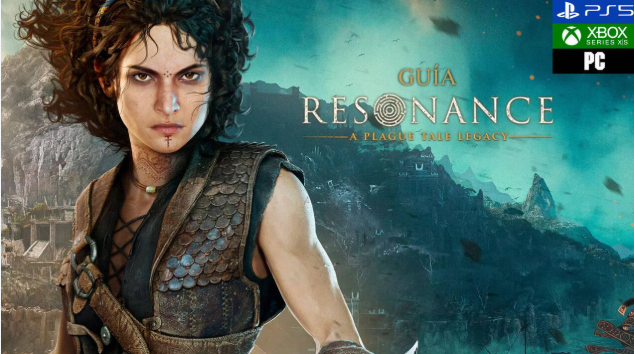
Complete guide · Action, puzzles and survival
Resonance: A Plague Tale Legacy: the definitive guide to crossing Crete with Sophia
Everything you need to master combat, solve every last light puzzle, and survive the secrets of the Minotaur’s island, chapter by chapter.
Fact sheet
| Developer | Asobo Studio |
| Publisher | Focus Entertainment |
| Game engine | Zouna Engine (Asobo’s proprietary engine) |
| Release date | August 27, 2026 |
| Platforms | PlayStation 5, Xbox Series X|S, PC (Steam, Epic Games Store, Xbox Game Pass) |
| Game mode | Single player |
| Direction | David Dedeine |
| Design | Kevin Pinson |
| Writing | Sébastien Renard |
| Music | Olivier Deriviere |
| Art direction | Olivier Ponsonnet |
After two installments built on fear, flight, and an unstoppable tide of rats, Asobo Studio has decided to completely reinvent the rules of its most acclaimed franchise. Resonance: A Plague Tale Legacy isn’t a third entry in the traditional sense: it’s a prequel set fifteen years before the events of A Plague Tale: Requiem, starring a character players had already glimpsed in passing, and set far from the plague-infested fields of France. Instead of Amicia and Hugo, this time the journey belongs to Sophia, a smuggler with a past that pulls her back to the Greek island where she grew up, where a bull-headed legend still guards secrets stretching back to Minoan civilization.
The change goes beyond the cast. Asobo has replaced much of the desperate stealth that defined the series with a melee combat system built around parries, counterattacks, a grappling hook, and skill trees, while keeping — and notably deepening — the environmental light-and-reflection puzzles that were already a hallmark of the series. The result is a game that feels familiar in its oppressive atmosphere and careful storytelling, yet radically different in how it plays minute to minute, almost as though the studio had kept the soul of the saga while swapping out its skeleton. This guide gathers everything a player needs to navigate that shift without getting lost: how combat works, how to solve every light and symbol puzzle, what to expect chapter by chapter, how to face the toughest enemies, and which tips make the difference between a frustrating trek across Crete and a smooth one.
It’s also worth placing the launch in context: Resonance arrives at a time when more and more narrative-driven, European-flavored franchises are being pushed to adopt more ambitious combat systems to stand out in a market saturated with third-person action-adventure titles. Asobo chose not to soften that shift with half-measures, opting instead for an almost total redesign of the core gameplay loop rather than simply polishing the stealth formula of its first two entries — a calculated risk that, as detailed in the critical reception section further down, has divided both the specialized press and the franchise’s longtime community.
Before diving in, one thing is worth establishing: this guide is meant to accompany your playthrough, not replace it. Mechanics, puzzle structures, and combat strategies are explained in enough detail to clear any roadblock, and a full chapter-by-chapter walkthrough is included with concrete solutions for the trickiest sequences — including the Minotaur section in chapter four, one of the points where the most players get stuck. If you’d rather avoid plot details, the story sections and the chapter walkthrough are clearly flagged so you can skip them without missing out on the rest of the practical content.
From Amicia to Sophia: why Asobo reinvented its own saga
Resonance’s turn didn’t come out of nowhere. At the end of A Plague Tale: Requiem, released in 2022, a post-credits scene hinted that the story of the De Rune family was far from the only chapter possible within the universe Asobo had built. Over the following years, the French studio kept the project quietly in the background while working on other productions, until the studio’s own leadership began openly discussing the need for a «creative reorientation» after seven years working with the same characters and the same narrative tone.
David Dedeine, the project’s director, has explained in several interviews that the team felt it had exhausted much of what Amicia and Hugo could offer as protagonists, and that continuing the saga without changing course risked repeating the same formula rather than pushing it forward. The answer was ambitious: a new central character, a new geographic setting, and above all, a combat system that shifted from desperate survival to a far more direct, choreographed confrontation. The studio itself has described the result as a game that «changes everything» compared to its predecessors, while still keeping the visual and narrative DNA that made the series famous in the first place.
The official announcement came on June 8, 2025, during the Xbox Games Showcase held as part of Summer Game Fest, after the news leaked a day ahead of the presentation. Initial reception was notably positive: the game went on to be nominated for Most Wanted Game at the 2025 Golden Joystick Awards, months before its release, a sign that the formula change had sparked curiosity rather than rejection within the community. Resonance: A Plague Tale Legacy ultimately launched on PlayStation 5, Xbox Series X|S, and PC on August 27, 2026, available from day one on Xbox Game Pass and compatible with Xbox Play Anywhere.
Key fact
The game runs on Zouna, the proprietary graphics engine Asobo Studio has been refining since A Plague Tale: Innocence, which explains the visual continuity across all three entries despite the radical change in setting and gameplay system.
The leak that preceded the official announcement by a single day set off a spike of speculation within the community, which had spent months assuming any continuation of the saga would keep Amicia and Hugo as its leads. When Asobo confirmed that the new project would revolve around Sophia and an entirely different setting, the initial reaction was surprise, but the reveal trailer — focused on showcasing the new melee combat system and the Mediterranean setting — convinced much of the specialized press that the change in direction had a solid creative justification behind it, beyond a simple marketing refresh.
That development process is also reflected in small production details that have surfaced in various interviews: the art team traveled to Crete during preproduction to document both real Minoan architecture and Mediterranean light, a factor that explains why the game’s reflection puzzles and ambient lighting feel so different from the damp, grayish interiors of medieval France in the first two entries. That research trip shows up constantly in the finished game, from the way sunlight scatters across weathered stone to the specific ochre tone of the ruins Sophia explores. That palette contrast — the cold gray of Innocence and Requiem against the ochres, blues, and golds of Resonance — is, according to several reviews, one of the best-received artistic decisions of the new chapter.
Story, setting, and characters (no major spoilers)
Resonance: A Plague Tale Legacy is set in 1334, fifteen years before the events of A Plague Tale: Requiem. The protagonist is Sophia, a smuggler that players of the second entry will remember as a supporting character with a murky past, and who here takes on the lead role for the first time. The plot brings her back to the island where she grew up — identified by critics and by the game’s own marketing as «the Minotaur’s island» — a stretch of Crete whose history is intertwined with Minoan civilization and with the origins of Prima Macula, the ancient entity or curse running through the entire saga, which in the first two entries manifested through the plague of rats.
One of the details that has drawn the most attention from critics is, precisely, the near-total absence of rats through much of the adventure, an element that until now was the franchise’s most recognizable visual and narrative signature. In their place, Resonance builds its horror and mystery around Greek mythology, Minoan ruins, and one very specific figure: the Minotaur, whose legend is woven here into Sophia’s personal biography, since the creature is directly tied to her father’s death. That family connection makes the search for answers about Prima Macula far more personal than in previous entries.
It’s worth pausing on exactly what Prima Macula is within the saga’s own mythology, since it’s the thread connecting all three entries despite their very different settings. In Innocence and Requiem, Prima Macula manifested through the rat plague and the powers tied to Hugo’s blood, presenting itself as an almost supernatural force associated with disease and mass death. Resonance travels back to a much older origin of that same force, weaving it into the mythology of the Minotaur and into ruins dating back to Minoan civilization, centuries before the medieval events of the first two entries. That narrative choice explains why the game’s setting and visual imagery drift so far from its predecessors without breaking the saga’s internal continuity: it isn’t a different story, but a much deeper layer of the same mythology, revealing an origin point the earlier games could only hint at.
The narrative rests on a dual timeline structure that proves key to understanding both the plot and some of the game’s puzzles: the player alternates between Sophia’s present, in the depths of the Middle Ages, and a series of sequences set in the Minoan period, where you control Theseus, the legendary Athenian king of Greek mythology. What’s interesting is that this alternation isn’t merely narrative: events resolved in the Minoan past can have direct consequences on the present, altering the state of certain areas, puzzles, or even the behavior of certain enemies, a design choice that gives every past-set sequence a weight it wouldn’t otherwise carry. Accompanying Sophia on her journey is Leni, a companion who provides both narrative and practical support, since she can offer optional hints whenever the player gets stuck on a puzzle.
Sophia: from supporting character to full-fledged protagonist
Described in official marketing as «a young, fierce raider determined to unravel the secrets of her past,» Sophia combines the pragmatism of a survivor hardened by smuggling with a deeply personal motivation: understanding what really happened on the island where she was born and what role the Minotaur played in her father’s death. On the gameplay side, she wields an agile, acrobatic combat style built around dual blades, designed for constant movement and quick counterattacks, in direct contrast to the slower, heavier brutality of Theseus in the past-set sections.
Theseus: the other protagonist, fifteen centuries earlier
In the sequences set during the Minoan period, the player takes control of Theseus, presented as the legendary king of Athens. His combat style is deliberately different from Sophia’s: heavy sword strikes, aggressive melee, and a sense of brute force that contrasts with the modern-day protagonist’s speed. These sections aren’t a mere decorative flashback: besides expanding the mythology of the Minotaur and of Prima Macula, they solve puzzles and unlock routes that directly affect Sophia’s path in the present.
Leni and the rest of the cast
Leni accompanies Sophia through much of the adventure and serves a dual purpose: on one hand, she reinforces the story’s more intimate narrative moments; on the other, she acts as an optional help system during environmental puzzles, offering hints once the player has been stuck for a while, with no penalty for using them. The rest of the supporting cast revolves around the island’s community and the figures who appear in visions of the Minoan past, all of them tied in one way or another to the origin of Prima Macula.
The relationship between Sophia and Leni functions, in many ways, as the emotional equivalent of the bond between Amicia and Hugo in the first two entries, though it’s built on a very different dynamic: not a protective relationship between siblings, but a friendship forged between equals who share a trade and its dangers. That difference in tone is especially noticeable in the dialogue, which is more direct and less protective than what characterized the original saga, and it reinforces the sense that Sophia is a seasoned, self-sufficient protagonist from the very first chapter, in contrast to the gradual growth Amicia underwent throughout Innocence. Where Amicia had to learn how to survive over the course of an entire game, Sophia already knows — her arc is about confronting the past, not developing the skills to endure it.
Pro tip
Pay attention to the murals and runic symbols that Sophia automatically logs in her journal. They aren’t just narrative decoration — they’re the key to solving most of the light puzzles later on, especially those whose final symbols don’t appear in the book itself and have to be found engraved somewhere in the environment.
Reinvented combat: from desperate flight to the sword
If there’s one thing that defines Resonance: A Plague Tale Legacy against its predecessors, it’s Asobo’s decision to make combat the core of the experience. In Innocence and Requiem, confronting a soldier directly was almost always a near-certain death sentence; here, by contrast, Sophia and Theseus are designed from the ground up to stand and fight. The studio has been explicit about this: stealth no longer dominates every encounter, and much of the campaign revolves around open sword combat, with enemies arriving in groups and areas that function almost like small arenas.
That doesn’t mean combat is a simple button masher. The system clearly prioritizes defense over offense: blocking, parrying, and dodging are the tools you need to master before charging in blindly, because mid- and high-tier enemies punish reckless attacks harshly, sometimes stripping a huge chunk of health in a single unblocked combo. A well-timed parry opens a counterattack window that usually leads into a particularly flashy — and particularly damaging — finisher, while sustained blocking reduces incoming damage but wears down Sophia’s or Theseus’s guard, forcing you to alternate between blocking and dodging depending on the type of incoming attack.
Built on top of that defensive foundation is a notably deeper layer than you’d expect from such an abrupt genre shift: charged attacks that break enemy guards, combos that vary depending on the equipped weapon, and unique finishers for each type of sword collected throughout the adventure. Add to that Sophia’s grappling hook, a tool that serves a double function: it’s used to move through the environment — swinging between ledges, reaching elevated platforms — and also as a combat resource, letting you yank enemies down from elevated positions before they can attack from range.
Two styles, two ways of fighting
The alternation between Sophia and Theseus isn’t just narrative — each character has a distinct moveset and its own combat philosophy. Theseus hits hard and slow, favoring aggressive melee and direct exchanges of heavy sword blows capable of staggering several enemies at once if the hit connects well. Sophia, by contrast, wields two blades with a far more agile, acrobatic style, built for constant dodging, chaining quick strikes, and repositioning between enemies rather than standing her ground. Adapting your pace to each character — patience and power with Theseus, mobility and chaining with Sophia — is one of the keys to not getting frustrated in the larger fights.
Progression: swords, amulets, and skill trees
Throughout the campaign you can find several additional swords, usually hidden in tombs and optional corners of the map, each with its own finishing combo and its own finisher animations. Switching weapons isn’t just cosmetic: some swords favor strike speed, others favor impact damage, and it’s worth trying several before deciding which fits your style best. On top of that come passive collectibles — amulets, bracelets, and other items — that grant permanent bonuses like wider parry windows or greater damage resistance once equipped.
Both Sophia and Theseus also have independent skill trees, fueled by so-called Resonance Points earned by exploring each chapter and completing certain optional challenges. Investing these points unlocks new combat techniques and improves base stats such as health, stamina, or dodge window, so thoroughly exploring each level — rather than sprinting straight for the next story objective — has a direct, measurable impact on how manageable later fights will feel. Skipping side content early on tends to catch up with players precisely in the mid-game chapters, when enemy groups grow larger and less forgiving.
Difficulty and accessibility settings
Resonance offers several difficulty levels that can be configured independently for combat and for puzzles, letting you, for instance, keep the challenge of fights at maximum while easing the solve times on the toughest light puzzles, or vice versa. This separation is especially useful for those coming from previous entries mainly for the narrative and atmosphere, who’d rather focus on the mystery of Prima Macula without the new combat focus becoming a constant obstacle. The game also includes visual and audio accessibility options — expandable subtitles, high contrast for interactive elements, and reinforced audio cues for attacks that require a parry — although, as several reviews have noted, settings specifically aimed at a more stealth-focused approach remain limited in the standard configuration, something Asobo could expand in future updates.
Estimated length and replayability
Completing the fourteen-chapter main campaign while following the story thread without straying too far into optional content takes around twelve to fourteen hours, a length similar to Requiem. Those who decide to hunt down every sword, artifact, and amulet, while also maxing out Sophia’s and Theseus’s skill trees, can easily stretch that figure to twenty hours or more, especially if they stop to solve every optional light puzzle instead of sticking to the ones required for story progress. The game doesn’t ship with a New Game Plus mode at launch, though it does keep a collectibles-and-achievements log accessible from the main menu once the adventure is complete, useful for anyone wanting to return later for anything they might have missed.
Common mistake
Charging in the moment a group of enemies appears is the fastest way to lose health you didn’t need to lose. The game is designed for you to size up your opponent first — watching their attack pattern for a hit or two — and release your parry or dodge at just the right moment before responding. Playing reactively, not proactively, is the foundation of the entire system.
The puzzle system: light, mirrors, and symbols
Despite the pivot toward action, Asobo hasn’t abandoned one of the elements that worked best in previous entries: environmental puzzles built around manipulating light. In Resonance, this mechanic is reinvented through a central object: a mysterious sphere of Minoan origin that Sophia carries for much of the adventure, capable of reflecting beams of light and also functioning as a portable light source in the darker corners of the ruins and caves.
The basic logic behind these puzzles is fairly simple to grasp, though execution grows notably more complex as the campaign progresses: you need to align a beam of light of a given color with its matching receptor of the same color, usually by rotating reflective panels placed at different points around the room. The game’s earliest puzzles involve a single beam and a single receptor, but variants with two, three, or even more panels soon appear, requiring a specific combination sequence, some of them hidden behind walls, rotating statues, or mechanisms that only activate after a previous sub-puzzle is solved.
Sophia’s journal is essential here once again: it automatically logs the runic symbols and murals she discovers along the way, and those same symbols are almost always the key to figuring out in what order or combination the various light receptors need to be activated. That said, not every puzzle in the game has its full solution written in the book: in several of the more advanced ones, some of the required symbols are engraved directly in the environment — on rings, statues, or walls — and can only be found by switching on torch or lantern mode and inspecting the room’s decorative elements up close. It’s a small design touch, but one that rewards curiosity over rushing, since a hasty glance around a puzzle chamber will often miss the very detail the solution depends on.
Symbol navigation: when the journal shows the way
Some sections, especially caves and underground galleries, replace the light puzzle with a navigation system based on directional symbols noted in Sophia’s book. The player must follow a specific sequence of turns — for example, right, right, right, right, left, left — to make their way through a maze of corridors without taking a wrong turn or triggering traps. It’s worth memorizing or mentally noting the full sequence before you start moving, since the environment tends to be dark and easy to confuse under pressure.
Spike traps and floor symbols
In several trapped corridors, the game presents symbols engraved on both the floor and the nearby walls. The solution involves identifying which wall symbol matches each floor tile and stepping only on the ones with an exact match, avoiding the rest to prevent triggering the hidden spike mechanisms. Moving slowly, tile by tile, checking each symbol before taking the next step, avoids the vast majority of avoidable deaths in these sections.
Multiple reflectors: the multi-stage puzzle
The game’s more elaborate puzzles — like the one blocking your path in the Minotaur area of chapter four, detailed later in the chapter-by-chapter walkthrough — aren’t solved in a single step, but through several chained phases: first a pair of receptors is activated, unlocking access to a new area or revealing new symbols; then the process repeats with a second pair, usually with Sophia’s sphere playing a more active role as an intermediate reflector; and only then does the final mechanism unlock. Taking the puzzle in phases, rather than trying to solve it all at once, helps a lot with keeping track of so many panels.
The Minoan sphere: more than a lantern
It’s worth pausing on the sphere Sophia carries, since how it works shapes much of the game’s level design. Unlike a simple torch, the sphere can be held aloft to light up wide areas, aimed directionally to act as a light emitter within a reflector puzzle, or even briefly thrown to reveal hidden inscriptions on surfaces beyond Sophia’s normal reach. In the game’s darker sections, especially during the chapter set almost entirely at night, constantly switching between these three uses — lighting the way, solving a puzzle, and revealing a hidden symbol — becomes the central routine of exploration, so getting familiar with all three modes early saves a lot of time later on.
Differences between Sophia’s and Theseus’s puzzles
The puzzles solved during the Theseus sections in the Minoan past have a slightly different character from Sophia’s: instead of rotating reflective panels, they usually require moving heavy stone mechanisms or pulling levers in a specific order derived from period religious inscriptions. Although the underlying logic — observe, note the corresponding symbol, apply the correct sequence — is the same across both timelines, the fact that some of these past-set puzzles directly alter the state of the equivalent rooms in Sophia’s present means paying attention to detail even when a sequence looks, on the surface, like a simple narrative flashback.
Key fact
Leni can offer contextual hints during any environmental puzzle just by interacting with her, and that help is entirely optional: it doesn’t penalize progress or block achievements or trophies. If you’ve been stuck in a room for more than a few minutes, there’s no reason not to turn to her before checking an outside guide.
Essential tips for surviving Crete
Combat: parrying, pacing, and reading patterns
The single most important tip in the whole game is, by a wide margin, mastering the parry. Unlike other action games where blocking alone is enough to survive, here a parry executed at the exact instant before impact opens a counterattack window that’s usually the most efficient way to take down armored enemies or break the guard of especially tough rivals. Practice the timing in the game’s earliest fights, where enemies are slower and more predictable, before facing the larger groups in the middle chapters. Amulets that widen the parry window are, in this sense, among the most cost-effective passive collectibles you can equip.
When you’re facing several enemies at once, avoid getting surrounded: use the grappling hook to take out rivals in elevated or distant positions first, since these are usually archers or throwers capable of striking while you’re busy with another melee enemy. Fall back to a spot where only one or two enemies can reach you at a time instead of standing your ground in the middle of the group.
Exploration: the hook as a tool, not just a weapon
Sophia’s grappling hook is also the key to much of the game’s optional content. Many tombs with collectible swords and chests with amulets sit on ledges, ruined towers, or platforms only reachable by swinging with the hook, so it’s worth visually scanning each room for anchor points before moving on to the main objective. If an area looks like a dead end but has a visible elevated structure in the background, there’s almost always a hidden hook point tucked behind a decorative element or a shadowed area.
Resource and gear management
Although Resonance doesn’t have the resource scarcity level of Innocence, it’s still worth prioritizing what to upgrade first in Sophia’s and Theseus’s skill trees. As a general rule, investing your first Resonance Points in health and stamina upgrades pays off before the flashier offensive skills, since surviving the game’s first large groups matters more for progress than dealing extra damage per hit. Once you’ve got the parry down, redirect points toward skills that widen counterattack windows or reduce the stamina cost of dodging.
The most common mistakes in the early hours
The most repeated mistake among players coming from Innocence and Requiem is trying to play pure stealth, avoiding every confrontation as if this were still Amicia hiding in tall grass. Resonance allows for a degree of situational stealth, but the level design explicitly pushes toward direct confrontation, and systematically avoiding fights tends to leave players under-leveled — with too few Resonance Points — for the mandatory encounters later on, where that shortfall becomes painfully obvious. The second common mistake is ignoring light puzzles when they look optional: several of them hide tombs with swords or amulets that make the rest of the adventure noticeably easier, so it’s worth investing the time to solve them even when they don’t block story progress.
Chapter-by-chapter guide
Spoiler warning
This section describes the structure and main puzzles of every chapter in the campaign. If you’d rather discover the story with no spoilers at all, you can jump straight to the collectibles section or the technical requirements section further below.
Resonance: A Plague Tale Legacy is split into fourteen chapters, some of them grouped in pairs within the game’s own narrative structure. Below is a summary of what each one offers, along with solutions to the trickiest puzzles.
Chapter 1: Blood Ties
The introductory chapter presents Sophia and lays the groundwork for the plot, establishing her trade as a smuggler and the reason pulling her back to the island of her childhood. It also serves as an extended tutorial for movement and the first notions of combat, with deliberately simple encounters meant to get you comfortable with blocking and dodging before the parry is introduced more demandingly in later chapters.
Chapter 2: Felons
Digs deeper into Sophia’s past as a smuggler and her relationship with Leni, with several exploration sections through coastal settlements. This is one of the first chapters where basic light puzzles appear, with a single beam and a single receptor, meant to introduce the mechanic without complicating it yet. It’s also here that the game’s first additional sword unlocks, hidden in a small side crypt accessible after solving that first optional light puzzle, so it’s worth not skipping the detour even if the main objective seems to point elsewhere.
Chapter 3: Those Before Us
Marks the first serious foray into ruins of Minoan origin and previews the first playable sequence in the past as Theseus, establishing the contrast in combat styles between the two characters that will carry through the rest of the campaign.
Chapter 4: From Hell It Rose — the Minotaur trial
This is, by a wide margin, one of the chapters where players get stuck the most, due to the Minotaur statue puzzle. Sophia and Leni must manipulate a gigantic Minotaur statue by reflecting beams of light onto a series of symbols arranged on rotating dials, and the solution is completed in three phases:
- First pair of symbols: aim the right light panel toward the upper-left corner of the room, matching it with a symbol that looks like a bell. Next, turn the left panel toward the lower-right corner to match it with a symbol resembling a capital «T.» Completing both moves the Minotaur statue’s right hand onto the platform.
- Second pair of symbols: place the left panel in the upper-right corner to point at a triangle-shaped symbol, and aim the right panel at the empty dial in the upper-left corner, positioned between symbols shaped like an inverted «3» and a cone. With this, both of the statue’s hands come to rest on the platform.
- Third pair of symbols (hidden): the last two symbols don’t appear in Sophia’s journal. Switch on torch mode and search directly on the rings around the statue’s hands: you’ll find a symbol shaped like a three-lined spike and another resembling a lowercase «n.» Reflect the left and right panels toward the central panel to activate it, then aim that central panel at the empty dial above the triangle symbol. Once complete, the Minotaur’s body lowers until it becomes accessible.
As soon as you place Sophia’s sphere into the unlocking receptacle after finishing the puzzle, the game immediately chains into a fight against a group of enemies accompanied by a particularly tough armored rival, who also introduces a new special combat ability. It’s a good idea to reach this room with stamina fully topped up, since the fight begins with no pause right after the puzzle is solved.
Chapter 5: Desolation It Wrought
After the previous chapter’s showdown, this stretch focuses on exploring a wider, more devastated area of the island, with several chained multi-reflector puzzles and a good number of optional tombs holding collectible swords. Along with chapter 11, it’s one of the levels with the densest secondary content in the whole game, so it’s worth exploring thoroughly before moving on: several forks that look like simple dead ends at first glance actually hide chests with amulets accessible only via the grappling hook.
Chapter 6: What Lies Beneath
Descends into the island’s underground galleries, where the first directional symbol navigation sections noted in Sophia’s book appear. Pay close attention to each indicated turn before moving, since the environment is dark and the corridors look visually repetitive.
Chapters 7 and 8: Death It Sowed / Resonance
These two chapters play out consecutively within the same narrative area and give the game its title. They combine tougher group combat with a multi-stage light puzzle, and dig deeper into the relationship between events in the Minoan past and the consequences carried into Sophia’s present, reinforcing the dual timeline mechanic introduced in earlier chapters.
Chapter 9: Night Has Come
A markedly darker chapter, both in tone and literal lighting, where Sophia’s sphere becomes essential as a portable light source in addition to a puzzle tool, across several sections of situational stealth against enemy patrols. This is one of the few stretches of the game where avoiding combat entirely is a viable option — and in some cases, even advisable — since the night patrols are numerous, and taking them all on at once can quickly drain your available healing resources before the next checkpoint.
Chapter 10: Parallel Paths — the symbol maze
Includes one of the longest cave sections in the game, where you have to follow a specific sequence of directional symbols noted in the book to reach the exit. The turn sequence to follow is: right, right, right, right, left, left. It’s worth memorizing the full order before you start moving, since several of the forks lead to spike traps if the turn doesn’t match the indicated symbol.
Chapter 11: Patera
Focused on deepening the mythology of Prima Macula and Theseus’s role within that story, with new puzzle variants based on mobile reflectors that shift position after each partial activation.
Chapter 12: Fading Light
Picks up the pace with several chained fights of escalating difficulty, designed to test your mastery of the parry and your ability to manage large enemy groups before the campaign’s final stretch.
Chapters 13 and 14: As One / What Remains
The game’s final stretch, grouped in this guide into a single block due to its narrative continuity, closes out both Sophia’s personal story and Theseus’s arc in the past, bringing both timelines together for the final resolution of the plot around the origin of Prima Macula. Hold onto unspent Resonance Points if you can, since the final battles are the most demanding of the whole campaign.
Enemies and special encounters
Resonance’s bestiary deliberately moves away from the rat hordes that defined previous entries, focusing instead on human enemies and creatures tied to Minoan mythology. This shift in focus has a direct gameplay consequence: while in Innocence and Requiem the danger tended to be massive but indirect — a tide of rodents to dodge or repel with fire and light — in Resonance the danger is individualized and direct, with each enemy representing a specific threat you have to read, anticipate, and respond to in real time. It’s, in a sense, the exact mechanical mirror of the narrative and design shift running through the whole game: fewer overwhelming numbers, but each individual opponent demanding far more attention than any single rat ever did. Most fights pit Sophia or Theseus against groups of three to five soldiers or raiders, with distinct roles: melee attackers demanding constant parrying, ranged units best neutralized first with the grappling hook, and every so often a tougher armored rival that acts almost like a mini-boss within the group itself.
The fight that follows the Minotaur statue puzzle in chapter 4 is representative of this design: a group of standard enemies accompanied by a heavily armored rival who introduces, in that very fight, a new special ability for Sophia specifically designed to break through that kind of reinforced guard. It’s the first real test of how the parry-counterattack-hook system all comes together, and it’s worth taking slow: fall back to the sides of the room to avoid getting surrounded, and use the hook to take out any enemy on nearby elevated platforms first.
The Minotaur figure itself functions more as an ambient threat and as the centerpiece of chapter 4’s puzzle than as a traditional final boss at that point in the story, though its presence keeps making itself felt throughout the rest of the campaign through visions, ruins, and direct mentions tied to the death of Sophia’s father. The playable Theseus sections in the Minoan past, meanwhile, introduce their own cast of period-appropriate enemies, consistent with the setting’s Greek aesthetic and mythology, and serve as a direct contrast to the medieval soldiers Sophia faces in the present.
Pro tip
Against armored rivals, neither sustained blocking nor a simple dodge tends to be enough: look for the exact parry moment to crack their guard open and immediately chain into the matching finisher. Trying to wear them down with regular hits only drags the fight out unnecessarily and burns far more stamina than needed.
How enemies scale across the campaign
The game introduces new enemy types gradually, almost always alongside your arrival in a narratively significant area. The early chapters stick to basic soldiers and unarmed raiders, meant to teach the rhythm of blocking and dodging without overwhelming you. From chapter 4 onward, with the introduction of the armored rival after the Minotaur puzzle, shielded variants start appearing that force you to use charged attacks to break their guard, and later on archers and projectile throwers join in, forcing you to prioritize targets instead of simply facing off against whoever is closest. Toward the final stretch, groups combine several of these archetypes at once — a shield-bearer, a couple of fast attackers, and an archer perched up high — turning quick battlefield reading into a skill just as important as parry handling itself.
Leni’s role during combat
Although Leni isn’t a playable character in the sense that the player never directly controls her combat actions, her presence during certain fights isn’t merely decorative: in several sequences she can momentarily distract an enemy or point out the position of a hidden rival, information worth using to decide who to target first. Her main role, however, remains narrative support and puzzle hints, so she shouldn’t be mistaken for a full cooperative combat system.
Collectibles: swords, artifacts, and amulets
Resonance: A Plague Tale Legacy’s optional content is organized into three broad categories of collectibles, on top of the Resonance Points scattered throughout each chapter. Swords are found mainly in hidden tombs, often accessible only with the grappling hook or after solving an optional light puzzle, and each one grants its own finishing combo and its own finisher animation, making them the collectible with the most direct impact on combat. Artifacts are historically valuable items scattered across the island’s various environments, focused mainly on expanding the narrative background and the mythology of Prima Macula and Minoan civilization. Finally, amulets are usually found in chests and grant the passive bonuses mentioned earlier — a wider parry window, extra damage resistance, among others — so it’s worth prioritizing the hunt for them before the toughest fights of the final stretch.
Resonance Points, for their part, act as the game’s progression currency and appear scattered throughout each chapter, both along the main path and in optional areas. Unlike swords or amulets, they don’t have a fixed, memorable location — instead, they reward systematic exploration of each level: checking every room before moving on to the next checkpoint usually translates into several extra points that make a real difference in Sophia’s and Theseus’s skill trees.
Tips for finding the most well-hidden optional content
Most of the tombs with swords and the chests with amulets share a recognizable visual pattern once you learn to spot it: they tend to be marked by the remains of partially collapsed Minoan structures, set slightly off the main path marked by the story, and they almost always require a deliberate detour — whether that’s using the grappling hook to reach a ledge, or solving a small light puzzle that isn’t mandatory for progress. A good rule of thumb is that if a room has an obvious exit toward the next objective but also has a dim area or a crack that doesn’t seem to lead anywhere, that secondary area is almost certainly hiding something worth grabbing before you move on. Chapters 5 and 11 are, according to several community guides, the ones packing the highest density of optional content per square meter of map, so it’s worth exploring them especially carefully.
Tips for veterans of the A Plague Tale saga
Those coming into Resonance after finishing Innocence and Requiem will need to adjust several reflexes picked up in those entries. The first, already mentioned, is dropping the habit of avoiding any eye contact with enemies: here, the game rewards measured confrontation, not constant evasion. The second is recalibrating resource management: while in the first two entries every flint or every vial of acid was a limited resource to ration carefully, in Resonance combat resources replenish far more often, and the real bottleneck lies in Resonance Points and in player skill, not in the inventory. Finally, it’s worth setting aside the expectation that every new room hides a threat you need to sneak past in silence: in Resonance, much of the level design explicitly assumes the player is going to enter combat, and structures the space — columns for cover, platforms for the hook, chokepoints to avoid being surrounded — with that direct confrontation in mind. In practice, that means treating each new arena less like a puzzle to sneak around and more like a battlefield to read before stepping in.
Resonance against the rest of the saga: comparison table
| Aspect | A Plague Tale: Innocence | A Plague Tale: Requiem | Resonance: A Plague Tale Legacy |
|---|---|---|---|
| Protagonist | Amicia de Rune | Amicia de Rune | Sophia (and Theseus in the past) |
| Main focus | Stealth and flight | Stealth with more combat options | Direct combat with parries and finishers |
| Setting | Medieval France, plague and rats | France and the Mediterranean Sea | Crete, Minoan mythology, no rats |
| Timeline structure | Linear | Linear | Dual: medieval present and Minoan past |
| Progression | Sling and alchemy upgrades | Amicia’s skill tree | Dual skill trees fueled by Resonance Points |
| Puzzles | Rat distraction and basic light | Light and environmental mechanisms | Light, reflectors, and symbols, far more complex |
The table above makes clear just how big a turn Resonance represents within its own saga: it keeps the oppressive medieval atmosphere and the fascination with light puzzles that defined its predecessors, but replaces the logic of flight and stealth almost entirely with a direct combat system, backed by a dual narrative structure with no precedent in the franchise. Measured against the usual standard for the third-person action-adventure genre, Resonance lands close to titles built around parry-centered combat, while still holding onto a visual and narrative identity that’s noticeably darker and more European than most of its peers.
PC technical requirements
Resonance: A Plague Tale Legacy is available on PC through Steam and the Epic Games Store, in addition to being included in the Xbox Game Pass catalog from launch. The requirements published by Asobo Studio confirm that the Zouna engine remains relatively accessible compared to other major releases this year, with mandatory SSD storage on both the minimum and recommended configurations.
| Requirement | Minimum (1080p, 30 FPS, low) | Recommended (1080p, 60 FPS, ultra) |
|---|---|---|
| Operating system | Windows 10/11 (64-bit) | Windows 10/11 (64-bit) |
| Processor | AMD Ryzen 3 3100 / Intel Core i3-12100 | AMD Ryzen 5 5600X / Intel Core i5-12400F |
| Memory (RAM) | 16 GB | 16 GB |
| Graphics card | AMD Radeon RX 5500 XT / NVIDIA GTX 1060 (6 GB VRAM) | AMD Radeon RX 6700 XT / NVIDIA RTX 3060 Ti (8 GB VRAM) |
| Storage | 75 GB, SSD required | 75 GB, SSD required |
| Graphics API | DirectX 12.1, Shader Model 6.6 | DirectX 12.1, Shader Model 6.6 |
One detail that has caught the attention of specialized outlets is that the game doesn’t rely on upscaling or frame-generation technologies — such as DLSS or FSR’s frame-generation mode — to hit its performance targets on either the minimum or the recommended configuration, something unusual for a release of this visual scale in 2026. On console, the game also includes specific enhancements for PlayStation 5 Pro.
Editions and pricing
Resonance: A Plague Tale Legacy launched with a simpler edition structure than other major releases this year. The standard edition is priced at $49.99 on PC through Steam, with the full game available in both digital and physical formats depending on platform, and simultaneously available in the Xbox Game Pass catalog from launch day. There’s also a minor cosmetic add-on, the Heritage Pack, available separately for $3.99.
For collectors, Focus Entertainment released the Collector’s Box, an IGN Store exclusive priced at $169. It’s important to highlight an unusual detail: this collector’s box does not include the game, and is instead sold as a companion product focused entirely on physical merchandise. Its contents include an individually numbered figure of Sophia and Theseus standing 23 centimeters tall, a premium SteelBook, three exclusive A5-format (14.8 × 21 cm) art prints, and a replica metal ring tied to the game’s iconography.
Key fact
If your goal is to play the full game, remember to buy the standard edition separately from the Collector’s Box, since the latter functions purely as a physical collector’s add-on and doesn’t include any copy of the game, digital or physical.
Critical reception
Following its release on August 27, 2026, Resonance: A Plague Tale Legacy received a notably divided reception depending on what each critic expected from the saga, and depending, too, on how attached they were to the mechanics of the earlier games. On Metacritic, the PlayStation 5 version sits at 80 based on 47 reviews, while Xbox Series X reaches 84 with 8 reviews, and the PC version reaches 85 with 35 reviews logged — a gap between platforms that mostly reflects sample size rather than any platform-specific technical issue.
More interesting than the average score is the sheer spread of individual ratings: the 35-point gap between the lowest review, a 60 from Eurogamer, and the highest, a 95 from PlayStation Universe, illustrates an almost ideological divide between two kinds of critic. Those who judged the game as a standalone action-adventure work, without constantly comparing it to the saga’s stealth identity, tend toward high scores; those who evaluate it as a direct continuation of Innocence and Requiem are considerably harsher on the formula change.
Among the elements consistently praised are the parry, counterattack, and grappling-hook-based combat system — described by several outlets as the most satisfying in the saga to date — the design of the Cretan setting with its historically richly detailed puzzle chambers, how the Minoan sphere functions both as a puzzle tool and a survival resource, and the visual and musical direction, which critics continue to consider one of the franchise’s consistent strengths under Olivier Deriviere’s baton. Several reviewers singled out the score in particular for weaving Mediterranean instrumentation into the tense orchestral style established in the earlier games. One review summed up the whole package as «a satisfyingly varied gameplay loop.»
On the critical side, the most repeated complaint is precisely the abandonment of stealth as a central pillar, with one outlet going as far as describing the result as «a shadow of the emotionally devastating narrative stealth series» that defined its predecessors. Some distance from the new protagonist on an emotional level has also been noted despite the mechanical leap forward, along with an inconsistent tone in the campaign’s second half that, according to Eurogamer, occasionally veers into gratuitous grimness during some of its harshest moments. Finally, several reviews have pointed to limited difficulty customization in the standard settings for those who would prefer a more stealth-oriented approach.
Beyond the aggregate score, it’s worth noting that Resonance already carried considerable anticipation before its release, reflected in its Most Wanted Game nomination at the 2025 Golden Joystick Awards. That anticipation translated into a solid commercial launch within Focus Entertainment’s catalog, further reinforced by its simultaneous availability on Xbox Game Pass, a distribution channel that in recent years has become a decisive factor for initial visibility on this kind of mid-to-high-budget production. Audience analyses agree that the curiosity generated by the formula change — both among those cheering it on and those questioning it before trying it — worked in favor of the conversation around the game during its first week on the market.
How does it connect to Innocence and Requiem?
Resonance: A Plague Tale Legacy functions as a direct prequel to the trilogy starring Amicia and Hugo, set fifteen years before the events of A Plague Tale: Requiem and centered on Sophia’s past, a character that players of the second entry knew only in passing. You don’t need to have finished Innocence or Requiem to enjoy this story, since it’s built as a self-contained experience centered on the origin of Prima Macula from a different angle, but those already familiar with the original trilogy will find several connections and references that enrich the reading of the saga as a whole.
The project’s very origin — that post-credits scene in Requiem hinting at a broader story within the Prima Macula universe — confirms that Asobo sees Resonance as a legitimate expansion of its mythology, not a disconnected spin-off. It remains to be seen whether the studio plans to keep exploring this new combat-focused direction in future entries, or whether this is a one-off detour before returning to the more purely narrative, stealth-driven tone that defined the franchise’s early years; for now, Asobo and Focus Entertainment have not confirmed any concrete plans beyond this release.
Final verdict
Resonance: A Plague Tale Legacy is, above all, an exercise in creative boldness: Asobo Studio has taken one of its most beloved franchises and rewritten much of its fundamental rulebook, betting on direct, choreographed combat instead of the anguished flight that defined its predecessors. The result won’t win over those hoping for a third entry that deepened the original formula, but for those approaching the game without that baggage of expectations, it offers one of the most polished combat systems in the saga, a gorgeous Cretan setting steeped in mythology, and a handful of light and symbol puzzles that rank among the most elaborate the studio has produced to date — proof that the team’s puzzle-design instincts translated just fine into a completely different mythological framework.
After years of development marked by an explicit need to reinvent itself, the game proves that risk has paid off, at least from a gameplay standpoint, though the debate over whether it was the right direction for the saga’s identity will likely stay open for quite some time among its most veteran followers.
For anyone wondering whether it’s worth setting out on this new journey, the most honest answer depends on exactly what you’re looking for in the experience. If what you value most is the tension of feeling helpless against a threat impossible to face head-on, as with the tide of rats in Innocence, Resonance will likely feel like a different experience than expected, closer in spirit to a swordplay-driven action game than to the survival-horror lineage the series started from. But if you approach it for what it really is — an ambitious prequel that repurposes the mythology of Prima Macula to tell a story of action, exploration, and mystery set in a corner of the Mediterranean steeped in legend — the game delivers in spades, offering one of the most satisfying combat systems in Focus Entertainment’s catalog in recent years and an art direction that confirms, chapter after chapter, why Asobo Studio remains one of Europe’s leading names in the third-person narrative genre.
Pros Deep, satisfying combat system, with parries, counterattacks, and varied finishers Light and symbol puzzles more elaborate than in previous entries Cretan setting and Minoan mythology very well integrated Art direction and soundtrack that live up to the saga Reasonable PC requirements with no reliance on AI upscaling | Cons Almost entirely abandons the stealth that defined the franchise Weaker emotional connection with the new protagonist, according to several reviews Uneven tone in the second half of the campaign Limited difficulty options for stealth-oriented players The Collector’s Box doesn’t include the game, which can cause confusion when buying |
Frequently asked questions
Do I need to have played A Plague Tale: Innocence and Requiem first?
Not necessary. Resonance is designed as a self-contained prequel centered on Sophia and on the origin of Prima Macula, but players familiar with the original trilogy will appreciate extra references and connections.
Are there still rats in Resonance?
Practically not. Unlike Innocence and Requiem, the absence of the rat tide is one of the most talked-about changes among critics, since the game replaces that element with Minoan mythology and the Minotaur as the core of its mystery.
Can you play in pure stealth, avoiding fights?
Partially. The game allows for a degree of situational stealth in some sections, but the level design is built around direct combat, so systematically avoiding fights isn’t a viable long-term strategy, nor is it recommended for skill progression.
How many chapters does the game have?
The campaign is split into fourteen chapters, two pairs of which are grouped together within the game’s own narrative structure: chapters 7-8 (Death It Sowed / Resonance) and chapters 13-14 (As One / What Remains).
How do you solve the chapter 4 Minotaur puzzle?
It requires completing three phases of reflecting light onto symbols: first a pair of symbols — a bell and a «T» — to lower one of the statue’s hands; then a second pair — a triangle and the adjacent empty dial — for the other hand; and finally two hidden symbols, engraved on the statue’s own hand rings and visible only in torch mode, activated by reflecting the central panel. The full, step-by-step breakdown is in the chapter-by-chapter guide section.
What’s the difference between playing as Sophia and as Theseus?
Sophia wields two blades with an agile, acrobatic style geared toward constant movement, while Theseus strikes with heavy swords in a slower, more forceful brand of melee. Both share the same foundation of blocking, parrying, and dodging, but their skill trees and combat animations are completely independent.
Is it available on Xbox Game Pass?
Yes. Resonance: A Plague Tale Legacy launched on August 27, 2026, simultaneously on Xbox Game Pass, with Xbox Play Anywhere compatibility between console and PC.
What exactly does the Collector’s Box include?
It includes a numbered figure of Sophia and Theseus at 23 cm, a premium SteelBook, three A5 art prints, and a replica metal ring, priced at $169 and exclusive to the IGN Store. It’s crucial to keep in mind that this box does not include a copy of the game.
Does the game need a powerful graphics card on PC?
Not especially. Minimum requirements are met with an NVIDIA GTX 1060 or an AMD RX 5500 XT, while the recommended specs call for an RTX 3060 Ti or an RX 6700 XT — moderate demands for a release of this visual scale in 2026. Installing on an SSD is mandatory, though.
Is it worth it for fans of the earlier games’ stealth?
It depends on expectations. Those who valued the desperate stealth and rat management of Innocence and Requiem above everything else may feel the change as a loss of identity; those who enjoy a good parry-based combat system paired with elaborate environmental puzzles will find Resonance one of the strongest offerings this year in the action-adventure genre.
How long does it take to complete the main story?
The main campaign, following the story thread without straying too far into optional content, runs about twelve to fourteen hours. Hunting down every sword, artifact, and amulet, plus maxing out both characters’ skill trees, can extend total playtime up to twenty hours or more.
Is there a New Game Plus mode after finishing?
Not at launch. The game keeps a collectibles-and-achievements log accessible from the main menu after completing the adventure, but it doesn’t include a second playthrough option with carried-over progression.
Can you play with a controller on PC?
Yes. Resonance: A Plague Tale Legacy supports controllers on both PC and console, and the interface and contextual icons automatically adapt based on whichever input device is being used at any given moment.
What happens if I miss a collectible within a chapter?
The game lets you revisit already-completed chapters through the chapter select once you reach a certain point in the story, making it easy to fill in any collectibles you might have missed without needing to restart the playthrough from scratch.
Will there be a sequel or more content for Resonance?
Neither Asobo Studio nor Focus Entertainment have confirmed any concrete plans beyond the August 27, 2026 launch. Given that the project itself originated from a post-credits scene in Requiem, it isn’t out of the question that the saga will continue exploring this new direction in the future, though there is no official announcement on the matter at this time.
Resonance: A Plague Tale Legacy shows that reinventing an established saga is a risk that can pay off in gameplay terms even when it divides its own community. Amid reflections of light on Minoan stone, the weight of a sword breaking through an enemy’s guard, and the constant echo of the Minotaur’s legend, Sophia and Theseus build a prequel that stands on its own, whether you’re arriving on the island for the first time or you’ve spent years following Amicia and Hugo’s footsteps across the roads of France.