

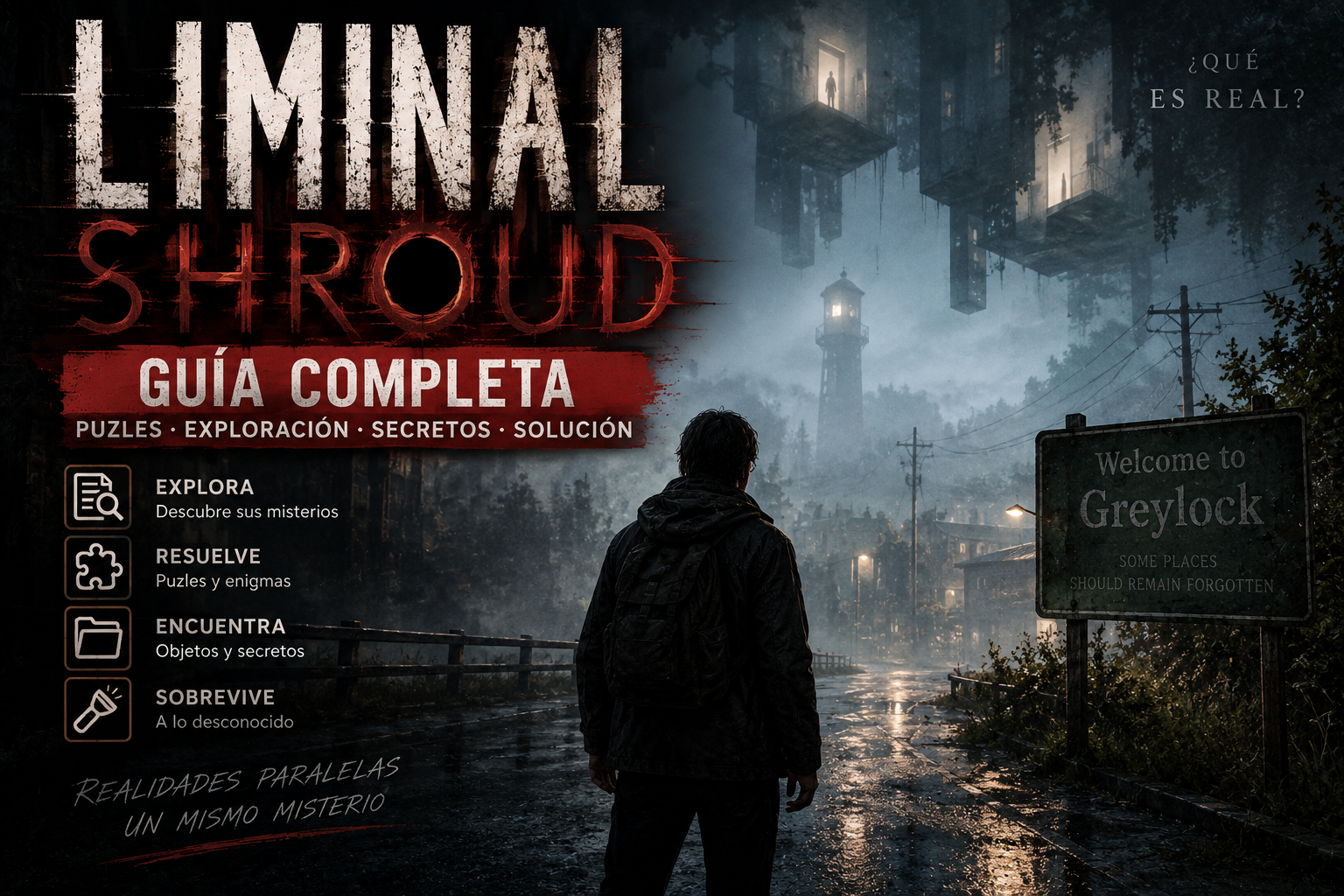
Liminal Shroud: Complete Guide and Walkthrough
All hidden paths, puzzles, secrets, areas, mechanics, and an explanation of the story and ending.
⚠️ Spoiler warning: this guide contains information about areas, mechanics, secrets, and the interpretation of the story of Liminal Shroud. If you want to discover the game completely on your own, use the sections only when you need them.
Liminal Shroud is a first-person psychological horror and exploration experience built around one fundamental idea: you cannot completely trust what you are seeing.
Spaces change. Paths can hide in plain sight. Walls stop behaving like walls. Ordinary objects take on unexpected importance, and seemingly normal environments eventually turn into impossible places.
Unlike many horror games, you do not need to master a combat system or defeat enemies to progress. The real challenge is to observe the environment, understand its anomalies, and discover which rules can be broken.
💡 The most important rule in Liminal Shroud
When it seems like there is no way out, do not only think about what you need to find. First ask yourself whether you are correctly interpreting the place you are in.
📌 Guide Contents
- How Liminal Shroud works
- All types of hidden paths
- How noclip works
- Puzzle solutions
- How to progress through the areas
- The park and the beginning
- The red maze
- The ball puzzle
- The chair area
- The slides
- The toy room
- The supermarket
- The cardboard fort
- All secrets and anomalies
- Story explained
- Ending explained
- Final tips
How Liminal Shroud works
To properly complete Liminal Shroud, you need to leave behind some of the usual habits you bring to exploration games.
When we reach a locked door in a conventional game, we usually think about finding a key. When we find a blocked corridor, we look for an alternative route. When a puzzle appears, we expect to receive instructions.
In Liminal Shroud, those expectations do not always work.
The game uses the environments themselves as a communication system. Architecture, lighting, sound, object placement, and visual anomalies can all function as clues.
For that reason, exploration should be divided into three phases.
1. Read the environment
When you reach a new area, do not immediately run toward the first exit.
Take a general look around and identify:
- Doors and corridors.
- Objects you can interact with.
- Elements that stand out visually.
- Side paths.
- Strange walls.
- Changes in lighting.
- Sounds coming from a specific direction.
- Objects that seem to have been deliberately placed.
2. Compare
One of the most important mechanics is remembering what a place looked like before.
If you return to a room, do not assume it will remain the same.
Check whether:
- A door has appeared.
- An object has changed position.
- A light is turned off.
- A route has changed.
- The sound is different.
- Something important has disappeared.
3. Experiment
Once you have observed the environment, it is time to test different possibilities.
Interact with relevant elements. Return to previous locations. Examine the boundaries of the environment and pay attention to anomalies.
The game’s philosophy is simple: observing first and acting afterward is usually much more effective than wandering around without direction hoping to find an exit.
All types of hidden paths
The hidden paths in Liminal Shroud do not all work in the same way. Some routes are physically hidden, while others appear because of changes in the environment.
Side paths
Environments can contain secondary paths that go unnoticed because the player is looking toward the seemingly main direction.
Whenever you enter a large room, check the sides before continuing.
Paths hidden by perspective
Some entrances can be difficult to see from the direction you entered.
That is why it is recommended to walk around the perimeter of large rooms and move around important structures.
Paths that appear after an event
In Liminal Shroud, the environment can react to your actions.
After interacting with something important, do not move on immediately. Look around and check what has changed.
Paths created by anomalies
The laws of physics do not always work conventionally inside the Shroud.
A surface that should normally stop you may become an entrance. A distortion may indicate a transition. A portal may appear where previously there was nothing.
Paths that seem wrong
One of the best ways to hide a path is to make it look like a bad idea.
If the game has taught you that reality is unstable, you need to consider possibilities you would normally dismiss.
How noclip works and when to use it
The ability to move through certain boundaries is part of Liminal Shroud’s identity.
However, this does not mean you should walk around every room trying to pass through absolutely every wall.
Noclip works best when the environment itself suggests that an anomaly exists.
When to suspect a wall
- When an area appears to have no exit.
- When the architecture seems impossible.
- When there appears to be space behind a surface.
- When a wall displays a visual anomaly.
- When the game has previously used a similar mechanic.
- When a route ends in an unusually strange way.
Recommended method
Step 1: explore the normal routes first.
Step 2: identify the place where a continuation should exist.
Step 3: look for visual or spatial anomalies.
Step 4: test only suspicious surfaces.
Step 5: observe what happens after crossing the boundary.
In the Shroud, a wall is not always a wall.
Puzzle solutions: how to interpret the clues
The puzzles in Liminal Shroud are mainly built around visual observation and interaction with the environment.
This means that before trying to solve something at random, you should study the entire room.
Look for patterns
Observe the elements that repeat and those that are different.
Ask yourself:
- What object stands out?
- Which colors are repeated?
- Is there a specific arrangement?
- Do the elements form a sequence?
- Is the room trying to point you in a particular direction?
Analyze positioning
The position of an object can be just as important as the object itself.
Do not only think about what you are seeing. Think about where it is placed and how it relates to the other elements around it.
Watch the consequences
After interacting with something, wait a few seconds.
Do not only watch the object you have just activated.
The reaction may occur:
- Behind you.
- Somewhere else in the room.
- Through a sound.
- With a change in lighting.
- By opening a new path.
How to progress through each area without getting lost
Although each chapter features different environments, there is a general strategy that works throughout the entire adventure.
| Situation | What to do |
|---|---|
| You cannot find the exit | Return to the last important point and check for anomalies. |
| The environment seems to repeat | Look for a small difference between visits. |
| There is a dead-end corridor | Check the sides, objects, and possible anomalies. |
| A puzzle seems to have no instructions | Analyze the environment as if it were part of the puzzle. |
| You hear something strange | Stop and try to identify the direction of the sound. |
| You have returned to the same place | Do not automatically repeat the same route: look for what has changed. |
The park and the beginning of Liminal Shroud
The opening establishes one of the game’s most important narrative ideas: the horror begins in a recognizable place.
The park initially appears to be an ordinary environment. You can explore the surroundings, observe the structures, and become familiar with the sense of normality.
But that calmness is deliberate.
The game uses this setting to make the changes that follow feel even more unsettling.
What you should do in the starting area
Do not try to rush through it.
Explore the park and pay attention to the elements that break the sense of normality. Exploration eventually leads you to one of the most important narrative points at the beginning: the board related to missing people.
This moment acts as a turning point.
After interacting with the important element, the world stops behaving like an ordinary environment.
The appearance of an impossible door represents the true beginning of the journey.
Tip: when a door appears where no door should exist, do not simply interpret it as an ordinary exit. That moment marks the crossing into the reality of the Shroud.
How to get through the red maze
The red maze uses visual repetition and loss of orientation to create confusion.
The worst strategy is to run around aimlessly hoping to find the exit.
The correct strategy
Choose a direction and explore systematically.
Look for visual references:
- Lights.
- Different corners.
- Changes in geometry.
- Objects.
- Color variations.
If you repeatedly return to the same place, do not keep doing exactly the same thing.
A liminal maze is not always solved simply by memorizing turns. The anomaly may be within the environment itself.
Stop when you find an irregularity and observe whether the surroundings are suggesting an alternative route.
The ball puzzle
The ball puzzle is one of the adventure’s recognizable interactive challenges.
The key is to avoid a succession of random actions.
Before moving anything
- Observe all available elements.
- Check their positions.
- Look for a relationship with the environment.
- Identify what happens after each interaction.
The environment itself should be interpreted as a clue.
If the puzzle does not respond as expected, do not keep pressing or moving things without analyzing the result. Mentally restart the sequence and look for the visual detail you may have been ignoring.
Useful rule for this type of puzzle: if a combination seems completely arbitrary, you probably have not yet found the visual clue that explains the logic.
The chair area and the strange encounters
Chapter Four introduces situations specifically designed to alter your sense of safety.
At this point, it is important to remember that you should not interpret every interactive object as completely harmless.
The chairs, the layout of the spaces, and the environmental encounters may all be part of the horror design.
How to progress
Move through the environment slowly.
Do not choose a route simply because it seems like the most obvious one. Examine the alternatives and pay attention to elements that appear out of context.
If an encounter changes the environment, immediately check the area again after the event.
How to get through the slide areas
The slide areas use movement and loss of control as part of their design.
Before entering one of these routes, check whether alternative paths exist.
Once you choose a descent, you may end up somewhere different from where you expected.
Tips to avoid getting lost
- Observe before using each entrance.
- Remember where you emerge.
- Look for routes back.
- Do not assume the fastest route is the correct one.
- Check the areas after each descent.
The goal is not simply to find a downward route. You need to understand how the different spaces connect.
The toy room: how to progress when you are tiny
The toy room radically changes the player’s scale.
When the character becomes smaller, everyday objects take on enormous proportions.
The logic of exploration changes, and platforming sections appear.
The key is to think vertically
Before, a table might have been simple decoration.
Now it can become a mountain.
A small object can become a platform, and a seemingly simple route may require using the environment in a completely different way.
How to get through the platforming sections
- Observe heights before jumping.
- Look for objects that can serve as steps.
- Do not ignore routes above your position.
- Take advantage of the area’s physical changes.
- If a route seems impossible, look for an indirect path.
The train and other environmental elements should be observed as part of exploration, not merely as decoration.
The supermarket and the shopping cart puzzle
The supermarket area transforms a completely ordinary environment into a surreal exploration space.
The shopping carts are part of the main challenge and force you to pay attention to the layout.
How to approach the puzzle
Do not try to move things without understanding what is actually blocking your path.
First identify:
- Which areas are blocked.
- Which routes remain open.
- Which carts form part of the obstacle.
- Which elements appear to have been placed deliberately.
The solution must be found in the relationship between the carts and the available route.
If an action makes your position worse, stop and analyze the layout again instead of continuing to move objects without a strategy.
Tip: the supermarket may look like an open space, but that very openness can hide the logic of the route. Mentally divide the area into sections.
The cardboard fort and the hidden city
The cardboard fort is one of the areas where exploring for secrets is especially important.
The cardboard-built city and its surrounding objects create a world where you need to pay attention both to what you see and to what you hear.
How to find keys and important items
Sound can help you locate relevant objects.
When you hear an anomaly or a strange effect, do not keep walking in the same direction without checking it.
Stop and slowly turn the camera.
Try to locate the point where the sound is most noticeable.
Then explore that area carefully.
What you should check
- Side streets of the cardboard city.
- Spaces between structures.
- Corners that appear decorative.
- Elements that break the visual repetition.
- Areas marked by strange effects or sounds.
All secrets: how to discover the Shroud’s anomalies
The secrets of Liminal Shroud should not only be searched for behind objects.
The concept of a secret is broader than that.
An anomaly can be:
- An impossible door.
- A side route.
- A portal.
- A wall that does not behave normally.
- A change in a familiar environment.
- An object that is out of place.
- An unexpected sound.
- A space that seems to exist outside normal geometry.
Method for discovering secrets
First: explore the main route.
Then: check the routes you left behind.
Next: look for elements that contradict the design of the environment.
Finally: return to important locations after completing events.
Empty rooms matter too
A seemingly empty room may exist simply to create atmosphere, but it may also hide an anomaly.
If a space seems too strange to have no purpose at all, examine it carefully.
How to tell whether you are on the correct path
One of the challenges in Liminal Shroud is that the game does not always provide a clear indication of progress.
That is why you need to interpret the results.
Signs of progress
- You have reached a visually new environment.
- A major change has occurred.
- A new route has appeared.
- The environment has reacted to an interaction.
- You have discovered a new transition.
Signs that you should rethink your strategy
- You keep repeating exactly the same route.
- You constantly return to the same point without any changes.
- You perform random actions without results.
- You are ignoring an obvious anomaly.
- You have left areas unexplored.
Liminal Shroud story explained
The story is not presented through long conversations or direct explanations.
The narrative is spread throughout the environments.
The architecture tells part of the story.
The sounds tell another part.
The objects and anomalies complete the rest.
This is fundamental to understanding the experience.
The Shroud as an altered reality
The Shroud can be understood as a space where reality has stopped obeying its normal rules.
The locations feel familiar, but they are incomplete.
You recognize a park.
You recognize an office.
You recognize a supermarket.
You recognize toys and everyday objects.
But something has changed.
The people, purpose, and safety we normally associate with these places are gone.
The ordinary becomes strange precisely because it is still recognizable.
The presence that watches
The game does not need constant chases to create tension.
The feeling that something is watching is enough.
The presence can be interpreted in several ways:
- As an entity related to the Shroud.
- As the place’s own consciousness.
- As a threat that is never fully revealed.
- As a representation of the protagonist’s fear.
The lack of a completely definitive explanation is part of the mystery.
Places as distorted memories
Another interesting interpretation is to view the environments as distorted memories.
They all seem to be inspired by familiar experiences.
A park.
An office.
A store.
A room full of toys.
But none of them work exactly as they should.
They are distorted versions of places we recognize.
What does escaping really represent?
Throughout the adventure, there is one constant question:
Does finding a door really mean that you have found a way out?
The game continually teaches you that appearances can be deceptive.
A door may lead to another area of the same world.
A portal may take you deeper into the mystery.
A seemingly correct path may become another maze.
Therefore, escaping is not simply about moving forward.
It is also about understanding where you are.
Liminal Shroud: ending explained
⚠️ MAJOR SPOILERS: from this point onward, the guide discusses the conclusion of the adventure directly.
The ending of Liminal Shroud deliberately maintains the ambiguous tone that accompanies the rest of the game.
After passing through impossible spaces, solving puzzles, and discovering different anomalies, the conclusion does not necessarily provide a traditional explanation for everything that has happened.
This is consistent with the narrative structure of the adventure.
The Shroud has never behaved like a place that explains its own rules.
The player has to discover them.
The most direct interpretation
One possible reading is that the entire journey represents an attempt to leave a reality that should not exist.
The protagonist gradually learns that normal rules are useless.
To move forward, they must change the way they think.
Walls are no longer absolute boundaries.
Obvious routes are no longer reliable.
Everyday objects take on new functions.
The conclusion represents the final step in that learning process.
The more disturbing interpretation
There is also a much darker reading.
Perhaps there was never a definitive way out.
Perhaps every door simply leads to another layer.
Perhaps the Shroud does not need to physically prevent you from escaping because it can convince you that you are making progress while you remain inside it.
The final door
The use of a door as the concluding element directly connects the ending to the beginning of the adventure.
At the start, an impossible door represents entry into the mystery.
At the end, another transition raises the opposite question:
Are you really getting out this time?
The fade and the lack of a completely closed explanation allow the player to build their own interpretation.
The best interpretations of the ending
Interpretation 1: the protagonist escapes
The final door represents a real exit.
The entire journey has been a series of necessary tests to understand how to leave the Shroud.
Interpretation 2: the cycle continues
The protagonist has simply reached another transition.
The ending does not represent freedom, but another stage of the same reality.
Interpretation 3: uncertainty is the answer
This is probably the interpretation that best matches the overall tone of the game.
Not knowing for certain what happens next is precisely part of the experience.
The Shroud works because it never allows you to feel completely safe.
Final tips for completing Liminal Shroud
✅ Definitive list of tips
- Explore slowly.
- Do not rush through areas without observing them.
- Look for differences when you return to a location.
- Listen for strange sounds.
- Check the side routes.
- Do not ignore objects that seem out of place.
- Use noclip when the environment suggests an anomaly.
- Observe the entire room before solving a puzzle.
- Do not repeat a strategy that has already proven ineffective.
- Think vertically when the character’s scale changes.
- Divide large areas into sections.
- Return to important locations after events.
- Be suspicious of routes that seem too obvious.
In summary
The real key to completing Liminal Shroud is not simply knowing a list of doors or routes.
It is learning the game’s language.
You need to understand that architecture can lie.
That a wall can stop being a boundary.
That an apparently empty room can hide an anomaly.
That a sound can be a clue.
And that returning to the same place does not necessarily mean you are in the same world.
The best way to move forward is to learn to distrust your own expectations.
In Liminal Shroud, the exit may be right in front of you. The problem is that you first have to learn how to recognize it.
Explore each area carefully, observe the changes, listen to the environment, and do not assume that the rules of the real world continue to function inside the Shroud.
That is the difference between simply playing through Liminal Shroud and truly understanding how to escape it.