

«`html
Otaku culture & video games
Ikemen Villains: the art of turning the villain into the most desirable character
A journey through the archetype of the attractive villain, from its origins in the Japanese word ikemen to its most literal version: the video game that turned the villains of classic fairy tales into the most coveted suitors.
In this guide you will find
- What exactly is an “ikemen villain”
- The origin of the word ikemen
- From kabuki stages to the modern bishonen
- Why we are drawn to dangerous villains
- The visual codes of the ikemen villain
- Ikemen Villains, the video game that gives the phenomenon its name
- The complete Ikemen series
- Ikemen villains in action and role-playing games
- The equivalent in anime and manga
- Comparative table of ikemen villains
- The keys to a well-constructed ikemen villain
- Fan art, cosplay and community: the villain’s life beyond the screen
- The debate: between fascination and controversy
- Where the archetype is heading
- Conclusion
What exactly is an “ikemen villain”
In the vocabulary of Japanese popular culture there is a term that has travelled far beyond its borders: ikemen. It is used to describe an attractive, elegant and magnetic man, with a touch of mystery that makes him seem unattainable. When that aesthetic quality is combined with moral ambiguity or outright villainy, the concept that gives this guide its title is born: the ikemen villain, that is, the beautiful villain.
This is not simply an antagonist with a good character design. An ikemen villain is one who uses his attractiveness as another narrative tool: he seduces, manipulates, generates empathy and, in many cases, manages to make the audience — or even the protagonist of the story — wonder whether they really want to defeat him. He is the villain one fears, but whom one would also like to hear an explanation from before the curtain falls.
“The ikemen villain does not seek only to frighten: he seeks to be remembered, desired and, sometimes, understood.”
The phenomenon has two faces that should be distinguished from the outset. On the one hand there is the narrative archetype, present for decades in anime, manga and role-playing and action video games, where we find charismatic and visually polished antagonists who steal entire scenes. On the other hand there is its most literal and recent version: Ikemen Villains, a romance video game developed by the Japanese studio Cybird in which, precisely, the villains of classic fairy tales are reinterpreted as young, attractive men with their own stories to tell. This guide covers both faces of the same phenomenon, because understanding them separately would mean missing half the story.
The origin of the word ikemen
To understand the cultural weight of the term one must go back to its etymology. Ikemen is a compound word that combines ikeru or iketeru — a colloquial Japanese expression meaning “cool” or “looking good” — with menzu, a phonetic adaptation of the English word men. The result, literally, would mean something like “guys who are cool” or “great-looking men”.
Although the term was popularised in the late 1990s through a column in a Japanese women’s fashion magazine, its earliest documented uses appear earlier, within colloquial circles, with very similar expressions employed to describe men who took particular care of their appearance. In just a few years, ikemen ceased to be a niche expression and became an everyday adjective in Japan, applied to actors, idol singers, manga characters and, later, to the protagonists and antagonists of romance video games aimed at a female audience.
What is interesting about the term is that it does not describe physical appearance alone. An ikemen man is usually portrayed with sharp features, an intense gaze, carefully chosen clothing and an attitude that mixes emotional restraint with occasional moments of vulnerability. It is a masculinity that moves away from the more dominant and physical ideal common in other narrative traditions, and that instead values elegance, patience, intelligence and the capacity for sacrifice. That combination of strength and sensitivity is precisely what, when transferred to an antagonist, produces the magnetic effect of the ikemen villain: someone formidable who nevertheless operates according to a code of his own.
From kabuki stages to the modern bishonen
The attractive villain was not born with mobile video games or contemporary anime. Its roots sink into a much older Japanese aesthetic tradition: that of kabuki, the classical theatre in which male actors also played female roles and in which androgynous beauty, the theatricality of make-up and the exaggeration of gestures formed part of the stage language. That historical fascination with stylised and ambiguous beauty laid the foundations for what centuries later would become known as bishonen, literally “beautiful youth”, a term that in manga and anime designates young male characters with delicate, almost ethereal features.
The bishonen and the ikemen are not exact synonyms, although they often overlap. The former tends to be associated with a more youthful, slender and sometimes fragile appearance; the latter describes a more adult masculinity, self-assured and directly linked to romantic desire. When shōjo manga and, later, otome video games adopted these aesthetic traditions to construct their antagonists, the result was a type of villain who does not repel through ugliness or monstrosity, but who attracts precisely for the opposite reason: by looking too pleasant to be trustworthy.
Shōjo manga of the 1970s and 1980s contributed its own chapter to this tradition. Pioneering works centred on protagonists and antagonists with stylised features, elaborate costumes and a strong emotional charge helped consolidate a visual language that prioritised elegance and theatricality over realism, laying the aesthetic foundations that decades later would be inherited by both romantic shōjo and the otome genre. That visual heritage — large expressive eyes, stylised silhouettes, an almost operatic use of colour — is still recognisable today in the design of any contemporary ikemen villain, from the antagonists of a role-playing game to the suitors of a visual novel.
This genealogy explains why the ikemen villain is a phenomenon so deeply rooted in Japanese pop culture and, by extension, in a good part of South Korean entertainment and the anime consumed globally. It is not a passing fashion, but the natural evolution of an aesthetic sensibility that has spent centuries playing with the ambiguity between beauty, danger and spectacle.
Why we are drawn to dangerous villains
Beyond aesthetics, the success of the ikemen villain has to do with a very specific narrative mechanism: the tension between desire and danger. An attractive antagonist forces the audience — and often the protagonist within the story itself — to confront an uncomfortable but fascinating contradiction: feeling curiosity, empathy or even attraction towards someone who represents a threat. That dissonance keeps the viewer hooked in a way that a purely monstrous or one-dimensional villain rarely achieves.
Writers of these stories usually exploit three resources recurrently. The first is hidden vulnerability: the ikemen villain is almost never evil without reason, but carries a trauma, a loss or an injustice that explains, even if it does not always justify, his behaviour. The second is a personal code of honour: although his methods may be questionable, he usually follows personal rules that distinguish him from a chaotic or gratuitous villain, reinforcing the sense that, deep down, he is someone with whom one could reason. The third is elegance in the threat: he rarely resorts to brute violence as a first option; he prefers manipulation, persuasion or ingenuity, tools that are far more interesting to watch on screen than a simple physical confrontation.
“A good villain does not merely oppose the hero: he offers him an uncomfortable mirror of what he himself could also become.”
In genres aimed specifically at a female audience, such as otome, this mechanism is taken one step further: the villain is not only understood, he is courted. The narrative invites the protagonist — and, by extension, the person playing or reading the story — to try to “save” or “redeem” that character through the romantic bond, a fantasy that combines the allure of danger with the satisfaction of seeing someone change thanks to a genuine connection.
There is also a purely structural component that explains the success of these characters: in any story, the villain usually enjoys more creative freedom than the hero. While the protagonist is obliged to be coherent, morally exemplary and easy for the audience to identify with, the antagonist can afford ambiguity, sarcasm, theatricality and unexpected twists. That narrative freedom is, to a large extent, what turns villains — attractive or not — into some of the most memorable characters in any work, and explains why, when they are also given a carefully crafted design, they frequently end up overshadowing the protagonist himself.
The visual codes of the ikemen villain
If there is one area in which the ikemen villain is recognisable at first glance, it is character design. There is a series of visual codes that are repeated, with variations, in practically every example cited throughout this guide, and that are worth identifying in order to understand why certain characters generate such an immediate visual impact.
The first is the dark colour palette with striking accents: blacks, deep purples, garnets or near-black blues combined with a single vibrant colour — often red, gold or violet — that acts as the character’s visual signature and that usually matches the colour of his eyes or of some distinctive element of his costume. The second is the extreme care given to hairstyle and gaze: long, well-groomed hair, asymmetrical cuts or locks that fall deliberately across the face, and eyes drawn or performed with special intensity, since in Japanese animation and illustration the gaze concentrates a large part of the character’s emotional information.
The third code is clothing as a symbol of status and era: capes, waistcoats, gloves, decorations or jewels that place the character in a specific historical or social context — Victorian aristocracy, Japanese feudal nobility, the royalty of a fantasy kingdom — and that reinforce the sense that this villain belongs to a different, almost inaccessible world from that of the protagonist. Finally, the use of recurring objects or gestures is common — a rose, a pocket watch, a glass of wine, a glove slowly removed — that function almost as a choreographic signature of the character and that the audience immediately associates with his appearance on screen.
These resources are not exclusive to the ikemen villain, but they acquire special weight in him because their function is not only aesthetic: every visual element reinforces the idea that this character, however charming he may be, still belongs to a dangerous, almost forbidden territory that the protagonist — or the player — dares to explore.
Ikemen Villains, the video game that gives the phenomenon its name
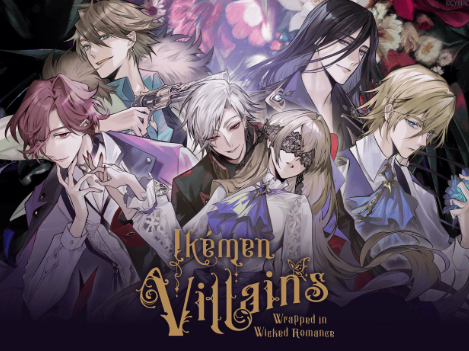
Within the catalogue of otome video games, few titles illustrate the concept as literally as Ikemen Villains: Wrapped in Wicked Romance, developed by the Japanese studio Cybird, a company specialising for more than a decade in romantic visual novels for mobile devices. The game, available for iOS and Android, forms part of the well-known Ikemen series, one of the longest-running and most recognisable franchises in the otome genre internationally.
The premise of Ikemen Villains transports the protagonist to a fantastical Victorian England, where a curse decreed by Queen Victoria herself condemns nine men to forever repeat the tragic fate of the villains of classic fairy tales. The protagonist, a postal worker who is drawn into this world, must investigate the crimes committed by the so-called members of “the Crown” while trying — not very successfully — to resist the magnetism of these nine characters.
The cast includes characters such as William Rex, Harrison Gray, Liam Evans, Elbert Greetia, Alfons Sylvatica, Roger Barel, Jude Jazza, Ellis Twilight and Victor, each linked to a different fairy-tale villain archetype, reinterpreted with an elegant, dark character design polished down to the last detail. The voice cast features top-tier Japanese voice actors, the character designs are the work of the illustrator known as Natsume, and the game’s main theme was performed by singer Maiko Fujita.
In terms of gameplay, Ikemen Villains follows the usual structure of Cybird’s otome visual novels: narrative chapters with dialogue choices, an affinity or “escort” system that unlocks fully voiced additional content, and a gacha component for obtaining collectible character cards. The overall atmosphere combines a theatrical and slightly unsettling soundtrack with a sophisticated visual aesthetic, in keeping with the tone of crime, political intrigue and dark romance that defines the title. Among the genre’s player community, the game has been especially well received for the quality of its soundtrack and for the emotional depth given to characters who, in the original stories, barely had any nuance.
What is most interesting about Ikemen Villains as a cultural phenomenon is that it makes literal what other media only hint at: instead of a secondary antagonist who steals glances from the sidelines, here the villain occupies the absolute centre of the narrative, with his own name, a redemption arc and the real possibility of a happy ending. It is the culmination, almost parodic and at the same time sincere, of a fantasy that the rest of Japanese pop culture has been subtly suggesting for decades.
Within Cybird’s own catalogue, the progression system of Ikemen Villains maintains the series’ usual structure: each character has an independent narrative route, free chapters unlocked with daily tickets, and an affinity level measured in points that gradually opens additional fully voiced scenes, many of them focused on moments of greater emotional vulnerability for the character. This route-based structure is common in the otome genre and allows each player to experience a different story depending on which villain she decides to follow, multiplying the replayability of a single title.
In recent years, specialised video-game media coverage has also begun to pay more attention to this type of offering, traditionally relegated to very specific communities of female fans. Media focused on independent games and detailed guides to niche titles have expanded their coverage towards the otome genre and towards gacha culture phenomena in general, recognising that this is a segment of the industry with a loyal, active player base willing to sustain highly elaborate conversations about the writing of their favourite characters — something traditionally associated only with big-budget role-playing or action games.
The complete Ikemen series
Ikemen Villains is not an isolated case, but the most recent entry in a franchise that Cybird has been building for years, always under the same formula: transporting the protagonist to a very specific historical or fantasy setting, populated by a small group of attractive men with markedly different personalities.
Ikemen Sengoku, one of the series’ first major successes, places the protagonist in the midst of Japan’s Sengoku period, surrounded by idealised versions of historical feudal lords such as Nobunaga Oda or Mitsuhide Akechi. Ikemen Vampire, another of the most popular entries, moves the action to an alternative version of revolutionary France, where the protagonist lives among vampires inspired by real historical figures. Ikemen Prince opts for a fantasy kingdom populated by princes with clashing personalities, while Ikemen Revolution is set in a magic academy with echoes of tales such as Alice in Wonderland.
What distinguishes Ikemen Villains within this family of games is precisely its twist: while the other entries present men who already start from a heroic, romantic or at least neutral position, here the starting point is explicitly villainy. It is the entry that takes the series’ name — ikemen — to its most direct consequence, uniting in a single concept the idealised beauty that gives the entire franchise its name with the fascination for the antagonist that was already present, in a more diffuse form, in the rest of the company’s catalogue.
One factor that has helped the Ikemen series transcend the Japanese market is its decisive commitment to localisation. Virtually all entries, including Ikemen Villains, have English versions and, in some cases, additional languages, which has allowed an increasingly large international community to access these stories without depending on Japanese. This expansion has turned Cybird into one of the reference studios within global mobile otome, competing and collaborating in an ecosystem where other developers specialising in the same type of interactive romantic narrative coexist. With each new entry, the formula remains recognisable — a small cast of men with highly differentiated personalities, a strong thematic setting and a system of independent routes — while the scenario and narrative tone change completely, which explains why the series has managed to renew its audience for so many years without losing its identity.
Ikemen villains in action and role-playing games
Although otome has taken the concept to its purest expression, the attractive villain has been present for decades in genres far removed from romance, especially in Japanese action and role-playing games, where some of the industry’s most memorable antagonists share precisely that combination of visual elegance and real danger.
A frequently cited example in this type of list is Sephiroth, the iconic antagonist of Final Fantasy VII: silver hair, oversized katana and a disturbing calm that contrasts with the devastation he leaves wherever he goes. His design has become a visual reference for an entire subgenre of elegant villains within Japanese role-playing games. In the same series, Ardyn Izunia, the main antagonist of Final Fantasy XV, adds a tragic component to that elegance: his evil has a concrete origin, linked to a betrayal suffered centuries earlier, making him a villain as sophisticated in costume as in writing.
The Devil May Cry series contributes Vergil, twin brother of the protagonist Dante, whose obsession with power and discipline makes him a cold, calculating and visually impeccable antagonist, always dressed in dark blue and with a mastery of the sword that borders on the choreographic. In The Legend of Zelda: Skyward Sword, Ghirahim breaks with the usual solemnity of the series’ villains through an almost mocking theatricality, exaggerated gestures and an extravagant design that immediately made him one of the franchise’s most discussed antagonists. Something similar occurs with Scaramouche, also known under the identity of the Wanderer in Genshin Impact, an ambiguous character between villainy and redemption whose popularity has grown enormously as his story has been revealed.
Dio Brando also deserves mention, one of the most influential antagonists of the manga and anime JoJo’s Bizarre Adventure, whose stage presence, exaggerated costume and iconic lines have turned him into a cultural reference that transcends the medium itself. And one cannot omit Handsome Jack, the villain of the role-playing shooter series Borderlands, whose very name — literally “Handsome Jack” — is a declaration of intent about the role his charisma plays within the narrative: a villain who knows he is attractive and uses it as a rhetorical weapon against the player in every one of his interventions.
What all these characters share, beyond the genre to which they belong, is that their visual design is never accidental: every detail of costume, every gesture and every line of dialogue is designed to generate a mixture of fear and fascination that keeps the player waiting for their next appearance.
The equivalent in anime and manga
Anime and manga are, together with otome, the terrain where the ikemen villain finds its most natural expression, precisely because both media have spent decades cultivating the bishonen aesthetic as part of their visual identity. One of the most frequently cited examples is Light Yagami, protagonist and at the same time moral antagonist of Death Note: his attractiveness, his outstanding intelligence and his progressive descent into megalomania turned him into one of the most analysed and debated characters in modern anime.
In Persona 5 — whose anime adaptation further expanded its popularity — Akechi Goro represents another paradigmatic case: elegant, publicly admired by the other characters and with a double life that places him in direct opposition to the protagonist group, his revelation as an antagonist is one of the most memorable narrative twists in Japanese role-playing games of the last decade. In JoJo’s Bizarre Adventure, in addition to Dio Brando, the character of Diavolo offers a different facet of the archetype: that of a villain whose beauty coexists with an emotional instability that makes him even more unpredictable.
Black Butler offers with Sebastian Michaelis a very particular variant: a demon with impeccable manners, Victorian elegance and an apparent loyalty that hides much darker intentions, in a tone that connects directly with the gothic atmosphere also found in Ikemen Villains. And within the otome genre itself adapted to anime, the franchise Diabolik Lovers built a large part of its identity around a group of vampire brothers whose beauty coexists, in a deliberately uncomfortable way, with treatment of the protagonist that is far darker than the genre average, which at the time generated an intense debate about the boundaries between fantasy romance and the representation of harmful dynamics.
Two additional cases deserve special mention for how much they have marked different generations of viewers. Itachi Uchiha, in Naruto, is probably one of the most frequently cited examples of an ikemen villain with a retroactive redemption arc: initially presented as a ruthless antagonist, the series later reveals that his actions responded to a silent sacrifice for the good of his village and his younger brother, which completely transformed the perception of the character without altering his serene and elegant design in the slightest. Kaworu Nagisa, in Neon Genesis Evangelion, represents a much more unsettling variant: his immediate closeness to the protagonist, his almost supernatural serenity and the final revelation about his true nature turned him into one of the most analysed figures in the history of anime, an example of how beauty and threat can coexist without the need for a single explicit threatening gesture.
These examples confirm that the ikemen villain is not a particularity exclusive to one studio or one specific genre, but a narrative language shared by a large part of contemporary Japanese fiction, which adapts with different nuances depending on whether the goal is to generate terror, empathy, desire, or all three at once.
Comparative table of ikemen villains
To put the variety of the archetype into perspective, this table brings together some of the most representative ikemen villains from anime, manga and video games, along with the medium in which they appear and the trait that best defines their particular version of attractive villainy.
| Character | Work / franchise | Medium | Distinctive trait |
|---|---|---|---|
| William Rex and the rest of the Crown | Ikemen Villains | Otome video game | Literal villainy as the central romantic premise |
| Sephiroth | Final Fantasy VII | Role-playing game | Unsettling calm and devastating power |
| Ardyn Izunia | Final Fantasy XV | Role-playing game | Tragic villainy with a centuries-old motivation |
| Vergil | Devil May Cry | Action game | Coldness, discipline and family rivalry |
| Ghirahim | The Legend of Zelda: Skyward Sword | Adventure game | Extravagant theatricality and dark humour |
| Dio Brando | JoJo’s Bizarre Adventure | Manga / anime | Stage presence and overflowing charisma |
| Akechi Goro | Persona 5 | Role-playing game / anime | Public and private double face |
| Sebastian Michaelis | Black Butler | Manga / anime | Victorian elegance with hidden intentions |
The keys to a well-constructed ikemen villain
Not every attractive antagonist works as an ikemen villain. When one analyses the examples that have worked best within the genre, several common elements can be identified that separate a memorable villain from a merely decorative one.
A visual design with narrative intention. Costume, colour palette and body language are not a mere aesthetic exercise: they communicate status, era, temperament and, very often, anticipate the dramatic turn that character is going to star in.
A voice of his own, both literal and figurative. Voice acting plays a decisive role in the otome genre and in anime: an actor capable of conveying threat and tenderness with subtle nuances multiplies the character’s emotional impact.
A past that explains the present. The best-written ikemen villains have a prior history — a betrayal, a loss, a systemic injustice — that provides context for their decisions without necessarily excusing them morally.
A clear boundary with the hero or the protagonist. The tension works better when there is a sharp frontier between fascination and safety: the audience must feel that the danger is real, not merely decorative, for the attraction to have dramatic sense.
A soundtrack that sustains the emotional tone. In anime and, especially, in otome video games, music plays a role almost as important as the script: an instrumental theme capable of conveying both threat and melancholy reinforces the sense that the character hides far more than he shows at first glance, and is usually one of the elements most valued by the fan community when analysing a new release.
When these elements are combined successfully, the result is a character capable of sustaining interest in a story on his own, generating entire communities of followers and, in the case of otome video games, becoming the main reason a player chooses a particular narrative route.
Fan art, cosplay and community: the villain’s life beyond the screen
No self-respecting ikemen villain ends his journey the moment the application is closed or the episode finishes. A fundamental part of the phenomenon occurs afterwards, in the space that the fan community builds around the character: illustrations, short comics, cosplay, themed playlists and discussion forums where his motivations, his costume or his possible alternative endings are analysed under a microscope.
In the specific case of otome video games, this community dimension is especially intense. Each new route or character is usually accompanied by a wave of art created by the player base itself, which in many cases surpasses in volume and quality the official promotional material. Social networks dedicated to illustration have become a reliable thermometer of which character has resonated most with the public, often ahead of the internal statistics that the studios themselves handle but rarely share. In the case of series such as Ikemen, it is not uncommon for a secondary character in the main plot to end up becoming, thanks to this type of fan production, one of the overall favourites of the entire franchise.
Cosplay adds another layer to this phenomenon: physically reproducing the costume and attitude of an ikemen villain almost always demands a level of craftsmanship above the average, precisely because the original design is already thought out in detail. Conventions dedicated to anime, manga and Japanese video games often reward this type of performance, and it is not unusual to find among the audience people who choose to portray the villain of a story rather than its protagonist — a choice that in itself sums up quite well the appeal of the archetype: embodying, even if only for an afternoon, that character who combines danger, elegance and a charisma that no conventional hero usually matches.
It is also common for these characters to transcend their original work through character songs, themed calendars or small commercial collaborations that reinforce their presence in the everyday lives of their fans, a phenomenon inherited directly from Japanese idol culture, where each public figure cultivates a close and almost personal relationship with their audience. In the case of the ikemen villain, that closeness is especially striking: it is a character originally conceived to be threatening, who ends up generating the same kind of everyday affection as any real idol.
The debate: between fascination and controversy
The appeal of the ikemen villain is not free of controversy, and it is worth addressing it honestly. The main criticism levelled at this type of narrative is the romanticisation of harmful behaviours: when a manipulative, possessive or outright violent character is presented wrapped in an attractive design and an emotional soundtrack, there is a risk that the audience — especially younger viewers — will confuse intensity with real love, or danger with passion.
Franchises such as Diabolik Lovers have been repeatedly singled out for this reason, for presenting dynamics of control and coercion wrapped in a romantic aesthetic. Studios more aware of this debate, including Cybird with its Ikemen series, usually introduce important nuances: the protagonist retains her own agency within the story, the villains undergo genuine arcs of change rather than simply being “tamed”, and the fantasy framework itself — cursed fairy tales, centuries-old vampires, feudal lords — functions as a safety distance that constantly reminds the audience that this is fiction.
“The fantasy of the redeemed villain only works when the audience never loses sight of the fact that it is, precisely, a fantasy.”
There is also a second debate, more linked to the industry than to the narrative: that of monetisation through gacha-type mechanics, very common in mobile video games of this genre, including Ikemen Villains. This system, which offers items or content at random in exchange for in-game currency or real money, has been criticised for its potential to encourage compulsive spending, something that the genre’s own players usually openly acknowledge even when they enjoy the product. It is a debate that goes beyond the ikemen villain as a narrative archetype and points more to the business models of mobile gaming in general, but that is inevitable to mention when discussing this type of title with honesty.
In any case, it is important to distinguish clearly between fiction and reality. That a character may be fascinating within a plot deliberately constructed as an escape fantasy does not imply, nor should it imply, a validation of controlling or manipulative behaviours in real relationships. Most of the creators of these stories are aware of that boundary, and a good part of the more constructive criticism of the genre does not call for eliminating the attractive villain, but for writing him with greater care: giving him real consequences for his actions, a credible evolution and a context that does not confuse dramatic intensity with a desirable relationship off-screen.
Where the archetype is heading
Far from being exhausted, the ikemen villain seems to be in full expansion. On the one hand, the otome genre continues to grow outside Japan, with an increasingly international player base that has turned studios such as Cybird into global references for interactive romance, which encourages further exploration of variations of the archetype: historical, mythological, supernatural villains, or ones taken directly from Western popular culture reinterpreted with Japanese sensibility.
On the other hand, major role-playing and action video games continue to bet on visually sophisticated antagonists as a narrative and commercial draw, aware of the impact these characters have on the player community, on fan-generated art and on social-media conversation. The boundary between the feared villain and the desired villain, which for a long time seemed exclusive to a very specific genre, has been gradually blurring across the rest of the entertainment industry.
It is therefore to be expected that the concept will continue to evolve in two complementary directions: a narrative one, towards increasingly nuanced and less Manichean villains, and an aesthetic one, towards ever more elaborate character designs that turn villainy into a visual spectacle as carefully crafted as that of any protagonist.
Conclusion
The ikemen villain sums up, better than almost any other archetype in Japanese pop culture, the idea that fear and desire are not always opposing feelings. From the theatrical elegance of kabuki to the imaginary Victorian England of Ikemen Villains, passing through the most memorable antagonists of series such as Final Fantasy, Devil May Cry or Death Note, the attractive villain has proven to be much more than a fashion: it is a narrative tool capable of generating empathy, tension and debate in equal measure.
Understanding this archetype — its origins, its best examples and also its more debatable zones — is, in the end, understanding an important part of how Japanese anime, manga and video games have constructed some of their most unforgettable characters: not despite their evil, but precisely thanks to it, wrapped in the most attractive face possible.
From the antagonist who steals a secondary scene to the absolute protagonist of an impossible romance such as the one proposed by Ikemen Villains, the beautiful villain will very probably remain one of the most effective — and most honest about human nature — narrative resources available to fiction to remind us that not everything that attracts is safe, and that precisely there lies a large part of its charm.
«`