

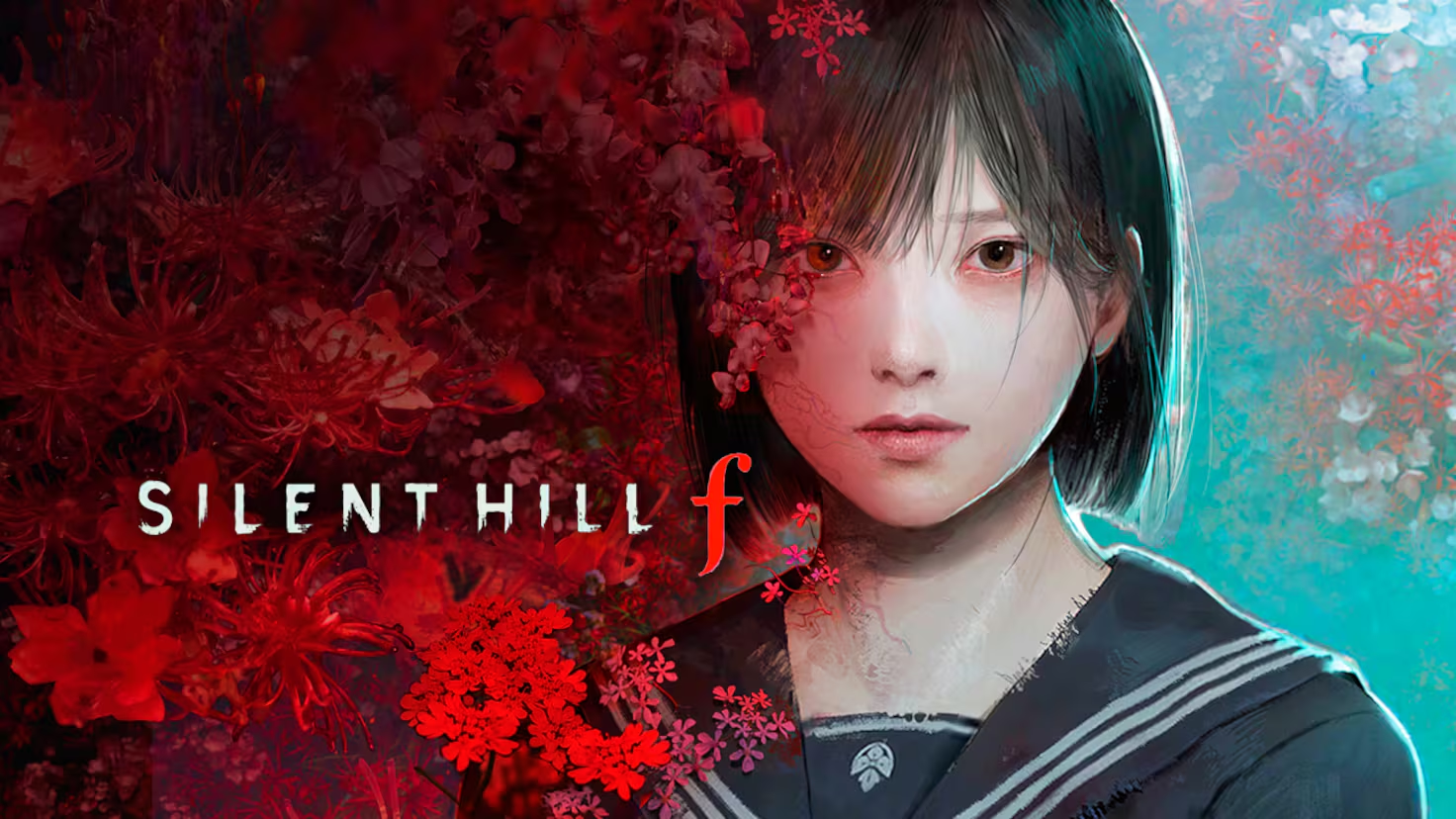
Silent Hill F Complete Guide — All chapters, puzzles and NG+
Silent Hill F is a radical reimagining of the Silent Hill universe, set in rural Japan during the 1960s. The story revolves around a young woman named Ayame, who returns to her hometown — an isolated village called Kirishima — to attend her mother’s funeral, unaware that the place is engulfed in a cycle of fungal corruption that distorts reality. Throughout the game, players unravel the mysteries of the location through exploration, solving environmental puzzles, and a deeply symbolic psychological narrative.
General Introduction
This complete guide is designed to accompany you step by step throughout the game, solving each puzzle, finding every relevant object, and understanding the narrative nuances that define the universe of Silent Hill F. It is written in a technical tone, with no unnecessary spoilers, and focuses on both practical resolution and environmental interpretation.
The game adopts an episodic structure, divided into six main chapters and a hidden epilogue. Each chapter alternates between moments of free exploration and closed sequences of psychological horror, where the rules of the environment change unpredictably. The guide explains how to anticipate these alterations and how to identify the symbolic patterns that serve as clues to solve the puzzles.
Setting and Atmosphere
The setting of Silent Hill F is one of its most studied and deliberately disconcerting elements. The village of Kirishima is surrounded by fields of withered poppies, which open in a spiral pattern as the fungal infection spreads. These flowers are not mere decorative elements: their colors, opening, and sound indicate the state of Ayame’s «inner world.» The ambient music subtly changes based on the number of flowers open, which also influences the appearance of enemies.
Environmental Interpretation
- Closed Flowers: symbolize denial of memory. Fewer enemies, but fewer visible clues.
- Half-Open Flowers: balance between reality and nightmare. Ideal for exploration and solving puzzles.
- Fully Open Flowers: imminent danger. Increases the Hollowed enemies and distorts visual clues.
The sound design integrates into gameplay. If you hear a buzzing or a sustained dissonant note, it means that a clue or threat is nearby, even if you can’t see it yet. This type of «informative» design is characteristic of composer Akira Yamaoka, and it is advisable to learn to read it like an emotional radar.
Exploration System
Exploration in Silent Hill F follows a semi-linear model. Each area gradually opens up as you solve puzzles or find memories (Memory Fragments) that reconstruct parts of Ayame’s past. There is no conventional map at first: the player must orient themselves using visual landmarks and ambient sound.
Orientation Tips
- Listen to the sounds of the environment: the wind, crickets, and water have different frequencies depending on the direction of the safe zone.
- The dim blue light indicates an important path; the red light indicates a threat or key event.
- Use the antique mirrors to save progress. They act as save points and transitions between planes of reality.
During exploration, you will encounter locked doors with fungal seals. These seals can only be broken when the player activates a specific «emotional memory.» Each seal is linked to a repressed memory. The fragments can be found in notes, objects, or murals that Ayame must examine while the environment reacts visually (usually accompanied by a murmur or breath). This guide will indicate in each chapter where to find these key points.
The Fungal Corruption System
One of the unique elements of Silent Hill F is the presence of the Mycelium System, a symbiotic form of corruption that reacts to your decisions and your level of fear. This system replaces traditional health or sanity indicators from previous games.
Corruption Levels
- 0%–25%: clear perception. Colors are natural and sounds coherent. Puzzles are presented logically.
- 25%–50%: sensory distortion. The environment changes subtly; puzzles become less evident.
- 50%–75%: appearance of Mycelic enemies. Key objects emit brief light pulses.
- 75%–100%: collapse of reality. Areas fold in on themselves and puzzles change form or solution.
The level of corruption increases when you stay too long in contaminated areas or if you examine painful memories. It can decrease by using Purification Flowers, found in the hidden gardens of each area or after completing a main puzzle. Managing the level of corruption is essential: in many chapters, the solution to puzzles depends on the state of the environment. For example, a pattern may only be visible with high contamination.
Combat and Evasion System
Silent Hill F is not a traditional action game. Combat is limited, symbolic, and deeply tied to Ayame’s mental state. There are two types of confrontations: physical (against tangible manifestations) and mental (projections that cannot be destroyed).
Physical Combat
It relies on improvised tools: rusty scissors, scalpels, oil lamps, or sharp branches. Each weapon has durability and a «psychic impact» that affects the level of corruption. Metal weapons reduce corruption upon hitting (symbolizing rationality), while organic ones increase it (symbolizing connection to the infection).
Mental Combat
During nightmare phases, enemies cannot be physically harmed. Instead, you must use Focus Points: observation points where Ayame can remember reality and reconfigure the scene. These areas are marked by a muffled breathing sound. The strategy is to move from one Focus to another without looking directly at the enemies. If you observe them for too long, the environment collapses and restarts the sequence.
This guide will indicate in each chapter safe routes, evasion objects (Incense Candles), and how to complete sections without resource expenditure. You will learn to distinguish moments when fighting is possible and those where the only sensible option is to run.
The Puzzle and Memory System
Puzzles in Silent Hill F are divided into three categories:
- Environmental: based on symbols, sounds, or colors.
- Psychological: linked to Ayame’s memories. They change based on your choices.
- Sequential: combinations of objects in a specific order.
Interestingly, the game does not explicitly indicate when a puzzle changes. Sometimes a solution becomes invalid if your level of corruption varies or if you have read a new document. In this guide, each puzzle will be explained with its internal logic, not just its solution. This way, you can deduce answers for yourself and understand how the game builds its metaphors.
Practical Example
One of the first puzzles (in Chapter 1) consists of opening a music box that sounds out of tune. The solution is not in the object, but in the song you hear as you approach a nearby portrait. If the melody is sharp, the environment is «real»; if it sounds flat, you are in the corrupt plane. The box only opens in the flat version. This type of duality will be constant throughout the game.
Progress and Key Objects System
Progress in Silent Hill F does not depend on levels or experience points, but on unlocked memories. Each memory is a fragment of the past that can be reconstructed by observing personal objects (combs, diaries, letters). Each of them can alter the environment, creating new paths or modifying existing puzzles.
Types of Memories
- Memory Fragments: basic pieces of the story. They act as narrative keys.
- Emotional Echoes: memories charged with emotion; activating them distorts the environment and reveals hidden clues.
- Residual Shadows: memories of other characters; they unlock alternative endings.
Some memories are not mandatory to finish the game, but they directly affect the ending you will obtain. This guide will show you all possible collection points and their narrative consequences.
Inventory and Resource Management
The inventory is limited. At first, you can only carry eight objects. However, offering chests (Offering Chests) allow you to store extra items. Each one is associated with a lunar calendar symbol, meaning you can only access them at certain times in the game (usually after sleeping or after a narrative event). The chests light up with the same pattern as the save mirrors.
Types of Resources
- Purification Flowers: reduce the level of corruption.
- Incense Candles: calm mental enemies and slow down the environment.
- Fungal Samples: research materials; some combine to create symbolic antidotes.
- Memory Keys: objects that allow you to open doors sealed by repressed memories.
The best strategy is to always keep at least one Purification Flower for emergencies and use the Incense Candles only in sections of mental escape. This guide will explain in which areas it is advisable to spend each resource and where to find replacements.
Recommendations Before Chapter 1
- Play with headphones: sound localization is crucial for identifying invisible enemies and clues.
- Avoid running for too long; it raises the level of corruption faster than it seems.
- Explore the edges of the map: secondary areas contain most of the Memory Fragments.
- Read all notes: although many seem irrelevant, they alter internal variables of the story and change small future decisions.
With this, the player will be prepared to delve into Chapter 1 — The Funeral and the Root, the true beginning of the story, where the first major symbolic puzzle is introduced: the offering at the ancestral home.
Chapter 1 — The Funeral and the Root
The first chapter starts in the old family shrine of the Kirishima. The constant rain and the deep sound of the wind work as an emotional metronome. In this phase, the main objective is to prepare the funeral offering and uncover the connection between the fungal corruption and Ayame’s lineage.
Main Objectives
- Explore the ancestral home and gather the three funeral objects.
- Solve the root puzzle in the offering.
- Unlock the first memory (Memory Fragment #1 — Mother’s Lament).
Initial Exploration
After the opening scene, check the main living room. On the table, there is a broken fan, a rosary, and a burned photograph: these objects become clues for the first puzzle. Search the cabinets until you find the Kitchen Key and a ceremonial vessel with dried fungi.
Puzzle — The Funeral Offering
At the altar, you will see three slots covered by living roots. Each one must receive a symbolic object: memory of the wind, memory of water, and memory of fire. The equivalent objects are the fan, the rosary, and the photo.
- Left Slot (wind): place the fan.
- Center Slot (water): the rosary, as it is associated with the Kirishima river.
- Right Slot (fire): the burned photo.
If the order is correct, the roots retract and the music changes to an ascending tone. An error produces a low shriek and darkens the room. Upon solving it, you receive the first Memory Fragment and access to the backyard opens.
The Garden and the Red Mushrooms
Outside, you will find the first Purification Flowers. Cut them with the ceremonial knife, but do not use more than three: each cut reduces the area’s energy and accelerates the plane change. Observe how the ground pulses; if the sound becomes throbbing, it means the world is becoming contaminated.
Memory Event
Examine the well at the back. When looking inside, you will hear a child’s voice: select «Respond» to trigger the memory Child at the Well. This fragment shows the first reality change and transports Ayame to the dark plane. An enemy Hollowed Nun will appear; do not fight. Run to the lobby and hide under the table. The scene ends automatically.
Chapter 2 — Voices Below the Lake
This chapter takes place around Lake Miharako, a place shrouded in mist where sounds distort. It introduces acoustic puzzles and the concept of reverse echo, fundamental for subsequent chapters.
Main Objectives
- Restore the energy of the submerged shrine.
- Resolve the puzzle of the floating bell towers.
- Recover Memory Fragment #2 — The Song of Still Water.
The Lakeshore
Start by moving along the path next to the water. You will hear distant bells; each sound indicates the position of an invisible bridge. If you walk quietly (without running), the waves of the lake will shine where you can step. The goal is to cross without breaking the sound compass.
Puzzle — Floating Bell Towers
In front of the submerged shrine, there are three bells that you must ring in the correct order to open the gate.
- Left Bell: low tone (deep water)
- Center Bell: medium tone (surface)
- Right Bell: high tone (wind)
Hit them with the stick in the pattern low → high → medium → low. The resulting echo generates a circular wave that clears the path. If you do it wrong, hands will emerge from the water; retreat to the shore and wait for the sound to dissipate before retrying.
The Submerged Shrine
Inside, you will find the second save mirror. Collect Fungal Sample A from the ground; it will be useful later to craft a symbolic antidote. At the back, there is a door with a musical mechanism: a resonance box with four notes. The clue is in the chirping of the crickets outside. Mentally record the pattern (3 shorts + 1 long) and repeat it on the box: press three times quickly, then once sustained. The gate to the lower tunnel will open.
Evasion Section
In the tunnel, Mycelic Hands will appear. These enemies move by sound: stop every time you hear a wet snap, and move when you hear dripping. If they touch you, corruption rises by 20%. Place an Incense Candle at the central crossing to keep them still and pass by the right side.
Memory and Escape
At the end of the tunnel, there is a figure wrapped in roots. Examine it to obtain Memory Fragment #2. The scene will change to a reddish plane, and Ayame will awaken on the shore. This point marks the transition to the next chapter. Save before leaving.
Chapter 3 — The School That Remembers
The third chapter takes Ayame to her childhood’s abandoned school, a structure overrun by fungi and fragmented memories. Here, text and sound overlay puzzles are introduced, as well as the first symbolic enemies that mimic her voice.
Main Objectives
- Traverse the classrooms and reactivate the electricity.
- Resolve the puzzle of the piano and the poem from class 3-A.
- Find Memory Fragment #3 — Echoes of the Classroom.
The Entrance Yard
Start in the yard overgrown with weeds. To the right, there is a generator with three levers. Each emits a distinct sound when activated. You must place them to recreate the continuous buzz of the main transformer: medium → low → high. If you succeed, the hallway lights turn on, and a group of Hollowed Students appears. Do not fight; enter the building and close the door.
Puzzle — The Poem from Class 3-A
In the classroom, you will find a poem written with alternate characters erased:
“When the flower speaks, the child is silent. When the child is silent, the echo lives.”
On the board, there are three numbered phrases. The key is to listen to the syllables: each pronounced word activates a lamp above the correct phrase.
- “The flower opens its eyes.”
- “The child learns to breathe.”
- “The echo becomes root.”
You must activate the switches in the order 2 → 1 → 3. This generates a breathing sound behind the classroom; approach and press “Examine” to reveal a secret compartment with a rusty key. Use it in the music room.
Puzzle — The Piano in the Music Room
This is one of the most remembered puzzles in the game. The piano has 12 functional keys, but only seven produce sound. Each key represents an emotional note (Fear, Nostalgia, Rage, Peace, Guilt, Desire, Silence). The correct order is deduced from an incomplete score on the board: each stain indicates an emotion missing from Ayame’s childhood.
Reasoning
In Professor Yukari’s diary, it is mentioned that the girl «forgot to feel peace before guilt.» Therefore, the last two notes are Peace and Guilt. Always start with Fear (the root emotion) and alternate with Desire. The complete pattern is:
Fear → Desire → Rage → Nostalgia → Peace → Guilt → Silence
When you execute it correctly, the piano will turn to dust, and a red flower will appear inside. Take it: it is a special Purification Flower that unlocks a hidden memory.
Memory — Echoes of the Classroom
After the puzzle, the classroom inverts chromatically, and a child’s laugh is heard. Move to the stage; there you will see a figure that repeats your movements with a one-second delay. Do not approach directly. Go around and touch the mirror at the back. This synchronizes both planes and releases Memory Fragment #3.
Escape Event
When you try to leave, the hallways distort. Follow the sound of the class bells — it is the audio cue to the exit. Run only during silences; if you run while they sound, corruption increases. Upon crossing the main door, the sound stops, and a scene will appear where Ayame remembers her mother’s face. End of Chapter 3.
Summary of Rewards and Key Objects (Acts 1–3)
| Object / Fragment | Chapter | Main Use |
|---|---|---|
| Memory Fragment #1 — Mother’s Lament | 1 | Opens access to the backyard. |
| Fungal Sample A | 2 | Ingredient for emotional antidote. |
| Special Purification Flower | 3 | Reduces corruption and activates hidden memory. |
| Memory Fragment #3 — Echoes of the Classroom | 3 | Unlocks new path to Chapter 4. |
With the end of Chapter 3, the player has mastered the basic mechanics: environmental manipulation, sound reading, and symbolic resolution. The next block of the guide will delve into chapters 4 to 6, where puzzles become non-linear and decisions begin to alter the final outcome.
Chapter 4 — The Weeping Manor
Chapter 4 begins in a decrepit mansion situated high on Mount Kurohana. It is the most labyrinthine setting of the game, with architecture that deforms to the rhythm of the player’s steps. Each room reflects an emotional state of Ayame, and the puzzles revolve around temporal perception and the use of mirrors.
Main Objectives
- Restore the energy of the mansion’s central clock.
- Resolve the puzzle of the three mirrors.
- Survive the encounter with the Hollowed Father.
Initial Exploration
Start in the foyer. You will see stopped clocks and paintings turned upside down. The first clue is in the sound: each tick-tock comes from a different room. The order in which you hear them indicates the correct sequence to restore the time of the main clock in the hall.
Puzzle — Clock of Memories
Locate three clocks: one in the study, another in the dining room, and one in the music room. Each clock shows a different time:
- Study: 11:15
- Dining Room: 7:45
- Music Room: 3:30
The trick is to pay attention to the order in which you hear them while moving through the house: if you enter from the west hallway, you will first hear 3:30, then 7:45, and finally 11:15. Adjust the clock in the foyer with that sequence: 3:30 → 7:45 → 11:15. When you complete the combination, the clock will open, revealing a teardrop-shaped key.
Puzzle — The Three Mirrors
On the upper floor, there is a gallery with three covered mirrors. Remove the cloths in the following order:
- The one reflecting the empty hallway (reality).
- The one showing an impossible garden (memory).
- The one that reflects nothing (corruption).
Doing so correctly will align the reflections and show a door where there was once a wall. Enter, and you will find the Hollowed Father, a symbolic creature that repeats distorted paternal phrases.
Combat — Hollowed Father
This is not a direct combat: each time the enemy utters a phrase, you must respond with the correct gesture using the quick dialogue options. For example, when he says, “Why did you leave?”, select “Silence” and not “Deny.” Each mistake increases your corruption. Upon getting three correct responses, the figure dissolves, leaving Memory Fragment #4 — The Father’s Silence.
Chapter 5 — The Blooming Streets
This chapter marks the return to Kirishima, now completely covered in floral fungi. It is an open and changing space, with multiple routes and puzzles that symbolically connect places. Here, Memory Links are introduced, chains of memories that must be activated in sequence to unlock access to the final temple.
Main Objectives
- Find the four Memory Links.
- Resolve the lantern puzzle.
- Discover the location of the Root Temple.
Free Exploration
The urban map is divided into three districts. Each has a distinct ambient sound and a predominant color in the fog. Use those clues to orient yourself: the northern district is reddish and resonant, the west is blue and silent, and the east is golden and distorted. Your goal is to find four points where the past and present intersect.
Memory Link 1 — The Bridge of Whispers
Cross the bridge to the west and listen to the voices. Names are heard; the order of pronunciation indicates the sequence to press the railings of the bridge: Left → Right → Center → Left. Completing it shows a brief vision of Ayame’s past with her mother.
Memory Link 2 — The Alley of Laughter
Enter the theater street. You will hear laughter that changes tone. Follow the deeper ones to find a closed door. Inside, there is a mural with faces; touch those smiling to the left. Upon success, a glowing inscription will appear: “Remember what made you laugh.”
Memory Link 3 — The Sunken Market
Descend into the flooded area. You will see a series of floating baskets. Each makes a sound when moving. Hit them following the rhythm 1-2-3-2. If done correctly, flowers emerge forming a circle. In the center is a statue: examine it to obtain an additional fragment.
Memory Link 4 — The Red House
To the east, enter the house marked with red paint. Inside, objects change places when you are not looking. Place the vase, chair, and clock in the order they appear in the mirror’s reflection. When all three match, the house collapses, and you find yourself in an unknown street. There, a scene activates that merges the four memories and opens the way to the Root Temple.
Puzzle — The Lanterns of Kirishima
Before accessing the temple, you must light the five lanterns placed throughout the city. Each lantern represents an element (water, fire, air, earth, void) and can only be lit with a corresponding type of flame.
- Water: use the Candle of Reflection, obtained in the market.
- Fire: use the Burning Memory from the red house.
- Air: light it with a spark generated by striking two bells together.
- Earth: use the green flame from the cemetery (light on wet ground).
- Void: leave the lantern off; its darkness counts as flame.
When you complete the sequence, the fog will clear, and you will hear a string melody. Head north; the roots will form a natural arch leading to the Root Temple.
Chapter 6 — The Root Temple
The final chapter before the endings. Here, all learned mechanisms converge in an environment where time folds over itself. The temple is divided into three levels: Entrance, Choir Chamber, and Fungal Heart. Each level has its own symbolic puzzle.
Entrance — Prayer Door Puzzle
You will see three doors covered by inscriptions. Each responds to a gesture from Ayame. Observe the shadows: when the protagonist’s shadow matches the carved posture, the door opens. The correct order is: Hands to the chest → Arms extended → Head bowed.
Choir Chamber — Harmonic Echo Puzzle
In this room, six statues emit tones. You must align them so they form a major chord. Rotate each statue until its tone matches the previous one without producing dissonant vibrations. The standard solution is to turn them in the order 2-5-3-6-1-4. When you complete the harmony, an invisible choir will sing, and the ground will open.
Fungal Heart — Final Symbolic Puzzle
The core of the temple is occupied by a massive organism that beats to the rhythm of your breath. There are no enemies here; the challenge is psychological. Three main roots block access. Each requires a pure memory to be cut.
- Root of Guilt: examine the rusty dagger from your childhood.
- Root of Desire: look at the portrait of your father in silence until the screen trembles.
- Root of Forgetting: open your mother’s diary and read the last sentence without blinking.
When the three roots wither, the heart will open and reveal a mirror of water. Ayame reflects alongside an identical but smiling figure: it is the manifestation of the final memory. Accepting or rejecting it will determine the ending you get in Chapter 7 (which is explained in Block 4).
Final Object of the Chapter
After completing the temple, you will receive Memory Fragment #6 — The Root of Self. Save your game at the central mirror; this is the point of no return before the ending. The following events will depend on the total number of memories found and the level of accumulated corruption.
Progress Summary (Chapters 4–6)
| Element | Location | Purpose |
|---|---|---|
| Teardrop-shaped Key | Chapter 4 | Access to the upper floor of the mansion. |
| Memory Fragment #4 — The Father’s Silence | Chapter 4 | Unlocks alternate dialogue in the ending. |
| Memory Links (x4) | Chapter 5 | Unlock entrance to the Root Temple. |
| Memory Fragment #6 — The Root of Self | Chapter 6 | Essential element for the True Ending. |
With the completion of Chapter 6, the player has reached the emotional climax of the journey. From here, the story branches into three main endings based on the choices made, the number of memories collected, and the level of corruption. The next block (Block 4) will detail each ending, its symbolism, and extra postgame content.
Chapter 7 — The Bloom of Memory (Endings)
The seventh and final chapter, The Bloom of Memory, represents the emotional and symbolic culmination of Ayame’s journey. Here, the game measures all that has been learned: your level of corruption, the memories collected, and your moral responses during key events. Based on these variables, one of three possible endings is unlocked.
True Ending — The Bloom Reborn
This is the hardest ending to achieve and the only one that shows the complete restoration of the village’s life cycle. To obtain it, you must meet the following requirements:
- Collect all six Memory Fragments.
- Solve all main puzzles without fatal errors.
- Keep the level of corruption below 60% upon reaching the Fungal Heart.
During the final sequence, Ayame confronts her reflection, the manifestation of pure memory. If you choose the option “Accept”, the environment slowly blooms, and the fungi turn into white poppy petals. The ambient sound changes to a tonal melody in the key of C major. This ending symbolizes reconciliation with the past and recognition of pain as part of collective memory.
After the credits, an extra screen titled Cycle Restored appears. If you wait 33 seconds without pressing anything, a secret cinematic unlocks, revealing that the cycle of fear has passed to another generation. This detail connects directly with the timeline of the Silent Hill saga.
Neutral Ending — The Root Eternal
This ending is achieved when you have completed between four and five Memory Fragments or maintain a medium level of corruption. In this ending, Ayame destroys the Fungal Heart but does not accept her reflection. The world returns to calm, but the color of the sky remains gray. The flowers do not bloom, and in the distance, the echo of the temple choir is heard without tonal resolution.
Symbolically, it represents partial denial: Ayame survives but does not free herself. The cycle of memory repeats with slight variations, suggesting that the player has understood the mechanics but not the emotional meaning. It is an intermediate and canonically valid ending.
Bad Ending — The Mycelium Consumes
This ending occurs if you reach the Fungal Heart with corruption above 75% or without the key memories. During the confrontation, if you choose “Reject” or if the fear level reaches its maximum, Ayame dissolves into the mushroom network. The camera pulls back, showing how the entire village becomes an organic mass. There is no music, only a constant buzzing.
This ending is considered the “eternal silence” of the cycle: without memory, there is no resurrection. A final phrase appears on screen: “The flower that forgot its name will never bloom again.”
Symbolic and Narrative Explanation
Corruption as Metaphor
The Mycelium System is a direct metaphor for generational trauma. Each increase in corruption reflects the impossibility of processing inherited pain. As the fungi cover the walls, the protagonist loses visual coherence but gains access to the truth. The game uses this system as a moral language: fleeing from corruption is denying the past, while coexisting with it without surrender leads to purification.
The 33-Year Cycle
The number 33 appears recurrently: in the clock, in the diaries, and in the archive titles. It symbolizes the age of emotional maturity and the closure of a human cycle. In the internal chronology, every 33 years, the village experiences a new fungal bloom that devours the memories of the inhabitants and replaces them with echoes. Ayame is the first to break that loop through conscious acceptance.
The Floral Symbols
- Red Poppy: guilt and repressed memory.
- White Poppy: purity and acceptance.
- Black Flower: total forgetfulness (only visible in the Bad Ending).
The color of the flowers in the final scene changes based on your choices. Many players do not notice it, but even the tone of the wind in the credits screen is slightly altered if you obtain the True Ending: it shifts from a minor tone to a major one, signaling restored harmony.
New Game+ (NG+)
Completing any of the three endings unlocks the New Game+ mode, accessible from the main menu. This mode introduces new objects and variations in puzzles, as well as additional lore scenes.
Main Changes
- The level of corruption advances faster, but you can control it with Resonant Seeds.
- Some auditory puzzles change tone or rhythm; for example, the floating bell towers in the lake sound in inverted scales.
- A new difficulty called Poetic Mode is enabled, where errors in puzzles alter the story.
- The inventory now includes the Golden Fungal Fragment, which reveals alternate memories of NPCs.
Exclusive NG+ Content
- New hidden ending: “The Flowerless Dream,” available only if you complete the game twice with True and Bad Ending.
- New area: “The Silent Orchard,” an infinite garden where you can experiment with corruption safely.
- Additional diaries: 12 notes from secondary characters that explain the origins of the root cult.
Technical and Puzzle FAQ
How do I know if I’m in the real plane or the corrupt one?
Listen to the ambient sound: if you hear a low pulse every 5 seconds, you are in the corrupt plane. In the real one, natural sounds (water, crickets) are clear. You can also pay attention to the color saturation: warm tones indicate reality, while cool tones indicate illusion.
What happens if I fail a main puzzle?
The game does not penalize you directly, but it alters the internal narrative. For example, if you fail the piano puzzle in chapter 3, the melody in chapter 5 will be incomplete, preventing you from unlocking the True Ending.
Are there firearms?
No. The game maintains symbolic coherence: direct violence has no place. However, there are improvised tools that represent emotional control: knives (decision), lamps (understanding), and canes (memory).
How can I quickly reduce corruption?
By meditating in front of mirrors. Remain still for 30 seconds in front of one to decrease corruption by 10%. You can also use Purification Flowers, but they are limited.
What is the most complex puzzle in the game?
The one in the Root Temple in chapter 6. Its logic is emotional, not mathematical. It requires having understood the symbolic sequence of “guilt → desire → forgetting.” If you do it in a different order, the temple collapses, preventing access to the True Ending.
Is there postgame content beyond NG+?
Yes. After completing Poetic mode, the “Director’s Room” is unlocked, a conceptual gallery where you can listen to the original audio from the designers explaining the symbols. An alternate visual filter called Root Vision can also be activated.
What is the difference between the True and Neutral endings?
In the True Ending, the camera rises over the village and the music resolves tonally. In the Neutral, it remains in a suspended chord (without resolution), suggesting an incomplete cycle.
Final Conclusion
Silent Hill F is not just a new installment: it is an interactive study on trauma, emotional inheritance, and the power of memory. Every puzzle, every color change, and every sound has meaning. This guide has shown you the way to understand it from the mechanical and symbolic structure: how to read spaces, how to interpret echoes, and how to decipher silences.
Mastering the game is not just about completing it, but synchronizing with its inner rhythm. When you manage to understand that every root and every flower represents a remembered or repressed emotion, you will have reached the true ending, even if the game does not explicitly say so.
If you have followed this guide, you now know every corner of the 33 cycle. Come back whenever you wish: Silent Hill always blooms for those who choose to remember.