

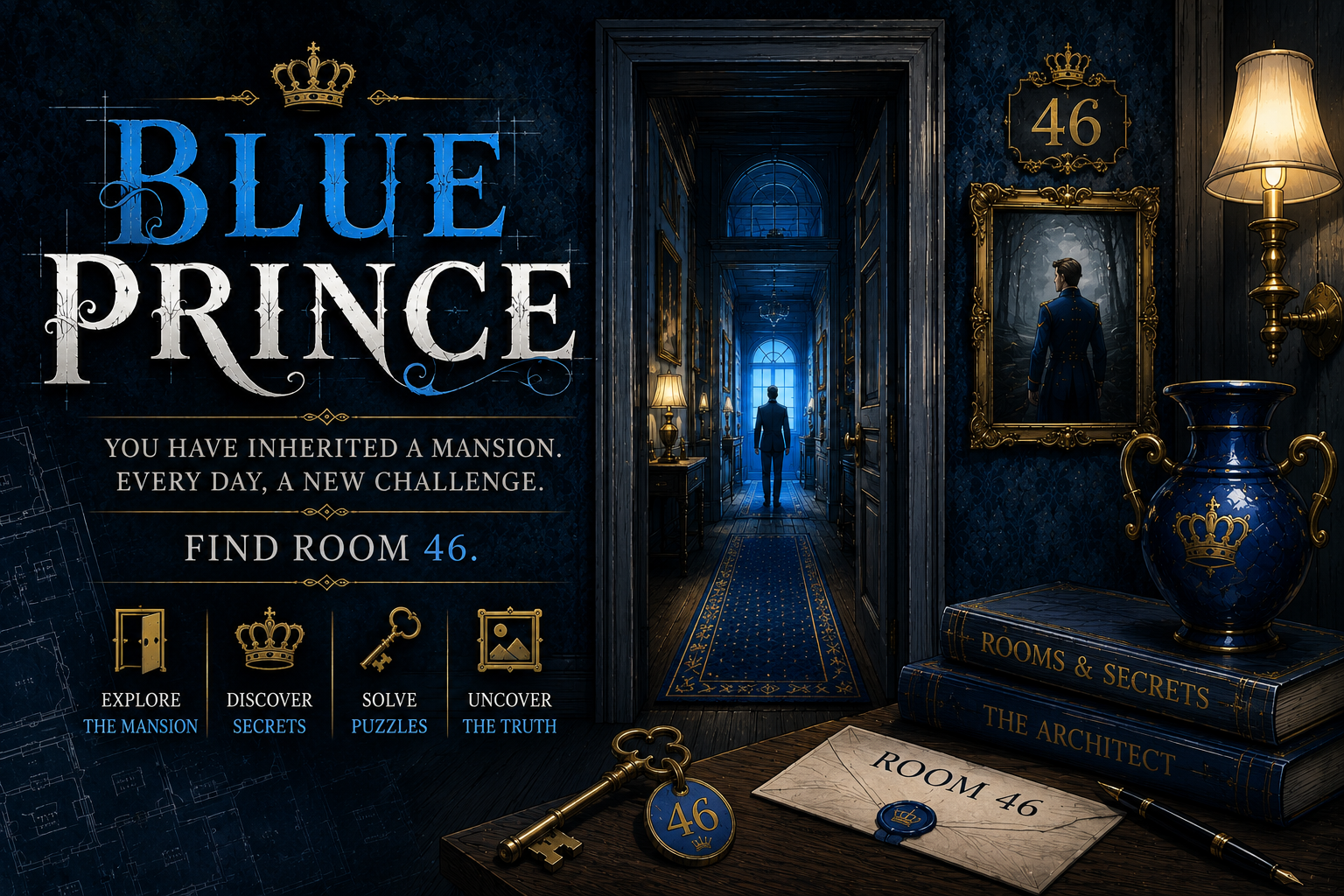
Complete guide · Draft, resources, and Room 46
Blue Prince: the definitive guide to finding Room 46
Everything you need to master Mount Holly: how the room draft works, managing steps, gems, and keys, the four doors of the Antechamber, and the full explanation of Room 46.
Fact sheet
| Developer | Dogubomb (Tonda Ros) |
| Publisher | Raw Fury |
| Release date | April 10, 2025 (PC, PS5, Xbox Series X|S) |
| Platforms | PC (Windows, macOS), PlayStation 5, Xbox Series X|S, Nintendo Switch 2 |
| Genre | Puzzle and exploration roguelike |
| Game mode | Single player |
| Direction, design, and writing | Tonda Ros |
| Production | Axel Haavikko |
| Art direction | Davide Pellino |
| Music | Trigg & Gusset |
After eight years of development, working practically alone, designer Tonda Ros achieved something very few independent games manage: becoming, almost overnight, the best-reviewed game of the year on Metacritic. Blue Prince blends the logic of a draft card game, the curiosity of a narrative walking simulator, and the detective-like obsession of a pencil-and-paper puzzle game, all wrapped in the premise of a mansion that rebuilds itself every night. The result is a game that resembles almost nothing published before it, and one that has managed to hook both roguelike fans and players who normally wouldn’t go near the genre.
Playing as Simon P. Jones, the player inherits the Mount Holly estate from his late great-uncle, Herbert S. Sinclair, under one very particular condition: to keep the property, he must find a hidden room, numbered as Room 46, in a building whose official floor plan only accounts for forty-five rooms. Each morning, the entrance Foyer is the only thing that stays fixed; the rest of the mansion is shuffled, and it must be rebuilt room by room, choosing between three available blueprints every time a new door is crossed. This guide brings together everything you need to fully understand that system: how the draft works, how to manage steps, gems, and keys, which rooms are worth prioritizing, how to reach the Antechamber through its four doors, and, finally, what happens once you reach Room 46 itself.
Before continuing, a practical warning: this guide explains in detail how the room draft works, which resources to prioritize, how to reach the Antechamber, and what happens in Room 46, so it inevitably contains some progression and story details. If you’d rather discover the mystery of Mount Holly on your own, the sections on technical requirements, edition and price, and critical reception are completely safe to read without fear of spoilers.
Eight years to build a mansion: the development of Blue Prince
Blue Prince is, above all, the work of a single person. Tonda Ros, the designer behind the studio Dogubomb, began developing the game around 2016 with the idea that it would take about six months to finish. Eight years later, after leaving his regular job to devote himself entirely to the project, Ros ended up releasing one of the most talked-about and best-reviewed independent games of 2025. For much of that time, the developer financed the project himself with his personal savings and the ad revenue from a Magic: The Gathering website he ran on the side, which gives some idea of just how handmade and personal the whole creative process was.
The game became playable from start to finish as early as 2021, but the following years were spent almost entirely polishing the draft system’s balance, adjusting clue placement so the puzzles felt fair without being obvious, and expanding the various layers of lore hidden in letters, books, and notes scattered throughout the mansion. The team grew over time to include producer Axel Haavikko and, especially relevant to the game’s visual identity, art director Davide Pellino, who joined the project about two years before launch and took roughly three years to define the painterly, illustrated style that would come to characterize Mount Holly.
One of the more curious facts about the development is that the game wasn’t called Blue Prince from the start: its original working title was «Bequest,» a title that fit the story premise perfectly but had to be dropped when Ros discovered another game on Steam already used it. The final title, Blue Prince, was chosen largely for its play on the word «blueprint,» a direct nod to the very room-draft system that underpins the whole experience.
The influences Ros has cited are as varied as they are revealing of the final result: on one hand, board and card games built around draft mechanics, such as Magic: The Gathering and Agricola; on the other, the tradition of pencil-and-paper puzzles by authors like Martin Gardner and Raymond Smullyan, and the «armchair mystery» genre popularized by books like Masquerade, by Kit Williams. The most direct reference, however, is Maze: Solve the World’s Most Challenging Puzzle, the celebrated 1992 book by Christopher Manson, whose own author was eventually hired by Ros to collaborate on the original art and puzzle design of Blue Prince, closing the circle between the work that inspired the project and the finished game.
Key fact
Blue Prince launched on April 10, 2025 for PC, PlayStation 5, and Xbox Series X|S, arrived on macOS on September 29 of that same year, and is scheduled to land on Nintendo Switch 2 on March 3, 2026, extending its availability nearly a year after the original release.
Davide Pellino’s arrival as art director deserves its own paragraph, since the game’s visual style itself ended up being one of the most talked-about elements among critics. Rather than pursue a photorealism that would have clashed with the story’s dreamlike, detective-tinged tone, Pellino developed a painted, warm, slightly stylized aesthetic that recalls both classic editorial illustration and certain board games from the late twentieth century. That visual search process, which Ros has described as the longest stretch of the entire development, partly explains why Mount Holly conveys a sense of handcrafted care even in its most mundane rooms, like a simple pantry or a laundry room.
The soundtrack was handled by the jazz duo Trigg & Gusset, an unconventional choice for a puzzle game that nevertheless fits surprisingly well with the contemplative tone of the exploration. Rather than reach for the electronic or ambient motifs that dominate much of the walking-simulator genre, Blue Prince’s score leans on piano compositions and gentle rhythm section, accompanying the exploration without ever overpowering it, leaving plenty of room for the player to focus on observing every detail of each room.
On the future of the franchise, Ros has been clear: he has no plans for a direct sequel to Blue Prince, though he doesn’t rule out a standalone game set in the same universe, explicitly citing the relationship between Myst and Riven as a reference model. That caution is consistent with the game’s own nature: much of its charm lies in the gradual discovery of a world revealed in fragments, and repeating the formula without a solid narrative reason could dilute exactly what made the first entry special.
Story and premise (no major spoilers)
The story begins with a poisoned inheritance. Simon P. Jones learns that his great-uncle, Herbert S. Sinclair, has died and left him ownership of the Mount Holly estate, an isolated mansion of impossible architecture. But the will includes a very specific condition: to keep the property, Simon must locate a hidden room known only as Room 46, a space that appears on none of the house’s official floor plans, which only account for forty-five rooms. Each day, if Simon fails to find it before running out of energy to keep exploring, the search must start from scratch, since the mansion’s internal layout is completely reorganized every night.
Simon P. Jones and the poisoned inheritance
Beyond the architectural challenge, the search for Room 46 works as a narrative excuse to gradually unearth the family history of the Joneses and the Sinclairs. As the various rooms of Mount Holly are explored, letters, diaries, and personal objects start appearing that suggest Herbert Sinclair’s death, and the strange conditions of his will, hide motivations far more complex than a simple eccentric old man’s whim.
The mystery of Marion Marigold
Running alongside the main plot, the mansion holds clues about the disappearance of Marion Marigold, a popular children’s book author whose real name turns out to be Mary Jones, Simon’s own mother. Investigating her trail reveals that she joined a resistance movement and, at some point, stole an artifact of considerable importance within the game world’s political backstory. This secondary thread interweaves with the search for Room 46 and provides much of the story’s emotional depth, moving away from the purely enigmatic tone of the central architectural mystery.
The world of Mora beyond the mansion
Blue Prince isn’t limited to telling the story of a haunted house: it sets its plot within a low-intensity fantasy universe called Mora, made up of various city-states, including Fenn Aries. Through postcards, books, and documents scattered around Mount Holly, the player pieces together fragments of a much broader political intrigue, centered on the overthrow of a powerful figure named Orinda Aries and on the tension between authoritarianism and resistance that runs through much of the game’s backstory. None of these elements are essential to completing the search for Room 46, but they generously reward those who take the time to read every document they find.
What’s interesting about this political backstory is that it’s never presented explicitly or in a straight line: there’s no single book that sums up the history of Mora or the conflict surrounding Orinda Aries all at once. Instead, each fragment is scattered among private letters, aged newspaper clippings, children’s toys with inscriptions, and even household product labels that, at first glance, look like simple set dressing. Reconstructing this layer of the story becomes, in practice, a second game within the game, aimed specifically at those who enjoy tying up loose ends with no hint system pointing them where to look next.
This design decision connects directly to the project’s own roots: as with Maze, by Christopher Manson, much of Blue Prince’s satisfaction comes not from clearing a mechanical obstacle, but from the feeling of having understood something the game never explained directly. Herbert Sinclair, Mary Jones, and Simon himself act as the connecting threads of a family story that, little by little, proves inseparable from Mora’s own political fate, giving the search for Room 46 an emotional weight that transcends the initial architectural challenge.
How the room draft works
The mechanical heart of Blue Prince is its room-draft system, an idea lifted directly from collectible card games and applied to the architecture of a mansion. Mount Holly is laid out as a grid nine columns wide by five rows tall, with the entrance Foyer fixed at the bottom center and Room 46, in theory, waiting somewhere at the northern edge. Every time the player opens a door leading to a still-empty tile on the grid, the game offers three partially randomly generated room blueprints, and only one can be chosen: the other two are discarded for the rest of that day.
The 9×5 grid and door logic
Every room in Blue Prince has a fixed number of doors in specific positions, and those doors must line up with the ones on adjacent tiles for passage to be possible. This means that, even though a room could technically be placed on a free tile, if its doors don’t line up with the room you’re coming from, or they block access to areas you’d already explored, the result can be a dead end that forces you to work around the problem or simply accept losing that route for the rest of the day. Learning to read each room’s blueprint before confirming it, paying attention to which sides have doors, is one of the basic skills that separates a novice player from an experienced one.
Always choosing between three blueprints
An important nuance of the system is that, once a specific room has been chosen from among the three options offered, that blueprint stops being available for the rest of the day: if you pick the Nook as your first room, no other Nook will appear again until the following day. This turns every choice into a decision with a real opportunity cost, since picking a given room not only shapes your current route, but also reduces the odds of finding that same room, or others of the same type, later in the run.
Rooms by category and rarity
Blue Prince’s full roster includes over a hundred distinct room templates, organized into several thematic categories: bedrooms, geared toward rest and step recovery; hallways and connector rooms, meant to solve routing problems; green rooms, outdoor in character and tied to gem generation; shops, where you can buy items and resources; red rooms, which usually impose some kind of penalty or cost in exchange for a greater benefit; study upgrades, tied to more advanced draft mechanics; found blueprints, secret rooms that don’t appear in the normal draft; and outdoor rooms, located outside the building’s main body. Each template also has a rarity level, represented by dots ranging from common room to rare room, which determines how often it appears among the three options offered during the draft.
It’s worth pausing on two of these categories, since they tend to raise the most questions among newcomers. Red rooms, despite their negative connotation at first glance, shouldn’t be avoided on principle: rooms like the Chapel, the Gymnasium, the Weight Room, or the Boiler Room usually demand an immediate cost — whether in steps, symbolic health, or some other resource — in exchange for a permanent or substantial benefit, so whether to draft them depends entirely on whether you can afford that cost at the specific moment they’re offered. Study upgrades, meanwhile, are rooms that directly change the rules of the draft itself, such as the Classroom, the Casino, the Secondary Entrance Foyer, or the Clock Tower, and they tend to have a disproportionately large impact on the rest of the run relative to their relative rarity.
Found blueprints make up the most unusual category of all, since their rooms — such as the secret glass Greenhouse, the Throne Room, or the Planetarium — never appear among the three normal draft options. Instead, they’re unlocked through specific mechanisms discovered elsewhere in the mansion, usually tied to objects or clues you first need to find. This makes found blueprints something like a reward for thorough exploration, reserved for those who take the time to investigate every corner instead of simply pushing forward along the most direct path.
Key fact
Although Mount Holly’s official floor plan only recognizes forty-five numbered rooms, the game contains over a hundred distinct templates distributed across those forty-five possible tiles, ensuring that no run looks exactly like the last one.
The resources that control everything
Beyond the grid itself, Blue Prince requires juggling several resources at once that determine how much you can explore before the day ends. Understanding each of them well, and above all understanding how they relate to one another, is the difference between a run that constantly stalls out and one that pushes solidly toward the north end of the mansion.
Steps: your personal hourglass
Each day you start with fifty steps, and moving from one room to an adjacent one costs exactly one, regardless of the actual distance covered inside that room; standing still to examine an object costs nothing. When your steps run out, the day ends automatically, so this resource functions as the true time limit of each run. Certain rooms, especially bedrooms and food-related areas, let you recover extra steps, which makes them priority draft targets whenever you feel your route is running short.
Keys: priority over locked chests
Keys open both locked doors and certain chests and cabinets scattered around the rooms. Since locked doors tend to block off entire routes to still-unexplored areas, while chests usually just hide one-off items, the general recommendation is to prioritize spending keys on doors over containers, unless you already know a particular chest’s contents are especially valuable for your current strategy.
Gems: the toll for the best rooms
Some of the game’s most powerful room templates require spending gems, in addition to taking up one of your three draft picks, in order to place them on the board. Green rooms tend to be the most reliable source of this resource, so it’s worth drafting them early in the day if you know you’ll need gems later for specific routes or upgrades. You don’t need to stockpile huge amounts to finish a run, but running completely out of gems can shut you out of some of the best options available at a given moment.
Dice: emergency rerolls
Dice are a much scarcer resource that let you reroll the three draft options offered at a given moment, replacing them with three new alternatives. Because they’re so rare, the near-unanimous recommendation from the community is to save them for genuine dead-end situations — when none of the three offered options let you continue your route in any reasonable way — rather than spending them simply because none of the options particularly excites you.
Coins: the least urgent resource
Money is, by far, the least critical resource for immediate survival within a run, though it’s useful for buying specific items in the shop-type rooms scattered through the mansion. Unlike steps, keys, or gems, running out of coins doesn’t usually cut off exploration routes directly, so it’s perfectly reasonable to deprioritize it relative to the other resources during your first runs.
That said, coins gain relevance as your overall progress advances, since some of Mount Holly’s more advanced shops offer permanent or consumable items of great use that don’t appear anywhere else. It’s worth not ignoring this resource entirely once you’ve mastered the basics of managing steps, keys, and gems: reaching an advanced shop with no money saved up can cost you an opportunity that takes quite a few runs to find again under similar conditions.
Pro tip
Although each day starts from zero in terms of accumulated items and resources, there are permanent upgrades that persist between runs, such as unlocking the West Gate, which grants access to outdoor rooms, or the Apple Orchard, which increases the base number of steps available each day. Prioritizing these permanent upgrades during your early runs dramatically speeds up your medium-term progress.
Essential tips for surviving each day
Draft for shape and fuel, not for the goal
One of the most common mistakes among new players is trying to head straight north on the grid from the very first minute, ignoring any room that doesn’t seem to physically bring them closer to Room 46. In practice, this strategy tends to run out of resources — steps, gems, or keys — long before reaching anywhere interesting. The approach that works best, as much of the community agrees, is to draft early in the day with your route’s overall shape and a basic resource supply in mind, saving the direct dash north for the final stretch of each run, once you know exactly what you need and how much margin you have.
Always prioritize rooms you don’t know yet
When the draft offers you a room you haven’t seen in previous runs, the general recommendation is to pick it almost automatically, even if it looks less useful at first glance than an already-known alternative. Every new room is a chance to learn mechanics, find clues for the game’s bigger puzzles, or discover synergies with other rooms you hadn’t identified yet. The knowledge you accumulate about what each room does is, ultimately, the single most valuable resource in Blue Prince, far more than any specific gem or key.
This priority also has a practical nuance worth keeping in mind: the earlier in your overall progress you first see a room, the sooner you can start planning routes and strategies around it in future runs. Delaying the discovery of a given template, simply because at some point it seemed less appealing than the other two options offered, carries an opportunity cost that accumulates run after run, much more than is obvious the first time you face that choice.
Use dead ends to your advantage
When you’re forced to place a room you know will block a route or won’t lead anywhere useful, try to put it along the edges of the map rather than in the center of your main path. This has an additional benefit that isn’t obvious at first: every room placed, useful or not, comes out of the pool of available options for the rest of the day, so deliberately «spending» an uninteresting template off to the side slightly improves the average quality of the options the draft will offer you later that same day.
Also remember that walking into a dead end and having to turn back costs one step going in and, almost always, another step coming out, so two bad decisions of this kind in a row can cost you as many steps as an entire room’s worth of productive exploration. Before confirming a room with few doors or an odd layout, take a second to picture whether that path is really worth it, or whether it would be better to sacrifice it along an already-explored edge, where the cost of a potential mistake is much lower.
Take notes outside the game — literally
Blue Prince is deliberately designed to require outside documentation: there’s no quest journal that automatically summarizes every clue, and many of its most satisfying puzzles depend on the player connecting information scattered across different rooms, sometimes seen in different runs. Taking screenshots or physical notes of any note, painting, or inscription that looks relevant — dates, numbers, color sequences — is practically essential for solving the more elaborate puzzles without relying solely on memory.
Don’t force puzzles you don’t understand yet
The vast majority of Blue Prince’s puzzles are quality-of-life improvements or optional objectives, not hard blocks on completing the main search. If you find yourself stuck on a particular puzzle, it’s fine to set it aside and keep exploring: the same rooms and puzzles reappear in later runs, so there will always be a new chance to return to them with more information or a different perspective once you’ve seen more pieces of the bigger picture.
A common pattern among players who’ve put in quite a few hours is discovering, weeks after getting stuck on a particular puzzle, that the missing piece was in a completely different room they hadn’t even connected to that puzzle at first. This kind of delayed revelation is, to a large extent, part of the game’s central appeal: accepting that not everything gets solved right away, and trusting that exploration itself will eventually deliver the missing piece, is far more rewarding in the long run than forcing solutions through trial and error.
A «failed» run isn’t wasted time
Running out of steps before finding Room 46 is simply the game working as intended, not a player failure. Unlike other roguelikes where a failed run feels like a punishment, in Blue Prince every attempt provides permanent knowledge about room layouts, clue locations, and puzzle logic — knowledge that doesn’t disappear when a new day begins. Accepting that you’ll need many attempts before finishing the game, rather than getting frustrated about it, radically changes how the experience is enjoyed.
Fill in the front rows before rushing north
A tip experienced players repeat often is to resist the temptation to chase the northernmost tiles right from the start of every run. Instead, it’s worth spending the first stretch of the day filling in as many tiles as possible in the rows closest to the Foyer, even if that means drifting sideways instead of moving in a straight line. This approach reduces the odds of running out of reasonable draft options halfway through, and also increases your chances of stumbling on new or uncommon rooms you’d otherwise miss by pushing forward too quickly.
Prioritize gems in the first half of the day
Since many of the most powerful rooms require spending gems in addition to taking up a draft slot, it’s worth building up a reserve of this resource before the opportunities you actually want show up. Drafting one or two green rooms early in your route, even if they don’t seem like the most exciting options at the time, tends to translate into far more freedom of choice during the second half of the day, once the map starts revealing routes to the mansion’s more interesting areas.
Use the rank system to unlock permanent upgrades
Much of Blue Prince’s long-term progress doesn’t depend on what happens within a single run, but on a rank and permanent-upgrade system that unlocks as you complete certain objectives across multiple days. Prioritizing these permanent unlocks, rather than focusing exclusively on trying to get as far as possible in a single run, tends to speed up overall progress much more, since every upgrade earned benefits absolutely every future attempt, while progress within a single day is completely lost once your steps run out.
Touring Mount Holly: key rooms and areas
Although Mount Holly’s exact layout changes every day, there’s a core set of especially relevant rooms worth knowing about in advance, either because they unlock permanent upgrades, because they grant access to normally closed-off areas, or because they’re the gateway to some of the game’s deepest systems.
The Foyer and the Parlor
The Foyer is the only truly fixed room in the entire mansion: it appears in the same spot every day and serves as the starting point of every run. The Parlor, one of the first blueprints you tend to find in the draft, is especially valuable because solving its internal puzzle grants two gems, a useful boost right when they’re most needed to access the run’s first paid rooms.
The Kitchen and step-recovery rooms
Rooms tied to food and rest, like the Kitchen or the various types of bedroom, are the main sources of extra steps within a run. The Nursery, specifically, is especially valuable in the early stages of a run because it grants extra steps every time a bedroom is drafted after it’s been placed, generating a synergy that adds up quickly if you manage to chain several bedrooms in the same day.
The Greenhouse and the Secret Garden
These two outdoor, green-type rooms are reliable sources of gems and, as detailed in the next section, each one holds one of the mechanisms needed to open one of the Antechamber’s four doors. The Secret Garden, in particular, hides a camouflaged lever that only reveals itself once two weathervanes are pointed correctly, while the Greenhouse requires locating a broken lever elsewhere in the mansion — typically in Security or in some Spare Room — so it can be repaired inside the Greenhouse itself.
The Underground and the Basement Key
Beneath Mount Holly’s main floor lies a network of underground rooms that can only be reached with a specific Basement Key. Inside the Underground waits one of the game’s most elaborate puzzles, a mechanism of rotating gears that must be solved correctly in order to pull the shrine lever that opens the Antechamber’s north door, the most direct of the four.
Security and the keycard system
Security grants access to the house’s keycard system and general inventory, two mechanisms that become increasingly relevant as more areas of Mount Holly are unlocked. Checking this room carefully as soon as it turns up in the draft is usually worth it, since it often contains items and clues that would otherwise go completely unnoticed.
Coat Check: your link between runs
Coat Check serves a very particular mechanical function within the game’s daily cycle: it lets you deposit a specific item so you automatically get it back at the start of your next run, sidestepping the general rule that everything picked up during the day is lost once your steps run out. This room becomes especially valuable when you get a high-value item — like a special key or a rare tool — but run out of steps before you can use it properly: instead of losing it, depositing it in Coat Check guarantees you’ll start the next day already holding it, saving you the time it would have taken to get it again from scratch.
The Library and written clues
The Library is one of the rooms with the highest density of text in the entire mansion, and therefore one of the most important for anyone trying to piece together the backstory of the Sinclair family and of Marion Marigold. Many of the books you can flip through in this room contain cross-references to other locations in Mount Holly, as well as indirect clues about the exact sequence of Herbert Sinclair’s travels, which turns out to be essential for Room 46’s final puzzle. Reading each available volume carefully, rather than rushing through the room looking for physical items, tends to pay off far more in the long run than it seems at first glance.
The Machine Room and the house’s systems
Scattered across different areas of the mansion are several mechanisms that control the house’s general systems, like the power supply or the water circuit, and which usually require locating and installing specific parts to activate them. These systems don’t just unlock one-off rewards — they often also affect how other, already-explored rooms function: a room that seemed completely empty on an earlier visit might reveal additional content once its corresponding electrical system is active, which is a good reason to revisit familiar areas after unlocking an upgrade of this kind.
Pro tip
Once you manage to open an Underground door with the Basement Key, that door stays permanently unlocked in future runs. If you run out of steps right when you’re holding the key, consider stashing it in a Coat Check so you can recover it at the start of your next run instead of losing it without having used it.
The Antechamber’s four doors: how to reach Room 46
Spoiler warning
This section details the location and mechanism of the Antechamber’s four doors, the mandatory step before reaching Room 46. If you’d rather discover this final stretch without help, you can skip straight ahead to the technical requirements section below.
The Antechamber is the room immediately before Room 46 itself, and its distinctive feature is that it has four separate doors, one on each cardinal point, each blocked by a different mechanism scattered across other areas of the mansion. You don’t need to open all four in the same run: unlocking just one is enough to cross north, though knowing all four alternatives gives you much more room to maneuver depending on what you come across each day.
West door: the Secret Garden
This door opens by turning two valves inside the Secret Garden until both weathervanes point west. Doing it correctly reveals a hidden lever that, once pulled, unlocks the Antechamber’s west door. Generally speaking, it’s one of the more straightforward mechanisms once you know exactly what to look for inside the garden.
South door: the Greenhouse
The south door requires locating a Broken Lever, which usually turns up in Security or in some Spare Room, and carrying it to the Greenhouse to install it in the corresponding wall mechanism. Once the lever is in place, activating it unlocks the Antechamber’s south access.
East door: the Great Hall
East access depends on a lever located in the Great Hall, with the particular wrinkle that the room’s other doors tend to appear locked. The most reliable way to guarantee passage is to have already drafted the Secondary Entrance Foyer, which helps keep the surrounding doors open, or, failing that, to arrive prepared with enough keys or opening tools so you don’t get stuck right at the end of the run.
This route tends to be the one that frustrates first-time players the most when they don’t already know about the Secondary Entrance Foyer requirement, since it’s easy to reach the Great Hall with plenty of resources to spare and still find yourself completely blocked by a lack of enough keys for the room’s other doors. If you’ve already permanently opened the north route through the Underground, it’s generally not worth pursuing this path unless you have a specific reason to prefer it, such as access to some item or clue found only in that particular part of the Great Hall.
North door: the Underground
The north route, generally considered the most direct of the four once permanently unlocked, goes through the Underground. You need to descend using the Basement Key, solve the rotating-gears puzzle mentioned in the previous section, and pull the corresponding shrine lever. As already noted, once this route is opened it stays permanently unlocked for the rest of your runs, which makes it the most cost-effective option in the long run if you have to choose which mechanism to focus your early efforts on.
The Underground’s rotating-gears puzzle deserves a comment of its own, since it tends to be the first major difficulty spike many players encounter on their way to the Antechamber. The mechanism consists of a series of interlocking toothed wheels that turn together, and each one has to be brought to a specific orientation — usually indicated by a symbol or visual mark on the gear itself — without moving one wheel throwing off another you’d already placed correctly. The most reliable way to solve it isn’t trying to memorize the whole solution at once, but adjusting one wheel at a time, checking the effect it has on the adjacent ones before touching the next, rather than turning several pieces at once hoping to hit the right combination.
The most sensible strategy, as much of the community agrees, isn’t to try to open all four doors in the same run, but to focus first on unlocking the Underground one for its permanence, and leave the rest as backup alternatives for days when the draft doesn’t easily offer the pieces you need for that particular route. Also keep in mind that draft luck directly affects how long it takes to gather all the pieces you need: you won’t always get the rooms you need in the order you’d prefer, and accepting that variability, rather than fighting it, is part of the game.
The ending of Blue Prince: Room 46 explained
Spoiler warning
This section explains in detail what happens when you reach Room 46 and the content of its final puzzle. If you’d rather experience that moment with no preconceptions, skip straight to the technical requirements section.
Unlike every other room in Mount Holly, Room 46 is never part of the normal draft pool: it’s reached exclusively through the Antechamber’s north door, once it has been unlocked by any of the four mechanisms described in the previous section. The first time a player reaches it, a cutscene plays followed by the game’s credits, formally closing out the main objective set by Herbert Sinclair’s will.
That moment, however, isn’t the real end of the game’s content. After those opening credits, Room 46 becomes fully explorable in later runs, and inside it wait both symbolic items — the Crown of Blueprints and the Sanctum Key — and one of the most elaborate puzzles in all of Blue Prince: a world map with eight numbered pins and the inscription «8 realms in 8 months.» Solving it requires having previously found, scattered across various postcards throughout the mansion, clues about the exact order in which Herbert Sinclair visited each of those regions during his life: Orinda Aries, Eraja, Arch Aries, Mora Jai, Verra, Corarica, Nuance, and Fenn Aries.
Correctly completing this sequence reveals the Deed and the complete Last Will and Testament of Herbert S. Sinclair, a document that ties up much of what’s left unresolved about why the old man structured his inheritance in such a particular way, and what his journey through Mora’s various regions actually has to do with Simon’s fate and with the parallel mystery of Marion Marigold. Without spoiling the document’s specific details here, it can be said that it confirms the search for Room 46 was never a simple whim or an arbitrary test of cleverness: it’s part of a far more deliberate plan on Sinclair’s part, designed specifically so that only someone with the patience and curiosity to explore the mansion thoroughly could ever fully understand it.
It’s also worth noting that the order of the realm sequence itself — Orinda Aries, Eraja, Arch Aries, Mora Jai, Verra, Corarica, Nuance, and Fenn Aries — isn’t something the game hands you directly: each of those stops has to be deduced by combining postcard fragments that can appear in completely different rooms, sometimes separated by several runs between when the first clue is found and when the entire sequence is completed. This deliberately scattered design is consistent with the rest of the game: nothing important is ever handed over all at once, and the satisfaction of completing the map puzzle depends directly on having gathered small fragments of information across many different days inside Mount Holly.
Pro tip
Don’t worry if you reach Room 46 without having completed the map puzzle: the game’s own design assumes most players will reach the main ending before gathering all the necessary postcards. The post-credits content is specifically meant to be a reason to keep playing, and replaying, the mansion once the main objective is cleared.
This «ending that isn’t really an ending» design sums up Blue Prince’s overall philosophy pretty well: the game’s true goal was never simply crossing a particular door, but learning to read Mount Holly as a complete system, with all its layers of information interwoven. Those who are satisfied seeing the credits roll once get a satisfying experience in its own right, but those who decide to stay and dig through every corner after that first ending discover the mansion still had much more to tell.
Blue Prince versus other puzzle and exploration games
Blue Prince is often compared to other recent titles that have leaned on unhurried exploration and environmental puzzles as the core of the experience, though its specific mix of random draft and narrative mystery clearly sets it apart from any of its closest counterparts.
| Aspect | The Witness / Return of the Obra Dinn | Blue Prince |
|---|---|---|
| World structure | Fixed, same layout every run | Regenerated every day via random draft |
| Progression | Linear, based on player knowledge | Cyclical, with permanent upgrades between runs |
| Resource management | Practically nonexistent | Central: steps, gems, keys, dice, and coins |
| Replayability | Low once the puzzles are solved | High, since every run generates a different mansion |
| Outside documentation | Recommended but not essential | Practically mandatory for advanced puzzles |
The comparison makes it fairly clear what sets Blue Prince apart from the rest of the genre’s touchstones: while games like The Witness or Return of the Obra Dinn present a fixed world that the player gradually learns to read, Mount Holly rebuilds itself every day, forcing players to combine that same detective-like logic with an added layer of resource management and decision-making under uncertainty, much closer to a draft board game than to a conventional walking simulator.
Another common point of comparison is with more traditional dungeon-crawling roguelikes, the kind built around combat or deck-building along the lines of Slay the Spire. Blue Prince shares with them the structure of repeated attempts and the idea of permanent progress between runs, but replaces the combat component entirely with one focused purely on exploration and puzzle-solving, which brings it closer to a domestic detective simulator than to a strategy game in the conventional sense of the term. This genre hybridization is, precisely, one of the reasons it’s so hard to fit Blue Prince into a single category when recommending it to other players.
PC technical requirements
| Requirement | Minimum | Recommended |
|---|---|---|
| Operating system | Windows 10/11 (64-bit) | Windows 10/11 (64-bit) |
| Processor | Intel Core i5-2300 | Intel Core i5-4690K |
| RAM | 16 GB | 16 GB |
| Graphics card | NVIDIA GeForce GTX 1060 | NVIDIA GeForce GTX 1080 |
| Storage | 6 GB | 6 GB |
Blue Prince’s requirements are notably modest for a game of this visual caliber, which fits with its nature as an independent project developed mostly by a single person in the Unity engine. Practically any mid-range machine assembled in the last five or six years should be able to run the game without major issues, even at its recommended settings, and Unity itself also enables a macOS version, which further widens the range of compatible machines.
This technical accessibility is no minor detail within the game’s overall pitch: since it doesn’t rely on demanding graphical effects or a cutting-edge technical showcase, Blue Prince can run smoothly on modest laptops or repurposed office machines, something fairly uncommon among each year’s most acclaimed games. That technical lightness, combined with the absence of microtransactions and a reasonable launch price for its ambition, reinforces the sense that Blue Prince was conceived, from the start, as a game meant to reach as many players as possible without demanding a disproportionate investment in hardware.
Edition and price
Blue Prince is sold in a single standard edition, with no deluxe editions or paid in-game content, at a price of $29.99 at launch on PC, PlayStation 5, and Xbox Series X|S. This simplicity in the business model contrasts with the game’s own internal complexity, and it has been well received by a segment of the audience that appreciates a title of this ambition not resorting to microtransactions or fragmented downloadable content.
For those who want to extend the experience beyond the game itself, Raw Fury has released the original soundtrack separately in digital format, priced independently at $9.99, along with a bundle that combines the base game and the soundtrack at a discount compared to buying them separately. The game is also part of some larger promotional bundles alongside other titles published by Raw Fury, such as a collection that groups it together with Inscryption, another card game with a strong narrative identity of its own.
Unlike many recent independent releases, Blue Prince also hasn’t resorted to aggressive launch discounts or temporary exclusivity windows on any particular digital storefront, something Raw Fury has justified by pointing to confidence in the product itself to sustain its launch price without artificial promotions. As the months have passed, the game has started showing up in the usual seasonal sales on major PC digital storefronts, with discounts that at certain times have exceeded thirty or forty percent off the original price, so it’s worth checking the current price before buying if there’s no rush to start playing right away.
Key fact
Blue Prince does not currently have localization into any language other than English. Tonda Ros himself has explained that translating the game would be about as complex as building a second game from scratch, since many of its puzzles rely directly on wordplay and quirks of the English language that can’t be carried over literally into other languages.
Critical reception
Blue Prince launched to an extraordinary reception, briefly becoming the best-reviewed game of 2025 on Metacritic at the moment of its release. The PC version sits at 92 out of 100 on Metacritic, the Xbox Series X|S version reaches 90, and the PlayStation 5 version stands at 85. On OpenCritic, 95% of the collected reviews recommend the game, one of the highest consensus figures recorded for an independent release in recent years.
Specialized outlets like Edge, Eurogamer, Game Informer, The Guardian, and IGN awarded it some of the highest possible scores on their respective scales, and publications such as Eurogamer, The Guardian, and Polygon went on to include it among their Game of the Year picks. Industry recognition has been just as notable: Blue Prince won Best Independent Game at the 2025 Golden Joystick Awards, Game of the Year and the Innovation award at the Indie Game Awards, the awards for Outstanding Achievement for an Independent Game and Game Design at the 29th D.I.C.E. Awards, the award for Best Design and Innovation at the 26th Game Developers Choice Awards, and the Game Design award at the 22nd BAFTA Games Awards.
This pile of awards is especially striking considering that Blue Prince competed that season against productions backed by far larger budgets and development teams. That a project largely designed, written, and directed by a single person managed to win out in game-design categories against studios with dozens of professionals dedicated exclusively to that discipline says a lot about how polished the draft system ended up being after eight years of constant iteration. Several juries specifically highlighted the internal coherence of the system: despite the enormous number of random variables in play, the game rarely feels unfair or arbitrary, no small design feat in a system so dependent on chance.
Reception from the general public on platforms like Steam has been similarly positive, with a very high proportion of user reviews rating the game favorably. Among the community’s most repeated comments is surprise at how long it takes the game to «run out»: unlike many puzzle titles that start to feel repetitive after the first few hours, many players note that Blue Prince keeps delivering genuinely new discoveries even after clearing the main objective of finding Room 46, thanks to the enormous amount of optional content and additional narrative layers scattered throughout Mount Holly.
Among the few criticisms noted by the specialized press is Polygon’s observation about the absence of a dedicated mode for colorblind players, a relevant issue given that some of the game’s puzzles depend directly on distinguishing specific colors. Beyond that particular point, critical consensus has been overwhelmingly positive, with recurring praise for the originality of its draft system, the quality of its puzzles, and the game’s ability to keep surprising players even after dozens of hours of play.
Final verdict
Blue Prince achieves something quite rare in today’s independent landscape: inventing its own genre out of familiar pieces. By combining the draft of a board game, the detective-like curiosity of a narrative walking simulator, and the repeated-attempt structure of a roguelike, Tonda Ros has built a mansion that feels different every time you cross its front door, without ever losing the internal coherence of its rules or the sense that every discovery fits into a much bigger plan.
The result isn’t without demands on the player — the reliance on outside documentation and the lack of localization into other languages can pose a real barrier to entry for part of the audience — but the whole thing holds together thanks to outstanding puzzle design, meticulous art direction, and one of the most original narrative structures the exploration genre has produced in recent years. With eight industry awards to its name and a critical consensus that’s practically unanimous, Blue Prince proves that a personal project, developed over nearly a decade by a single person, can still surprise an entire industry.
Perhaps Blue Prince’s greatest achievement is managing to make a system as dependent on chance as the room draft feel, almost all the time, like a fair challenge rather than a frustrating lottery. That balance, the product of years of quiet tweaks to each template’s odds of appearing, is exactly the kind of invisible work that rarely gets the credit it deserves, yet is essential for the whole design to function. For any player willing to take their time, take notes, and accept that not every run will end in a spectacular discovery, Mount Holly offers one of the most generous and best-built puzzle experiences in recent years.
| Pros | Cons |
|---|---|
| Deeply original room-draft system within the exploration genre | No localization into any language other than English |
| Elaborate puzzles with multiple layers of depth and discovery | Requires constant outside documentation for the advanced puzzles |
| High replayability thanks to the mansion’s random generation | Lack of colorblind mode despite color-dependent puzzles |
| Narrative that reveals itself organically through exploration | Draft variability can needlessly drag out some runs |
| Very accessible PC requirements for its level of ambition | Demanding learning curve for those not used to taking outside notes |
Frequently asked questions
Is Blue Prince translated into other languages?
No. The game is only available in English, since the developer himself has explained that many of its puzzles rely on wordplay and language quirks that are very difficult to carry over into other languages without redesigning the puzzle entirely.
How long does it take to finish a full run of Blue Prince?
There’s no fixed figure, since it depends enormously on draft luck and the player’s skill at managing resources, but completing the main objective — reaching Room 46 for the first time — usually requires many repeated days inside the mansion, with total playtimes that typically exceed twenty to thirty hours for most players.
Do you need to finish the game in a single real-world play session?
No. Permanent progress, such as unlocked upgrades or permanently opened doors, is saved between sessions. What resets each «day» is the mansion’s internal layout and the temporary items picked up during that specific day, not your overall progress in the game.
What happens if I run out of steps before finding Room 46?
The current day simply ends and a new one begins, with the mansion completely reorganized. There’s no narrative penalty for this: it’s actually the normal, expected outcome for the vast majority of runs.
Do I need to open all four Antechamber doors to finish the game?
No, unlocking just one of the four is enough to access Room 46. Knowing all four alternatives simply gives you more options depending on what the draft offers you on a given day.
Does the game end once you reach Room 46?
Reaching it for the first time triggers the credits, but it doesn’t exhaust the game’s content: Room 46 itself becomes explorable afterward, with an additional puzzle that digs deeper into the narrative backstory of Herbert Sinclair’s will.
Does Blue Prince have a colorblind mode?
No, at launch the game lacks specific accessibility options for colorblindness, something critics have flagged as a weak point given that certain puzzles depend on distinguishing specific colors.
Can I play Blue Prince on Mac?
Yes. Although the original launch in April 2025 was limited to PC on Windows, PlayStation 5, and Xbox Series X|S, the game officially arrived on macOS on September 29, 2025.
Is it confirmed for Nintendo Switch 2?
Yes, a Nintendo Switch 2 version is planned, with a release date set for March 3, 2026.
Is it a hard game for someone who doesn’t usually play puzzle games?
The learning curve is moderate: the first rooms and mechanics are fairly intuitive, and much of the initial challenge simply involves learning how the draft and the basic resources work. Difficulty rises noticeably in the more advanced puzzles, where patience and a willingness to take outside notes really pay off.
Is there an official in-game guide?
There’s no quest journal or built-in hint system beyond the notes and objects you find while exploring. The game is deliberately designed for the player to rely on their own observation and, if they choose, outside documentation.
Is it worth replaying the game after seeing the credits?
Yes. The content after your first arrival at Room 46 includes additional puzzles, more fragments of narrative backstory about Mora and the Sinclair family, and symbolic items that can’t be obtained before that point. Many players consider that the game’s full experience is only truly appreciated after spending time on this post-credits phase.
Does Blue Prince have paid downloadable content?
There’s no paid playable downloadable content; the only additional purchase available is the game’s original soundtrack, sold separately or in a bundle with the base game.
Do I lose all my progress if I run out of steps halfway through a puzzle?
You lose the temporary items and that particular day’s room layout, but any knowledge of how the puzzle works — the player’s own knowledge, not the character’s — stays intact, and any permanent upgrades already unlocked remain available on your next attempt. Puzzles reappear on later days, so there’s always a new chance to finish them with the information you’ve already gathered.
Is it worth using outside guides, or is it better to play without help?
It depends on the kind of experience you’re after. The game is designed to reward your own observation and deduction, so playing without outside help during the first several hours tends to be the most satisfying way to discover its draft system and basic mechanics. Turning to guides for specific puzzles you’ve been stuck on for a long time is perfectly reasonable and doesn’t ruin the rest of the experience, since the vast majority of the game’s content will still feel like a genuine discovery even after looking up the solution to one isolated puzzle.
Is it a relaxing game, or does it generate a lot of tension?
The overall tone is contemplative and unhurried, with no combat and no direct threats to the character’s well-being, which makes it feel closer to a relaxing puzzle experience than to a horror or survival game in the traditional sense. The one real source of tension is managing your own daily step limit, which can create some time pressure toward the end of an especially productive day, but it never reaches the stress levels of a combat-driven roguelike.
Can I play with a controller, or is it built only for keyboard and mouse?
The game supports both control schemes with no meaningful limitations, and the console versions — PlayStation 5, Xbox Series X|S, and the upcoming Nintendo Switch 2 version — are, naturally, designed around controller use from the ground up. The exploration and draft experience runs smoothly on both schemes, so the choice largely comes down to each player’s personal preference.
Blue Prince proves that, even in a market saturated with roguelike and exploration-puzzle offerings, there’s still room for a truly original idea when it’s given the time and obsession it needs. Amid the creak of its wooden floors, the shifting logic of its rooms, and the symbolic weight of every card found, Mount Holly builds one of the most complete and rewarding puzzle experiences in recent years, for those who love planning every move and for those who simply want to lose themselves in the mystery of a house that’s never quite the same twice.