
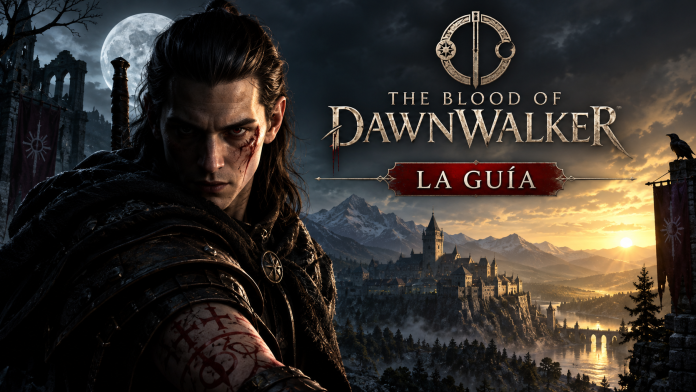
Complete guide · 30 days, day and night, endings
The Blood of Dawnwalker: the definitive guide to surviving Vale Sangora
Everything you need to master the 30-day system: how to manage the Blood Hunger, make the most of day and night, choose a skill tree, and unlock every one of the seven endings.
Technical Specs
| Developer | Rebel Wolves |
| Publisher | Bandai Namco Entertainment |
| Release date | September 3, 2026 |
| Platforms | PC (Windows), PlayStation 5, Xbox Series X|S |
| Game engine | Unreal Engine 5 |
| Genre | Open-world action RPG |
| Mode | Single player |
| Director | Konrad Tomaszkiewicz |
| Creative director | Mateusz Tomaszkiewicz |
| Design director | Daniel Sadowski |
| Narrative director | Jakub Szamalek |
| Art director | Bartłomiej Gaweł |
When a group of veterans from The Witcher 3 and Cyberpunk 2077 leaves CD Projekt to found their own studio, expectations are, almost by definition, sky-high. The Blood of Dawnwalker is Rebel Wolves’ answer to that pressure: an open-world action RPG set in a fictional gothic realm in the fourteenth century, where the player controls Coen, a young man forcibly turned into a Dawnwalker — half human, half vampire — with only thirty days to rescue his family from the clutches of the vampire lord Brencis.
What sets Dawnwalker apart from other open-world RPGs isn’t just its vampire-and-plague setting in the Carpathians, but the way it structures playtime itself: each day and each night is divided into limited stretches, and only actions that push the plot forward consume that time, while exploring, talking, and preparing cost nothing. This guide brings together everything you need to fully understand that system: how to manage the thirty days, how to make the most of Coen’s dual daytime and nighttime nature, how to control the Blood Hunger, which skill tree is worth prioritizing, and how to unlock each of the seven available endings.
It’s worth placing this release within the genre’s broader context: after years of open-world RPGs competing largely on map size and the number of icons scattered across it, Rebel Wolves has chosen a different path, betting on the deliberate scarcity of time as the main source of gameplay tension. This guide is meant precisely to help you navigate that scarcity wisely, so you don’t reach the end of your thirty days feeling you squandered a resource that, unlike health or material resources, can never be recovered once spent.
Before continuing, a practical warning: this guide explains in detail how the time system works, how to manage the Blood Hunger, the structure of the quests, and the game’s seven endings, so it inevitably contains some progression and story details. If you’d rather discover Vale Sangora on your own, the sections on technical requirements, editions and pricing, and critical reception are completely safe to read without fear of spoilers.
From CD Projekt to Rebel Wolves: the game’s development
Rebel Wolves was born in February 2022, when Konrad Tomaszkiewicz, director of The Witcher 3: Wild Hunt, decided to leave CD Projekt along with several trusted colleagues to found his own studio. What began as a small team of barely twenty people grew steadily until it reached one hundred and sixty employees by April 2026, shortly before the launch of its first project. The studio’s leadership roster is, to a large extent, a reunion of familiar faces for any fan of The Witcher and Cyberpunk 2077: Konrad Tomaszkiewicz himself as director, his brother Mateusz Tomaszkiewicz as creative director, Daniel Sadowski as design director, Jakub Szamalek as narrative director, and Bartłomiej Gaweł as art director, all of them with years of prior experience on CD Projekt’s most ambitious projects.
That shared background explains much of The Blood of Dawnwalker’s design choices, starting with its commitment to a heavily branching narrative and a world that reacts tangibly to the player’s decisions. However, the team has been explicit about distancing itself from the quest formula that defined its previous projects: Rebel Wolves has described its philosophy for side quests as «a personal vendetta against filler content,» aiming for every quest, however modest it may seem on the surface, to have a weighty narrative reason to exist within the tight thirty-day window that structures the entire campaign.
The studio turned to Unreal Engine 5 instead of developing an engine of its own from scratch, a pragmatic decision that let it focus much of its resources on narrative and systems design rather than on base technology. Publishing was handled by Bandai Namco Entertainment, a publisher with extensive experience in large-scale action RPGs, which backed the project from a relatively early stage of its development.
Key Fact
The Blood of Dawnwalker launched on September 3, 2026 for PC, PlayStation 5, and Xbox Series X|S. Although the initial announcement capped the console versions at 40 frames per second, a day-one patch enabled a 60 fps mode on both PlayStation 5 and Xbox Series X, though not on Xbox Series S.
The studio’s own growth, from twenty to one hundred and sixty employees in barely four years, also reflects the scale of the project’s ambition from the very start: Rebel Wolves never framed The Blood of Dawnwalker as a modest production aiming for a quiet niche in the market, but as a statement of intent capable of competing directly with the industry’s biggest-budget open-world RPGs. That ambition shows both in the sheer scale of Vale Sangora itself and in the number of interconnected systems that sustain the experience: the day/night cycle, the thirty-day limit, the Blood Hunger, the three skill trees, and the seven-ending structure together form a design architecture considerably more complex than that of a conventional action RPG.
Another notable aspect of the development is the deliberate choice of an underused setting within the genre: rather than reaching once again for the medieval Western Europe that dominates much of dark fantasy in video games, the team led by Jakub Szamalek and Bartłomiej Gaweł chose to set Vale Sangora in an environment inspired by Hungarian, Romanian, and Carpathian mythology, with a visual style that blends the timber architecture of peasant villages with the gothic baroque of the vampiric courts. This decision, relatively risky from a commercial standpoint, has been one of the elements most praised by specialized critics when assessing the game’s identity against other genre touchstones.
Beyond this first game, Rebel Wolves has made clear that The Blood of Dawnwalker is only the starting point of a broader saga set in the same universe, but spread across different historical eras. Each installment is designed as a self-contained story, without cliffhangers or open plot threads dependent on future sequels, and without relying on time-travel devices to connect them. A trailer shown in June 2026 even hinted at future installments set in the present day, suggesting the studio intends to take the Dawnwalker concept well beyond the medieval framework of this first chapter.
Story and characters (no major spoilers)
The action takes place in Vale Sangora, a fictional gothic realm with a Central European setting located in the Carpathians during the fourteenth century, with strong influences from Hungarian, Romanian, and surrounding regional mythology. A devastating plague ravages the land, and amid the chaos rises Brencis, a vrakhir — the game’s term for its noble-blooded vampires — who establishes himself as de facto ruler, offering healing blood in exchange for a monthly «blood tax,» during which the realm’s weakest inhabitants are executed as part of the tribute.
Coen and the transformation into a Dawnwalker
Coen, the player-controlled protagonist, is the eldest son of a family from Laslea who are kidnapped and taken to Brencis’s castle as a sacrificial offering. During the conversion process meant to turn him into just another vampire in Brencis’s service, something goes wrong: Coen becomes a Dawnwalker, a creature half human and half vampire, a kind of being Brencis himself doesn’t even know exists. This hybrid condition grants Coen advantages no conventional vampire possesses — sunlight doesn’t harm him, for instance — but it also saddles him with a new and strange hunger he must learn to control. From that point on, Coen has thirty days to rescue his family before Brencis’s investiture ceremony, a deadline that structures absolutely the entire game experience.
What’s interesting about the narrative setup is that Coen doesn’t wake up as a predestined hero or a seasoned warrior: until the moment of his conversion, he was an ordinary young man from a peasant village, with swordsmanship as his only prior preparation for the conflict now bearing down on him. That outsider status within the vampiric hierarchy itself — neither fully human, nor accepted by the vrakhir as one of their own — is precisely what lets him move between both worlds without fully belonging to either, a narrative position the script uses constantly to question both the morality of the humans surviving under Brencis’s yoke and that of the very vampires ruling Vale Sangora.
Brencis and the three boyars
Brencis rules Vale Sangora from Greifberg Castle, and his court is made up of three vrakhir boyars who administer different facets of his domain: Xanthe, the eldest vrakhir, tied to the cathedral and the blood guard; Ambrus, the boyar of the north, tasked with overseeing the realm’s blood supply network; and Bakir, the boyar of the southwest, responsible for organizing «The Lunar Game,» a spectacle as cruel as it is revealing of the kind of power the vampiric nobility wields over the population. Brencis functions simultaneously as the final antagonist and as a possible negotiating partner, depending on the choices the player makes throughout the playthrough.
The «blood tax» that Brencis levies monthly on Vale Sangora’s population functions as one of the central pieces of the game’s political backdrop: in exchange for healing blood capable of slowing the effects of the plague, the realm’s inhabitants must pay a periodic tribute during which the weakest and most vulnerable are executed as part of the ritual. This system, presented almost as a formalized economy of terror, forces the population to survive within a perverse logic in which collective survival itself depends on sacrificing each community’s most fragile members, a moral dilemma that resurfaces in different forms across several of the game’s most memorable side quests.
Lacra, Crake, and Anca: optional allies
Beyond the direct confrontation with Brencis, Coen can forge alliances with several characters pursuing their own goals within Vale Sangora. Lacra is another vrakhir hunting Brencis for reasons of her own, and completing her extensive quest line can turn her into a key ally during the story’s final stretch. Crake leads the Manumit, a resistance network dedicated to fighting the vampiric grip on the realm, and offers an alternative alliance route centered on collective liberation rather than personal revenge. Anca, for her part, is a witch who grants Coen access to Witchcraft, one of the game’s three skill trees, and has her own storyline that can be explored alongside the main plot.
The thirty-day system: how time works
The most distinctive structural element of The Blood of Dawnwalker is its limited-time system. After the prologue, the player has thirty days and thirty nights to complete the main objective: rescuing their family before Brencis holds his investiture ceremony. However, this limit doesn’t function as a real-time countdown or a clock that ticks while you explore the world: as the developers themselves have explained, as long as you limit yourself to wandering, observing, and listening without decisively intervening, the sun will stay high and the clock won’t move.
In practice, this means exploring the map, talking to characters, investigating new areas, or simply preparing for what’s ahead consumes none of your thirty available days. What does move the clock forward are actions that decisively push the main plot or certain side quests flagged as relevant to the passage of time. Each day, moreover, is divided into eight segments between dawn and dusk, which adds an extra layer of planning: it’s not enough to know how many days you have left — you also have to decide exactly which moment of each day is worth spending your resources on.
More quests than time available
The game’s own design guarantees you’ll never have enough time to complete absolutely everything in a single playthrough: the number of available quests and storylines deliberately exceeds the number of days you have to complete them. Far from an oversight, this design choice is the philosophical heart of the whole experience: every decision about what to spend a given day on necessarily means giving up something else, and the game is built so that those trade-offs carry tangible narrative consequences later on.
This philosophy connects directly with Rebel Wolves’ promise to avoid filler content: since you can’t complete everything, every quest you choose to take on automatically gains more relative weight, since choosing it means having ruled out other equally valid alternatives. The result is a sense of deliberate scarcity that’s fairly unusual within a genre accustomed to rewarding thoroughness and fully clearing the map: in Dawnwalker, trying to do everything isn’t just impossible — it directly contradicts the game’s central design proposition.
The eight segments of the day and how to plan them
Each full day, from dawn to dusk, is divided into eight independent segments, each of which can be devoted to a different activity: an important conversation, a specific raid, a training session, or simply travel to another part of the map. Learning to read how much relative time each type of activity consumes within those eight segments, rather than just watching the overall counter of days remaining, is one of the skills that most separates an experienced player from one who arrives at the story’s final stretch scraping the bottom of the barrel on time.
What happens if you run out of the thirty days
Unlike similar structures in other games, there’s no full reset here in the style of a time loop: if you reach the thirty-day limit without having completed your objective, the story continues, but with serious and permanent narrative consequences, since your family ends up being sacrificed as part of Brencis’s ritual. This outcome, known among the community as one of the game’s negative endings, grants no special achievement and serves as a reminder that time management isn’t a mere design suggestion, but a real constraint you have to account for in every major decision.
Pro Tip
The vast majority of side quests don’t consume any of your thirty main days, and many of them remain available even after you’ve completed the main quest. If you’re worried about running out of room, prioritize advancing the central plot and save the longer side quests for after you’ve secured a favorable outcome.
Day and night: the double edge of being a Dawnwalker
Coen’s hybrid condition translates mechanically into two completely different ways of playing, depending on whether the sun is in the sky or night has fallen. Learning to make the most of each at the right moment, rather than treating both phases as interchangeable, is one of the most important keys to enjoying the game without frustration.
By day: dialogue, stealth, and Witchcraft
During daylight hours, Coen keeps his human appearance and abilities, which favors resolving conflicts through dialogue and richer narrative options than those available at night. It’s also when you can call on Witchcraft, the magic of runes carved into Coen’s skin that lets him, among other things, speak with the dead to gain information that would otherwise remain hidden. Day generally favors a more patient playstyle based on negotiation, investigation, and stealth, rather than direct confrontation.
By night: claws, walls, and Shadowstep
With the sun down, Coen gains access to his vampiric side: he can climb walls and vertical surfaces, teleport via Shadowstep, fight with claws in addition to his sword, and feed on defeated enemies to regenerate health on the fly. Night also opens access to restricted areas that are inaccessible during the day, turning certain quests and locations into exclusively nocturnal content. In exchange for all this extra power, night imposes its own limitation: the Blood Hunger, described in detail below.
This asymmetry between day and night has a practical consequence worth internalizing early on: certain quests and specific objectives are literally impossible to complete at the wrong time of day, either because physical access to an area depends on nighttime vampiric abilities, or because a relevant character is only willing to talk to Coen during daylight hours, when his appearance seems less threatening. Checking your active quest log before deciding whether to wait for nightfall or make the most of the rest of the day saves more than one wasted trip across the map.
Shift forms to fit what each quest needs
An idea worth internalizing early is that the daytime form and the nighttime form aren’t simply a matter of aesthetics or scheduling, but two completely different problem-solving tools that you should actively switch between depending on what each specific situation demands. A quest that seems blocked by a lack of dialogue options during the day can often be solved easily by waiting until night and reaching a restricted area through an alternate route, while an objective that at night requires facing an entire garrison of guards can be far easier to resolve through daytime negotiation with the right character.
The Blood Hunger and how to manage it
Every supernatural action Coen performs at night — sprinting across rooftops, unleashing blood mists, or simply taking heavy damage — gradually increases a meter known as the Blood Hunger. This meter moves through four stages: at a low level, Coen enjoys enhanced abilities and health regeneration; at a moderate level, a visual distortion starts appearing at the edges of the screen; at a high level, health regeneration stops completely and enemies begin to sense the latent threat; and at the critical level, Coen loses conscious control and automatically lunges at the nearest living creature to feed, without distinguishing between an ordinary enemy and a character key to your quests.
Several options exist for managing this hunger, each with different consequences. Feeding on forest animals — deer, wolves — offers modest relief but carries no moral penalty and doesn’t affect your reputation with nearby villages. Feeding on humans, by contrast, provides much greater relief, up to half the meter at once, but kills the target, raises the alarm level in the area, and doubles guard patrols for a while. There’s also a third, intermediate option, a kind of non-lethal stun-and-sip, that reduces the hunger moderately while leaving the victim simply unconscious rather than dead.
The choice between these three approaches isn’t purely mechanical: each one reflects, in its own way, how far Coen accepts or rejects his own vampiric nature. Players who stick exclusively to hunting animals tend to describe an experience closer to classic heroic restraint, while those who more often resort to lethal feeding on humans end up managing a far more ambiguous reputation with Vale Sangora’s communities, who come to fear Coen almost as much as they fear the vrakhir ruling the realm. Neither path is flagged as «correct» by the game’s own design, which reinforces the sense that the Blood Hunger is, above all, a narrative tool as much as a simple resource meter.
Pro Tip
Before infiltrating a garrison or high-security area at night, quickly hunt a nearby deer or wolf so you go in with a comfortable hunger level. Arriving with enough of a buffer lets you use your supernatural abilities freely without risking a frenzy near a character important to your quests.
The three skill trees
Coen’s progression is split across three clearly differentiated skill trees, each tied to a different facet of his hybrid nature. Understanding what each offers, and above all how they complement one another, is essential to building a character that fits your preferred playstyle.
Swordmastery
This tree serves as the game’s most reliable and consistent combat foundation, available both day and night with no additional restrictions. It includes offensive skills like Piercing Edge, built for constant aggressive pressure, alongside defensive options like Omniblock, which eases learning the combat system in the early hours. Its ultimate skills include Last Stand, which boosts weapon damage by 150% below 30% health, Blade Sage, which resets your ability cooldowns, and Tactical Mastery, which restores your Ability Charges.
Witchcraft
Exclusive to daylight hours, Witchcraft channels Hex magic through the runes carved into Coen’s skin, and stands out for its control, its weakening effects, and its damage-over-time against enemies. It does, however, carry a particular cost: casting a Hex spell consumes a small portion of Coen’s own health, which forces careful pacing in prolonged fights. Its ultimate skills include Entwined Torment, capable of hitting two targets at once, Runic Bulwark, a magical shield that blocks up to three consecutive attacks, and Ether Cascade, which reduces the cost of your abilities.
Vampirism
The nighttime specialization unlocks openly supernatural abilities, such as Ravenous Bite, which lets you leap onto an enemy, drain them, and instantly recover health, along with mobility options like Shadowstep teleportation and wall-climbing via Shadow Walk, as well as a transformable wolf form. The trade-off for all this power is, as already described, the need to actively manage the Blood Hunger. Its ultimate skills include Deadly Rebound, which grants temporary immunity once per fight, Lethal Crescendo, which increases claw damage after each kill, and Blood Renewal, which resets Ravenous Bite’s cooldown.
It’s worth noting that none of the three trees is fully isolated from the other two: several mid-tier passive skills offer direct synergies across branches, such as Swordmastery passives that slightly boost vampiric claw damage, or Witchcraft nodes that reduce the Blood Hunger cost of certain Vampirism abilities. Exploring the full tree before committing your first skill points, rather than investing blindly as soon as the first available node unlocks, helps you spot these kinds of combinations before you’ve spent resources in a direction that doesn’t fit the rest of your build.
Pro Tip
A build strategy that works well for most playstyles is to treat Swordmastery as your permanent foundation, since it works around the clock, and then specialize in Witchcraft or Vampirism depending on whether you prefer to solve problems through daytime magical control or nighttime supernatural aggression, rather than spreading points evenly across all three trees without a clear plan.
Essential tips for surviving Vale Sangora
Master directional blocking before anything else
The combat system in human form relies on directional blocking, which requires keeping the left stick neutral to hold your guard, since moving it selects a specific block direction. Timing a block correctly against an enemy attack triggers a Perfect Block, which leaves your opponent open to a counterattack and costs no stamina at all. For those still learning each enemy’s patterns, Omniblock offers an automatic alternative that does consume stamina but is far more forgiving while you master the correct timing.
Practicing this system against the campaign’s early enemies, deliberately slower and more predictable than those who show up later, pays off far more in the long run than trying to rush ahead while ignoring directional-block practice. Treating those first hours as an extended tutorial, rather than simply coasting through fights with automatic Omniblock, lays a foundation that especially shows in the toughest fights against the blood guard and the final battles.
The perfect dodge in vampire form
At night, combat rewards mobility far more than static blocking. Dodging a horizontal attack at the last instant triggers a Perfect Dodge, which costs no stamina and opens a brief window for an advantageous counterattack. Vertical attacks, on the other hand, are better handled by falling back and resetting distance than by trying to dodge them directly, since their movement pattern is much harder to read precisely.
Combining Shadow Walk’s vertical mobility with the perfect dodge also lets you approach night fights from angles that are impossible during the day: climbing to a nearby ledge or rooftop to briefly fall back, regain stamina out of the enemy’s direct reach, and drop back down with a well-timed Shadowstep is a especially effective tactic against large groups of common enemies, though you should keep a close eye on the Blood Hunger meter if you lean on supernatural abilities this way.
Always watch for unblockable attacks
Certain enemy blows are marked with a red skull indicator signaling an unblockable attack — neither directional blocking nor Omniblock will stop it: the only valid response is to dodge. Ignoring this visual cue, especially in fights against multiple enemies, is one of the most common ways to lose an entirely avoidable chunk of health.
This kind of indicator becomes even more important in group fights, where it’s easy to focus on the enemy right in front of you and lose track of a second or third opponent about to land an unblockable hit from a different angle. Getting into the habit of periodically sweeping the screen with your eyes during multi-enemy fights, rather than locking the camera on a single target for too long, considerably reduces the risk of taking one of these hits by surprise.
Manage your stamina carefully
Attacking, dodging, and most defensive actions share the same stamina bar, so overextending offensively can leave you without resources right when you most need to react to a dangerous attack. Investing early in skills like Endless Effort, which increases maximum stamina, or Light Foot, which reduces the cost of dodging, is usually more valuable in the short term than chasing purely offensive skills from the start of the game.
A common mistake among players coming from other action RPGs is treating stamina as a secondary resource compared to health, when in practice the two bars are deeply connected: running out of stamina in the middle of an exchange of blows tends to translate, almost immediately, into a hit that lands squarely on your health. Actively watching your available stamina before deciding whether an extra attack is worth it, rather than checking only once you’ve already run out of room to react, avoids a good share of avoidable deaths in the game’s early stretches.
Plan every day before committing
Since only actions that advance the plot consume time, take a moment before accepting a quest flagged as relevant to the passage of time to ask yourself whether you really want to spend one of your days on that particular objective instead of another. Exploring, talking to characters, and gathering information costs nothing, so use that free margin to make an informed decision before committing one of your thirty days.
Don’t leave important side quests for the end
Although many side quests remain available after completing the main plot, character storylines like Lacra’s or Crake’s can directly influence which endings you have access to, so it’s worth advancing them fairly regularly rather than putting them off indefinitely. Reaching the story’s final stretch without having invested time in these relationships can lock you out of some of the game’s most satisfying outcomes.
Take advantage of spreading points across trees
Although it’s tempting to dive completely into a single skill tree from the start, keeping a minimum investment in the other two tends to considerably broaden your range of solutions to the same problem. A fight that seems impossible with a purely offensive Swordmastery approach can become far more manageable if you have a couple of basic Witchcraft nodes to weaken a specific enemy before committing to melee, or a Vampirism mobility skill to reposition quickly against a large group.
This flexibility becomes especially valuable during the story’s final stretch, where fights tend to combine several types of threats at once — armored enemies that demand patience with Swordmastery, spellcasters best neutralized with Witchcraft, large groups where Vampirism’s mobility makes the difference — and relying on a single approach can leave you without an answer for one of those specific variants.
Use daytime dialogue to gather information before acting at night
Since conversations and investigation during the day don’t consume any of your thirty days, it pays off handsomely to spend daylight hours gathering all the information you can about a target before planning a nighttime raid. Knowing in advance the guard layout, patrol schedules, or a target’s exact location inside a building drastically reduces the risk of having to abort an infiltration halfway through for lack of information — something that at night can prove far costlier in terms of needlessly accumulated Blood Hunger.
A tour of Vale Sangora: zones and key quests
Spoiler Warning
This section details the general structure of the quests and mentions some important storylines. If you’d rather discover Vale Sangora with no prior preparation, you can jump straight to the endings section or the technical requirements section further below.
Vale Sangora is organized as a connected open world, with Laslea, Coen’s home village, as the narrative starting point and Greifberg Castle, Brencis’s seat, as the final destination of the main plot. Between these two points stretches a territory dominated by the plague, the vampiric presence, and the remnants of a peasant society trying to survive both threats at once.
Laslea and Coen’s home village
The starting point of the adventure, where Coen’s family ties are established and the kidnapping that sets off the entire quest takes place. Pieter, who taught Coen swordsmanship, along with Esme, Yanna, Mirto, and Lunka make up the family core whose rescue structures the campaign’s thirty days, and returning to this area at different points in the playthrough offers a valuable perspective on how things change as time goes on.
Laslea also serves as a useful narrative barometer throughout the playthrough: the changes taking place in the village, in its collective mood, and in its inhabitants’ attitude toward Coen indirectly reflect how both your overall reputation in Vale Sangora and the accumulated consequences of decisions you’ve made in other areas of the map are evolving, even if you’ve never set foot again in the regions where those decisions originated.
Ambrus’s blood supply network
The quests tied to the boyar Ambrus, in the north of the map, revolve around the logistics of the blood supply that sustains Brencis’s grip on the region. Investigating this network often opens alternative routes to weaken Brencis’s position before the final confrontation, in addition to offering extra context on how Vale Sangora’s vampiric economy works. This supply chain connects, more or less directly, to much of the rural villages across the north of the map, making this area a good starting point for understanding how boyar politics affects the daily life of the peasant population far beyond Greifberg Castle itself.
Bakir’s Lunar Game
In the southwest, the boyar Bakir organizes «The Lunar Game,» a cruel spectacle that serves both as entertainment for the vampiric nobility and as a tool for controlling the subjugated population. The quests tied to this area tend to combine nighttime stealth with weighty moral decisions, and offer one of the most direct windows into the everyday cruelty of Brencis’s regime.
Xanthe’s cathedral and the blood guard
Xanthe, the eldest vrakhir in Brencis’s court, operates from the realm’s cathedral, protected by the blood guard, an elite force considerably more dangerous than conventional patrols. The quests centered on this area tend to reward a careful, well-prepared approach over direct confrontation, given the density and quality of the enemies guarding it.
The plague-stricken villages
Scattered throughout Vale Sangora, several rural settlements are fighting both the plague and the vampiric threat at once, offering some of the smallest but best-crafted side quests in the entire game. These quests tend to present concrete, tightly focused dilemmas — who to help with limited resources, what information to share with which faction — that serve as an intimate counterpoint to the much larger scale of the main plot, and fit well with Rebel Wolves’ design philosophy of giving narrative weight even to the most modest tasks.
Many of these rural quests are also directly connected to one another, so a decision you make in one particular village can subtly but noticeably alter the options available in a neighboring settlement several game-days later. This web of local consequences, less flashy than the big decisions tied to Lacra or Crake but just as carefully crafted, is one of the aspects specialized critics have most consistently praised when assessing the writing of the game’s side quests.
Lacra’s and Crake’s storylines
Alongside territorial exploration, Lacra’s and Crake’s quest lines offer alternative narrative paths toward the final confrontation. Lacra’s route delves into her own personal vendetta against Brencis and can lead to a direct alliance against him during the final stretch. Crake’s route, centered on the Manumit, instead presents a collective liberation of the realm from vampiric oppression, with an approach more focused on organized resistance than personal revenge. Completing at least one of these two storylines before facing the final stretch unlocks ending options that would otherwise remain closed off.
Pro Tip
If you intend to see more than one ending across successive playthroughs, advancing Lacra’s and Crake’s storylines as far as possible during a first playthrough lets you directly compare how the available options in the final stretch change depending on the alliance chosen, without having to replay the entire campaign from scratch each time.
The seven endings of The Blood of Dawnwalker, explained
Spoiler Warning
This section details the game’s seven endings and the general conditions for unlocking each one. If you’d rather discover them unaided, skip straight to the technical requirements section.
The Blood of Dawnwalker features seven distinct endings, determined mainly by the dialogue choices made during the final mission, rather than by a cumulative tally of reputation or faction alignment. Two of them, moreover, can be triggered at any point in the playthrough without needing to reach the story’s final stretch.
The Traitor
Coen betrays his allies and strikes a direct deal with Brencis to get his family back, giving up any attempt to overthrow the vampire lord. It’s the ending that departs furthest from the conventional heroic arc and explores the consequences of putting the personal objective above every other consideration. Reaching it doesn’t require having completed any specific quest line beyond keeping the negotiation path with Brencis open during the final conversation, which paradoxically makes it one of the most accessible endings despite also being one of the darkest in narrative terms.
The Folk Hero
Coen defeats Brencis alone, without the backing of Lacra or Crake, taking on all the glory — and all the risk — of the final confrontation by himself. This ending is generally considered the most demanding from a purely gameplay standpoint, since it forgoes any outside support during the final battle, so it’s worth arriving at it with a well-developed combat build and plenty of healing resources stockpiled.
The Parricide
This ending requires having completed Lacra’s quest line: Coen faces Brencis together with her, giving the final confrontation extra emotional weight tied to Lacra’s own personal vendetta against the vrakhir. The ending’s very name — a direct reference to the killing of a symbolic father figure — hints at part of the nature of the relationship between Lacra and Brencis, and those who see her quest line through to the end tend to describe this outcome as the most satisfying from a purely narrative standpoint.
The Kingmaker
Available after completing Crake’s quest line, this ending pits Coen and Brencis against each other with the backing of the Manumit, turning Coen’s personal outcome into the catalyst for a much broader shift in power across all of Vale Sangora. Unlike The Parricide, which centers on resolving a personal conflict, this ending puts the focus on the political and social consequences of toppling Brencis, with implications that clearly extend well beyond Coen’s own family story.
A Hero They Deserve
One of the two endings that can be triggered at any point in the playthrough: Coen decides to flee Vale Sangora entirely, abandoning both his rescue mission and any responsibility he’s taken on throughout the story.
Together Forever
The second ending that can be triggered early, tied to the quest «A Sweet Home»: Coen becomes trapped in a dream alongside his family, a resolution with a markedly different tone from the rest of the game’s endings.
Time Runs Out
The game’s negative ending, which triggers automatically if the thirty days run out without the main objective having been completed: Coen’s family is sacrificed as part of Brencis’s ritual, and no special achievement is granted for reaching this outcome.
It’s worth noting that, as the community has generally agreed after thoroughly analyzing the game, the four main late-game endings — The Traitor, The Folk Hero, The Parricide, and The Kingmaker — depend chiefly on the dialogue choices made during the final mission itself, not on a cumulative reputation tally built up over the course of the playthrough. Completing Lacra’s or Crake’s storylines unlocks the corresponding options in that final conversation, but the ultimate decision still rests with the player at that precise moment, which in theory allows you to refuse the help of an ally you’ve already secured if the ending you’re aiming for requires it.
The Blood of Dawnwalker vs. The Witcher 3: comparison table
Given the background of much of Rebel Wolves’ team, the comparison with The Witcher 3: Wild Hunt is almost inevitable, though the design differences between the two games are just as revealing as their similarities.
| Aspect | The Witcher 3: Wild Hunt | The Blood of Dawnwalker |
|---|---|---|
| Time structure | No time limit on the main plot | Strict thirty narrative-day limit |
| Protagonist | Geralt of Rivia, veteran witcher | Coen, a young, newly turned Dawnwalker |
| Combat | Sword and magic signs | Sword, Hex magic, and vampiric claws |
| Day/night cycle | Cosmetic, with no deep mechanical impact | Central: different forms and abilities depending on the time of day |
| Endings | Three main endings | Seven possible endings |
The most decisive difference between the two titles lies not so much on the surface — open world, narrative choice, sword combat — as in the handling of playtime itself. While Geralt can roam the Continent with no real time pressure on the main plot, Coen faces a narrative clock that turns every planning decision into a bet with permanent consequences, pushing the experience closer to a time-management sim as much as a conventional action RPG.
This comparison shouldn’t be read, however, as a hierarchy of quality between the two games, but rather as a sign of just how deliberately Rebel Wolves has chosen to set itself apart from the formula that made its own founders famous. Introducing temporal friction into a genre that for years has rewarded unrestricted exploration is, in a way, a risky bet in the eyes of an audience more used to the open, pressure-free formula of titles like The Witcher 3, and much of the specialized critics’ more divided opinions stem precisely from this structural decision.
PC technical requirements
| Requirement | Minimum (1080p, 30 fps) | Recommended (1440p, 60 fps) |
|---|---|---|
| Operating system | Windows 10 or later, DirectX 12 | Windows 10 or later, DirectX 12 |
| Processor | Intel Core i5-11400F / AMD Ryzen 7 2700X | Intel Core i7-11700K / AMD Ryzen 7 5700X |
| RAM | 16 GB | 16 GB |
| Graphics card | NVIDIA GTX 1060 / AMD RX 580 (6 GB VRAM) | NVIDIA RTX 4060 / AMD RX 7600 XT / Intel Arc B580 (8 GB VRAM) |
| Storage | 60 GB (SSD recommended) | 60 GB (SSD recommended) |
It’s worth noting that two slightly different requirement tables have circulated for the game: the one published directly on the Steam listing, somewhat more lenient, and an official five-tier table published by the studio itself, which demands somewhat more powerful graphics cards at its minimum rungs. In any case, the game supports DLSS and FSR upscaling technologies from launch, which in practice allows for notably better performance than the native specs would suggest, especially on systems with a modern but not especially powerful graphics card.
The use of Unreal Engine 5 as the base engine partly explains this relatively high technical demand for a newly founded studio: the global illumination and virtualized geometry tools the engine offers make it possible to faithfully recreate both the mist and vegetation of Vale Sangora’s forests and the architectural detail of interior spaces like Xanthe’s cathedral or Greifberg Castle itself, at the cost of considerably higher resource consumption than older engines or ones developed in-house by the studio itself.
Editions and pricing
The Blood of Dawnwalker launched with four different editions, designed to cover everyone from the player who just wants the campaign to the collector after physical collectible items. The standard edition, priced at $60 (€60), includes the base game along with a pre-order bonus, the Sangora Traveler’s Set.
The Eclipse Edition, digital only and priced at $70 (€70), adds to the standard edition’s content a digital world compendium, the digital soundtrack, and a digital comic set in the same universe. There’s also a Day 1 physical edition, at the same $70 price, which replaces the purely digital content with a physical steelbook case and a physical map of the game world.
At the top tier sits the collector’s edition, priced at $200 (€200), which bundles absolutely everything above — digital content included — along with the physical steelbook case, the world map, a sixty-page hardcover compendium, and a nine-inch Coen figure made by Purearts. Availability of this collector’s edition varies considerably by region, so it’s worth checking local availability before assuming you can pre-order it.
When deciding which edition to buy, the most common practical advice is simple: if your priority is just experiencing the campaign, the standard edition covers that need without any drawback, since none of the higher editions’ extra content affects the length or difficulty of the main story. The Eclipse Edition or the physical Day 1 edition make sense mainly for those who value the extra material — the compendium, the soundtrack, or the comic — or prefer having a physical item on their desk, while the collector’s edition is aimed almost exclusively at the most dedicated fans of the franchise, given its considerably higher price than the rest of the available options.
Key Fact
Pre-orders for The Blood of Dawnwalker opened on April 28, 2026, several months before its actual launch on September 3 of that same year, a relatively long lead time that reflects Bandai Namco’s confidence in the project’s commercial potential.
Critical reception
The Blood of Dawnwalker launched to a reception Metacritic classifies as «generally favorable,» though with more nuance than other recent big-budget releases. The PC version sits at 84 out of 100, the Xbox Series X|S version reaches 88, and the PlayStation 5 version lands at 83. On OpenCritic, 93% of the compiled reviews recommend the game, a solid figure though with a wider spread of opinion than titles with a more unanimous consensus.
That spread is clear when looking at individual scores from major outlets: Destructoid gave it 9.5 out of 10, IGN a 9 out of 10, and RPGFan a 92 out of 100, while PC Gamer was more measured at 83 out of 100, Game Informer at 7 out of 10, and GamesRadar+ at 3 out of 5. This range of opinions suggests a game that connects strongly with a portion of the audience and of critics specializing in narrative RPGs, while proving less convincing to those who prioritize more uniformly polished technical and gameplay execution.
Digging into the substance of the most enthusiastic reviews, the element praised almost unanimously is the thirty-day system itself: numerous reviews note that, for the first time in a long while, a big-budget open-world RPG dares to introduce real friction into exploration, forcing the player to make decisions with real weight instead of simply accumulating content indiscriminately. On the flip side, the harsher reviews point out that this same time limit can generate anxiety in players used to exploring without pressure, and that certain stretches of the main campaign suffer from uneven pacing, with peaks of narrative tension interspersed with transition sections that feel less inspired.
Player reception on digital storefronts has generally been more enthusiastic than that of specialized critics, with a high proportion of positive user reviews focused specifically on the game’s gothic setting and the writing of the supporting cast, especially Lacra and Crake. This contrast between critical and player reception, while not uncommon in the industry, is particularly interesting in Dawnwalker’s case because it suggests that the game’s riskiest systems — the time limit, the Blood Hunger management — are precisely the ones that divide critics the most but that, once absorbed by the average player after the first few hours, end up being rated far more positively by those who finish the entire campaign.
Commercial performance, in any case, has been resounding: The Blood of Dawnwalker surpassed a million copies sold in just two or three days after launch, a notable figure for an independent studio’s first project, placing Rebel Wolves among the most successful debuts of recent years within the open-world action RPG genre. This early commercial success further reinforces the already-announced plans for a broader saga set in the same universe, confirming there’s a player base ready to follow the studio into its future projects.
Final Verdict
The Blood of Dawnwalker is the calling card of a studio that thoroughly understands the mechanics of a big-budget open-world RPG, and that chose to take a risk exactly where it would have been easiest to play it safe: the experience’s own temporal structure. The thirty-day limit, far from being a simple bit of narrative-urgency dressing, forces a rethink of almost every habit the genre has normalized over the last decade, from systematically emptying out maps to indiscriminately stacking up side quests.
The result isn’t without its rough edges — the spread of scores among specialized critics makes that clear, with opinions ranging from outstanding to barely passing — but the whole thing holds together thanks to an outstanding gothic setting, a genuinely original dual day/night nature system, and a seven-ending structure that rewards replayability without feeling artificially padded. With more than a million copies sold in just a few days and a full saga already announced, Rebel Wolves has managed, on its first attempt, something very few newly founded studios achieve: carving out a place of its own within an extremely competitive genre.
Perhaps the most significant thing about Rebel Wolves’ debut is its willingness to deliberately unsettle part of its own target audience in pursuit of a distinct identity. A studio made up of veterans from one of the most revered RPG sagas of the last decade could have chosen, with little commercial risk, to replicate that same formula with a fresh coat of visual polish. Instead, The Blood of Dawnwalker bets on a time structure that demands a far more active commitment from the player toward their own decisions, and although that bet doesn’t win everyone over equally, it’s precisely what makes this first chapter something more than a simple spiritual heir to earlier projects.
| Pros | Cons |
|---|---|
| A thirty-day system that reinvents time management in an open-world RPG | Notably scattered critic scores across outlets |
| Day/night duality with real mechanical impact, not just cosmetic | Console performance initially capped at 40 fps before the launch-day patch |
| Seven endings with varied conditions, well woven into the plot | Blood Hunger management can feel punishing for those who like to explore unhurried |
| Three well-differentiated, complementary skill trees | Collector’s edition with limited regional availability |
| A Central European gothic setting rarely used in the genre | Steep learning curve for the directional-blocking system |
Frequently asked questions
How long is The Blood of Dawnwalker’s campaign?
The estimated playtime runs between fifty and seventy hours, depending on how many side quests and character storylines you decide to explore before facing the story’s final stretch.
What happens if I go over thirty days without rescuing my family?
The «Time Runs Out» ending triggers, in which Coen’s family is sacrificed as part of Brencis’s investiture ritual. No special achievement is granted for reaching this outcome, and it’s considered the game’s only negative ending.
Does exploring the world consume any of my thirty days?
No. Only actions that decisively advance the main plot, or certain specifically flagged side quests, consume time. Exploring, talking to characters, and preparing carry no cost against your thirty-day limit.
Can I complete every side quest in a single playthrough?
It’s not realistic to try: the game deliberately offers more content than can be completed within the thirty-day limit, forcing you to prioritize which stories you want to see in any given playthrough.
How many endings does the game have, and what do they depend on?
There are seven endings in total. Four of them depend mainly on dialogue choices made during the final mission, two can be triggered at any point in the playthrough, and the seventh is the negative ending that activates when your thirty available days run out.
What happens if the Blood Hunger reaches the critical level?
Coen loses conscious control and automatically lunges at the nearest living creature to feed, without distinguishing between an ordinary enemy and a character important to your quests, which can have serious narrative consequences if it happens near the wrong person.
Is it better to feed on animals or on humans?
It depends on the context: animals offer modest relief with no moral or reputation penalty, while feeding on humans reduces the hunger much faster but kills the target and raises alertness in the area. There’s also a non-lethal middle option that leaves the victim unconscious rather than dead.
Which skill tree should I prioritize at the start?
Swordmastery tends to be the safest choice early on, since it works both day and night with no additional restrictions, leaving specialization in Witchcraft or Vampirism for once you have a clearer sense of the playstyle you prefer.
What frame rate does the game run at on console?
Although the initial announcement capped the console versions at 40 fps, a launch-day patch enabled a 60 fps mode on PlayStation 5 and Xbox Series X, though not on Xbox Series S, which stays at the original configuration.
Do I need to have played The Witcher to understand The Blood of Dawnwalker?
No, this is a fully independent story set in its own universe, with no plot connection to The Witcher saga beyond sharing part of the development team.
Will there be more games set in the same universe?
Yes, Rebel Wolves has confirmed that The Blood of Dawnwalker is the first chapter of a broader saga set across different historical eras within the same universe, with each installment designed as a self-contained story.
What’s the difference between the Eclipse Edition and the Day 1 edition?
Both cost the same, but the Eclipse Edition is purely digital and includes a digital compendium, soundtrack, and comic, while the physical Day 1 edition replaces that digital content with a physical steelbook case and world map.
Does the game require an internet connection to play?
This is a fully single-player experience with no multiplayer component, so it doesn’t depend on a constant internet connection to be playable once installed, beyond the usual digital-platform activations.
Can I play on the hardest difficulty from the start?
The game offers four selectable difficulty levels, and although you can technically pick the highest one from the outset, the community recommends starting on an intermediate level until you’ve mastered directional blocking and stamina management, especially if this is your first time with this kind of combat system.
Do decisions made early in the playthrough affect the ending?
Yes — although the four main endings depend mostly on the choices made during the final mission, the path you take to get there — which quest lines you complete, which relationships you develop with Lacra, Crake, or Anca — determines which specific options are available in that decisive conversation, so early decisions do matter indirectly.
Can you keep playing after completing the main story?
The game’s structure, with a strict thirty-day limit on the main plot, means the traditional post-game found in other open-world RPGs doesn’t quite work the same way here: once you reach one of the endings, the playthrough concludes, so anyone wanting to explore extra content or try a different ending generally needs to start a new playthrough or load a save from before the story’s final stretch.
What languages is the game voiced in?
The game includes text localization in several languages, and given the studio’s Polish origins and its international publisher, it features voice acting in several of the main European and North American markets’ languages, though it’s worth checking the specific availability of voice acting depending on the platform and region of purchase.
Can I switch between human and vampire form at will?
The transition between both forms is tied mainly to the game world’s own day/night cycle, not to a freely activated manual switch at any moment, although certain abilities and items can offer specific nuances to this general rule depending on the narrative context of a given quest.
Is there any way to recover days lost by mistake?
There’s no mechanism within the game itself to «give back» a day already spent, so the most reliable way to protect yourself against a decision you might regret is to keep periodic manual saves before undertaking any quest flagged as relevant to the passage of time, especially in the hours before decisions you suspect might be irreversible.
The Blood of Dawnwalker proves that, even in a genre as saturated as the open-world RPG, there’s still room to reinvent its most entrenched conventions when a studio decides to take a risk on its systems rather than simply polishing a familiar formula. Amid the mist of Vale Sangora, the weight of each of the thirty available days, and the constant tension between humanity and Coen’s thirst for blood, Rebel Wolves delivers an ambitious first project that, rough edges and all, makes clear why so many players were eagerly awaiting this team’s return at the helm of a large-scale RPG.