

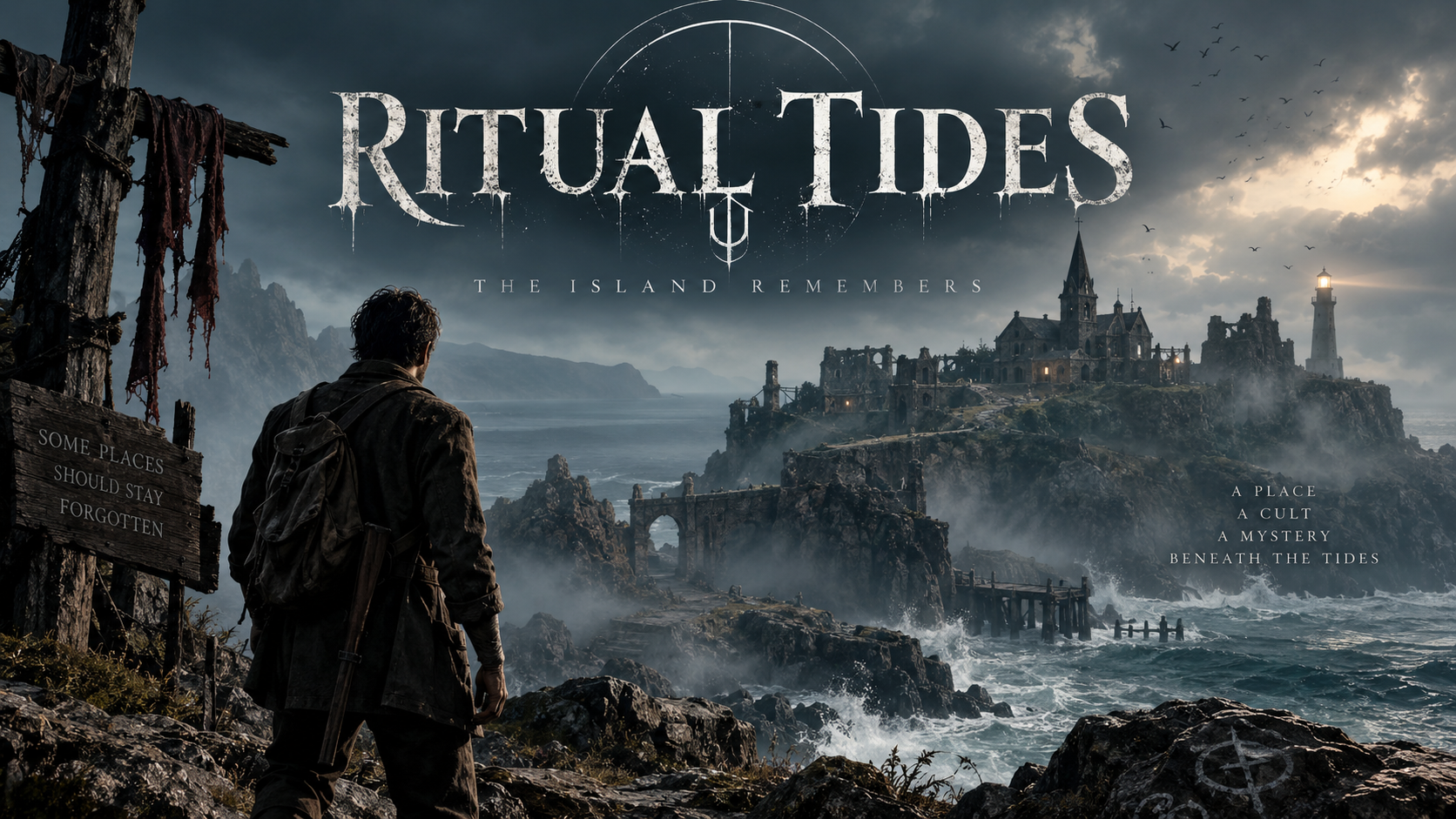
Ritual Tides: Complete Guide, Combat, Exploration, Survival, Secrets and Story
This complete guide to Ritual Tides brings together everything you need to know about the psychological survival horror experience set on the mysterious island of Hortus. Here you will find detailed advice about exploration, climbing, combat, stealth, ammunition management, resources, enemies, the Fallow Parish cult, Mother Hortus, Malcolm, environmental storytelling and the mysteries surrounding the island.
What Is Ritual Tides?
Ritual Tides is a psychological horror and survival horror game developed by Vertpaint. It takes place on the mysterious British island of Hortus, an isolated location surrounded by a hostile sea and hidden beneath an atmosphere of fog, decay and uncertainty.
The experience combines exploration, environmental storytelling, stealth, scarce-resource survival and limited combat. Rather than turning the protagonist into an unstoppable action hero, the game is designed around vulnerability. Ammunition matters, weapons are not always reliable and many situations are better approached by observing, hiding or finding another route instead of fighting.
One of the most important aspects of Ritual Tides is its emphasis on physical interaction with the environment. Climbing requires the player to control each hand independently, while narrow surfaces require careful balance. Even apparently simple traversal sections can become dangerous when the character is being pursued or when visibility is reduced by fog and darkness.
Ritual Tides in a nutshell
- Genre: Psychological horror, survival horror, action and adventure.
- Setting: The isolated island of Hortus.
- Main themes: Memory, cults, transformation, isolation, faith and the unknown.
- Gameplay: Exploration, stealth, climbing, traversal, environmental interaction and limited combat.
- Main threat: The Fallow Parish and the creatures connected to the island’s dark secrets.
- Narrative focus: Discovering why Hortus exists and what happened to its inhabitants.
The Island of Hortus
Hortus is much more than a conventional horror setting. The island itself is one of the central characters of Ritual Tides.
According to the game’s premise, Hortus was never supposed to exist. There are no reliable records placing it on ordinary maps, and ships do not seem to pass close enough to the island to explain how its inhabitants have survived there. The player arrives after washing ashore with no clear memory of how they reached the island.
This creates an important narrative contradiction. Hortus appears isolated from the outside world, yet it contains traces of human occupation, religious activity, abandoned structures and a community that seems to have its own traditions, beliefs and history.
The environment is deliberately designed to feel old, hostile and physically authentic. Natural surfaces, rocks, vegetation, soil and other terrain elements have been created with detailed photogrammetry references from English and Scottish landscapes, helping the island feel grounded in a recognizable British environment before the supernatural elements become more prominent.
The coastline
The coastline is one of the most distinctive areas of Hortus. Rocky cliffs, rough water, ruined structures and thick fog create a setting where the player is constantly forced to judge distances and possible routes.
The sea also reinforces the sensation of isolation. It is not simply scenery in the background. It serves as a constant reminder that there is no easy escape from the island.
Why Hortus is dangerous
Hortus combines several different types of danger:
- The terrain can make traversal difficult.
- Visibility can be reduced by fog and darkness.
- Supplies are limited.
- Enemies may force the player away from a safe route.
- The island contains a hostile cult.
- The player does not initially understand what happened there.
The result is an environment where simply moving from one area to another can become an important part of the horror experience.
The Story and Central Mystery
The protagonist awakens after reaching the shore of Hortus without a clear memory of what happened. Almost immediately, the game establishes that the island is not a normal place.
A character named Malcolm becomes an important part of the early narrative, offering assistance while the protagonist tries to understand where they are and why they cannot remember their past.
At the same time, the player begins to encounter references to the Fallow Parish, a group whose beliefs revolve around ideas of devotion, salvation and a mysterious figure or entity known as Mother Hortus.
The narrative deliberately avoids explaining everything at once. The central questions grow as the player progresses:
- Why does Hortus exist?
- Why is the island absent from ordinary records?
- What happened to its inhabitants?
- Who or what is Mother Hortus?
- Why does the Fallow Parish worship or follow her?
- What happened to the creatures that now inhabit the island?
- Why has the protagonist lost their memory?
First Steps in Ritual Tides
The beginning of Ritual Tides should be approached carefully. The game is designed around uncertainty, so rushing forward and treating every encounter as a conventional action-game sequence can quickly create problems.
Observe before moving
When entering a new location, stop for a moment and look around. Check possible paths, elevated surfaces, doorways, gaps between rocks, cover and objects that appear intentionally placed.
The game encourages environmental reading rather than relying exclusively on traditional interface markers.
Do not waste ammunition
One of the most important survival rules is simple: do not assume that every enemy should be killed.
Ritual Tides treats ammunition as a valuable resource. Every shot can become important later, particularly because weapons do not automatically turn the protagonist into a dominant combatant.
Listen carefully
Sound can provide information before visual confirmation. Footsteps, distant movements, environmental noises and changes in the atmosphere can help you determine whether an area is safe or whether something is approaching.
Exploration and Navigation
Exploration is one of the pillars of Ritual Tides. The game does not appear to be designed around a constant stream of explicit markers telling the player exactly where to go.
Instead, the environment itself becomes part of the navigation system.
How to avoid getting lost
Pay attention to distinctive landmarks. Large rock formations, buildings, cliffs, ruined structures and unusual vegetation can help you mentally divide the island into recognizable areas.
Also remember where you found resources, difficult encounters or suspicious locations. Even without a traditional map, environmental memory can become an important survival tool.
Look for environmental routes
Ritual Tides encourages players to look vertically as well as horizontally. A blocked path at ground level does not necessarily mean that the route ends there.
Inspect rock faces, ledges, damaged structures and elevated platforms for possible traversal opportunities.
The game uses environmental clues rather than relying exclusively on brightly coloured navigation objects. This makes observation more important and helps maintain immersion.
Climbing and Traversal
Climbing is one of the most distinctive gameplay systems shown in Ritual Tides.
The system is designed around controlling both hands independently. Rather than simply pressing a button to automatically climb a surface, the player must manage individual grips and make decisions about which hand should move and where the next grip is located.
Basic climbing strategy
When approaching a climbable surface, slow down. Look for available handholds and consider the sequence of movements before committing to the climb.
Keeping your balance and controlling both hands correctly is more important than speed.
Do not climb blindly
A common mistake is assuming that every visible ledge is safe. Before committing to a climb, inspect the area above and around you whenever possible.
Running out of stable grips can leave the protagonist exposed or cause a fall.
Climbing during a chase
Traversal becomes substantially more stressful when enemies are nearby. A route that feels simple while exploring can become difficult when the player is under pressure.
This is another reason not to treat climbing as a purely mechanical action. Positioning and preparation matter.
Stealth
Stealth is an important survival option in Ritual Tides because combat resources are limited and some encounters are more dangerous than they initially appear.
The basic principle is straightforward: avoid unnecessary attention.
Use the environment
Rock formations, structures, narrow paths and terrain can provide opportunities to break line of sight or alter an enemy’s approach.
Do not assume that hiding always means standing still. Sometimes the best stealth decision is simply choosing another route.
Observe enemy movement
Before moving through a dangerous area, study what is happening around you. Learn when an enemy is looking away, where it tends to move and which spaces provide alternatives.
This reduces the chance of being forced into a desperate combat encounter.
Combat and Weapons
Combat exists in Ritual Tides, but it is deliberately restrained. The game does not attempt to transform its horror experience into a conventional shooter.
Weapons can be unreliable, ammunition is scarce and encounters are designed to maintain tension.
When to fight
Combat makes sense when an enemy blocks a critical path, when there is no safe alternative or when taking a controlled shot creates an opportunity to escape.
When not to fight
If you can avoid an enemy without spending ammunition or exposing yourself to unnecessary damage, stealth is usually the more efficient choice.
Firearms are not a guarantee of safety
The game emphasizes weapon handling and reliability rather than making firearms feel like magical solutions to every threat. This helps preserve the vulnerability central to the survival horror experience.
Resources and Survival
Resource management is one of the most important aspects of Ritual Tides.
Exploration can reward the player with food, ammunition and other supplies, but these resources should be treated as valuable rather than disposable.
| Resource | Best approach |
|---|---|
| Ammunition | Save it for unavoidable or dangerous encounters. |
| Food | Use it thoughtfully rather than consuming resources immediately. |
| Supplies | Search abandoned areas and secondary locations carefully. |
| Safe routes | Remember useful paths so you do not waste resources on unnecessary detours. |
Creatures and Threats
The creatures of Ritual Tides are closely connected to the island’s mystery.
The game deliberately presents them as more than simple enemies. One of the most important narrative ideas is that these creatures may have once been something else.
That suggestion changes the way the player interprets them. They are not merely obstacles. They may be evidence of what happened on Hortus.
Study behaviour instead of memorising health bars
Because the game prioritizes tension over arcade-style combat, understanding how an enemy behaves can be more useful than trying to calculate how many shots it requires.
Look for movement patterns, sounds, territorial behaviour and environmental clues.
The Fallow Parish
The Fallow Parish is one of the central factions in Ritual Tides.
The group is associated with themes of devotion and salvation, and its beliefs are deeply connected to the mythology surrounding Mother Hortus.
Rather than being presented simply as a group of hostile humans, the Fallow Parish represents the ideological and spiritual side of the island’s mystery.
How to approach the cult
Do not assume that every encounter with the Fallow Parish should immediately become a fight.
Their presence also functions as a narrative tool. Their behaviour, symbols, language and locations may provide clues about the history of Hortus.
Whenever you encounter evidence connected to the Parish, pay attention to the surrounding environment. Important story information may be communicated through the location itself rather than through a traditional exposition scene.
Who or What Is Mother Hortus?
Mother Hortus is one of the greatest mysteries in the game.
The Fallow Parish speaks about Mother Hortus in terms associated with devotion and salvation, but the true nature of this figure or entity remains part of the central mystery of the story.
At this stage, the safest way to approach the character is to distinguish between what the game establishes and what can only be interpreted by the player.
Malcolm
Malcolm plays an important role in the protagonist’s early experience on Hortus.
After the protagonist wakes without their memories, Malcolm becomes a source of assistance and information. His role is especially important because he provides another perspective on the island and helps establish the relationship between the player character and the wider mystery.
However, the presence of another character should not automatically be interpreted as proof that everything they say is true. Horror stories built around memory loss, isolated communities and cult beliefs naturally encourage the player to question what they are told.
Secrets and Environmental Clues
Ritual Tides relies heavily on environmental storytelling.
This means that secrets may not always appear as traditional collectibles with obvious notifications. Instead, they can be communicated through architecture, ruins, symbols, objects, traces of human activity and unusual environmental details.
What should you look for?
- Unusual markings on rocks or structures.
- Religious symbols and signs.
- Abandoned buildings.
- Objects that appear intentionally positioned.
- Environmental changes that suggest human activity.
- Areas that look difficult to reach.
- Objects or locations that appear connected to the Fallow Parish.
Do not rush through abandoned locations
One of the advantages of exploring carefully is that abandoned locations can provide context even when they do not produce immediate rewards.
A room may tell you something about the people who occupied it, while a ruined structure may reveal how the island changed over time.
Puzzles and Progression
Because Ritual Tides is still a developing project, it would be misleading to publish a complete mission-by-mission puzzle solution as though every element were already final.
What can be said with confidence is that exploration and environmental interaction are central to progression.
Players should therefore expect to solve problems by observing the surroundings, understanding routes, interacting with the environment and paying attention to clues.
How to approach a difficult section
When you feel stuck, resist the temptation to search randomly through the entire area.
Instead, return to the last location where the game gave you meaningful information. Check nearby objects, examine alternative paths and consider whether the intended solution requires vertical traversal rather than a conventional doorway.
Advanced Survival Tips
Think before using ammunition
Always ask yourself whether the enemy actually needs to die. A successful escape without spending ammunition is often the better result.
Do not ignore your surroundings
Environmental details are not merely decorative. Rocks, cliffs, ruins and structures can influence where you can move and how encounters develop.
Remember useful routes
When you find a safe route or an area rich in supplies, remember it. Returning to known territory can be much safer than wandering through unknown terrain while under pressure.
Use sound as information
A quiet environment does not necessarily mean safety. Likewise, hearing something nearby does not always mean combat is unavoidable.
Control panic
One of the game’s greatest challenges is psychological. A player who reacts impulsively to every sound, movement or pursuit can waste resources very quickly.
Slow down whenever the situation allows it.
Chases and Dangerous Traversal Sections
Ritual Tides can make traversal significantly more difficult when the protagonist is being pursued.
During a chase, the player must think about more than simple movement. Narrow paths, climbing sections and balancing challenges become more dangerous because fear and pressure encourage mistakes.
The best preparation for these sequences is learning how the environment works before an enemy forces you to use it quickly.
Sound and Atmosphere
Sound is one of the strongest tools in psychological horror, and Ritual Tides uses the isolated nature of Hortus to reinforce this effect.
Wind, waves, distant movement and changes in ambient sound can make seemingly empty areas feel threatening.
Do not immediately assume that every noise is an enemy. Sometimes the game uses sound to create uncertainty rather than deliver a direct gameplay warning.
Mist, Lighting and Visibility
The foggy coastal environment is an important part of the game’s visual identity.
Reduced visibility can make routes difficult to recognize, obscure distant landmarks and increase the sense that something may be nearby without actually showing it.
This creates an important survival principle: do not depend entirely on what you can see at a distance.
When visibility is poor, slow down, use nearby landmarks and rely more heavily on sound and environmental structure.
Psychological Horror and Fear
Ritual Tides is not built exclusively around jump scares. Its horror comes from uncertainty, isolation, disturbing implications and the feeling that the player does not fully understand the world around them.
The island itself creates tension because there is no comforting sense of civilisation nearby.
Every discovery raises additional questions. Every apparently safe area can contain clues that change the player’s interpretation of previous events.
The Victorian and British Horror Atmosphere
The presentation of Hortus draws strongly from the visual language of isolated British coastal environments, old religious structures and bleak rural landscapes.
This aesthetic is important because the horror does not need to look obviously supernatural at all times. Ordinary locations can become disturbing when surrounded by fog, decay, isolation and strange symbols.
The result is an atmosphere closer to slow-burn psychological horror than to constant action.
Environmental Storytelling
One of the best ways to understand Ritual Tides is to stop treating the environment as decoration.
A ruined building can tell you that something happened there. A path blocked by debris can suggest a change in the island’s history. Religious imagery can reveal what the Fallow Parish believes. A damaged structure can suggest that the community did not disappear peacefully.
These details may be just as important as traditional dialogue.
How to Approach the Fallow Parish
The Fallow Parish should be treated as both a gameplay threat and a narrative source.
When you encounter their territory, look for signs that explain how they use the environment. Religious spaces, symbols, objects and patterns of occupation may provide valuable clues about the island.
Whenever possible, avoid entering hostile territory without first considering escape routes.
Preparing for an Expedition
Before exploring an unknown part of Hortus, check your supplies and think about what kind of danger you are likely to encounter.
| Preparation | Why it matters |
|---|---|
| Check ammunition | Avoid entering dangerous areas without enough options for emergencies. |
| Study the route | Identify cliffs, narrow paths and possible escape routes. |
| Look for landmarks | Helps maintain your orientation. |
| Observe the environment | Possible clues may be hidden in plain sight. |
The Right Mindset for Playing Ritual Tides
The best way to experience Ritual Tides is to accept that not everything will make sense immediately.
You are not supposed to understand Hortus after the first few minutes. The protagonist does not understand the island, and the player is deliberately placed in the same position.
Try to treat uncertainty as part of the experience rather than as a problem.
What Makes Ritual Tides Different?
Several design elements help distinguish Ritual Tides from more traditional horror games.
- Physical traversal: climbing and balancing require direct interaction rather than simple contextual animations.
- Limited resources: ammunition and supplies matter.
- Environmental storytelling: the world itself provides information.
- Psychological horror: uncertainty and atmosphere are central.
- Isolated setting: Hortus creates a powerful sense of separation from the outside world.
- Limited combat power: weapons are useful but do not eliminate vulnerability.
Story, Revelations and Endings
One of the most important points when discussing Ritual Tides is separating confirmed story information from speculation.
The game establishes the protagonist’s memory loss, the mysterious island of Hortus, Malcolm’s involvement, the Fallow Parish and the presence of Mother Hortus. It also strongly suggests that the creatures encountered by the player are connected to a previous human or biological state.
However, it would be misleading to invent a complete list of endings, final decisions, secret routes or definitive explanations before those details are formally established.
Recommended Strategy for a First Playthrough
For your first playthrough, prioritize discovery over speed.
Explore carefully, conserve ammunition, pay attention to environmental clues and do not assume that every problem requires a combat solution.
When you discover an area that seems important, take the time to examine it. Horror games often hide their most meaningful information in places that are easy to ignore when rushing forward.
Ritual Tides Survival Guide at a Glance
| Situation | Recommended action |
|---|---|
| You hear an enemy | Do not immediately fire. Observe first. |
| You find ammunition | Treat it as a valuable resource. |
| You reach a cliff | Look for grips and alternative routes. |
| You get lost | Return to a known landmark and reassess the area. |
| You encounter the cult | Look for an escape route before committing to combat. |
| You discover a strange symbol | Inspect the surrounding environment for context. |
Frequently Asked Questions About Ritual Tides
What is Ritual Tides?
Ritual Tides is a psychological survival horror game set on the mysterious island of Hortus. It combines exploration, stealth, limited combat, climbing, traversal and environmental storytelling.
Where does Ritual Tides take place?
The game takes place on Hortus, an isolated British island that appears to have no normal place on conventional maps.
Who is Mother Hortus?
Mother Hortus is a mysterious figure or entity connected to the beliefs of the Fallow Parish. Her true nature is part of the game’s central mystery.
Who are the Fallow Parish?
The Fallow Parish is a religious group connected to the island and to the worship or reverence of Mother Hortus. The group represents one of the main human threats in the story.
Who is Malcolm?
Malcolm is a character who helps the protagonist after they awaken on Hortus without their memories. His role is closely connected to the early story.
Is combat important in Ritual Tides?
Combat exists, but it is not designed as the main focus. Ammunition is limited and weapons do not remove the player’s vulnerability.
Should I save ammunition?
Yes. Resource management is an important part of the survival experience, so unnecessary shooting can make later encounters more difficult.
Does Ritual Tides have climbing?
Yes. Climbing is one of the game’s notable traversal mechanics, with the player controlling both hands and managing individual grips.
Is stealth useful?
Yes. Avoiding enemies can often be more efficient than fighting them, especially when ammunition is scarce.
Is there a complete puzzle walkthrough?
A fully verified mission-by-mission puzzle solution should not be treated as definitive until all systems and story sequences are formally established. The game clearly places significant emphasis on environmental interaction and exploration.
What are the main inspirations for Ritual Tides?
The game has been presented alongside inspirations that include Amnesia: The Dark Descent, Resident Evil Village, Silent Hill and the work of H. P. Lovecraft.
Is Ritual Tides focused on psychological horror?
Yes. The game combines physical danger with isolation, uncertainty, disturbing environmental details and a mystery that unfolds gradually.
Conclusion
Ritual Tides is built around a simple but effective horror concept: place the player in an isolated environment where almost nothing is fully understood and survival depends as much on observation as on combat.
Hortus provides the perfect setting for that philosophy. Its cliffs, fog, coastline, ruins and abandoned structures create a world that feels physically believable while hiding something much darker underneath.
The Fallow Parish, Mother Hortus, Malcolm and the mysterious creatures all contribute to a narrative in which answers are deliberately incomplete. The protagonist has lost their memory, the island does not appear to belong in ordinary geographical records and the creatures may have once been something entirely different.
From a gameplay perspective, the most important lesson is to remain cautious. Conserve ammunition, observe enemy behaviour, read the environment, learn the terrain and avoid unnecessary confrontation.
The climbing and traversal systems reinforce the same philosophy. Movement is not simply a way to connect one combat arena to another. Getting from one place to another can itself become a source of tension, especially when visibility is poor or an enemy is nearby.
For players who enjoy atmospheric survival horror, environmental storytelling and stories built around mysterious isolated locations, Ritual Tides offers a particularly intriguing combination of exploration and psychological horror.
Final Survival Rules
Explore carefully.
Conserve ammunition.
Listen to your surroundings.
Study climbing routes before committing.
Use stealth whenever possible.
Remember important landmarks.
Treat environmental clues as part of the story.
And above all, remember that on Hortus, not everything is what it seems.