

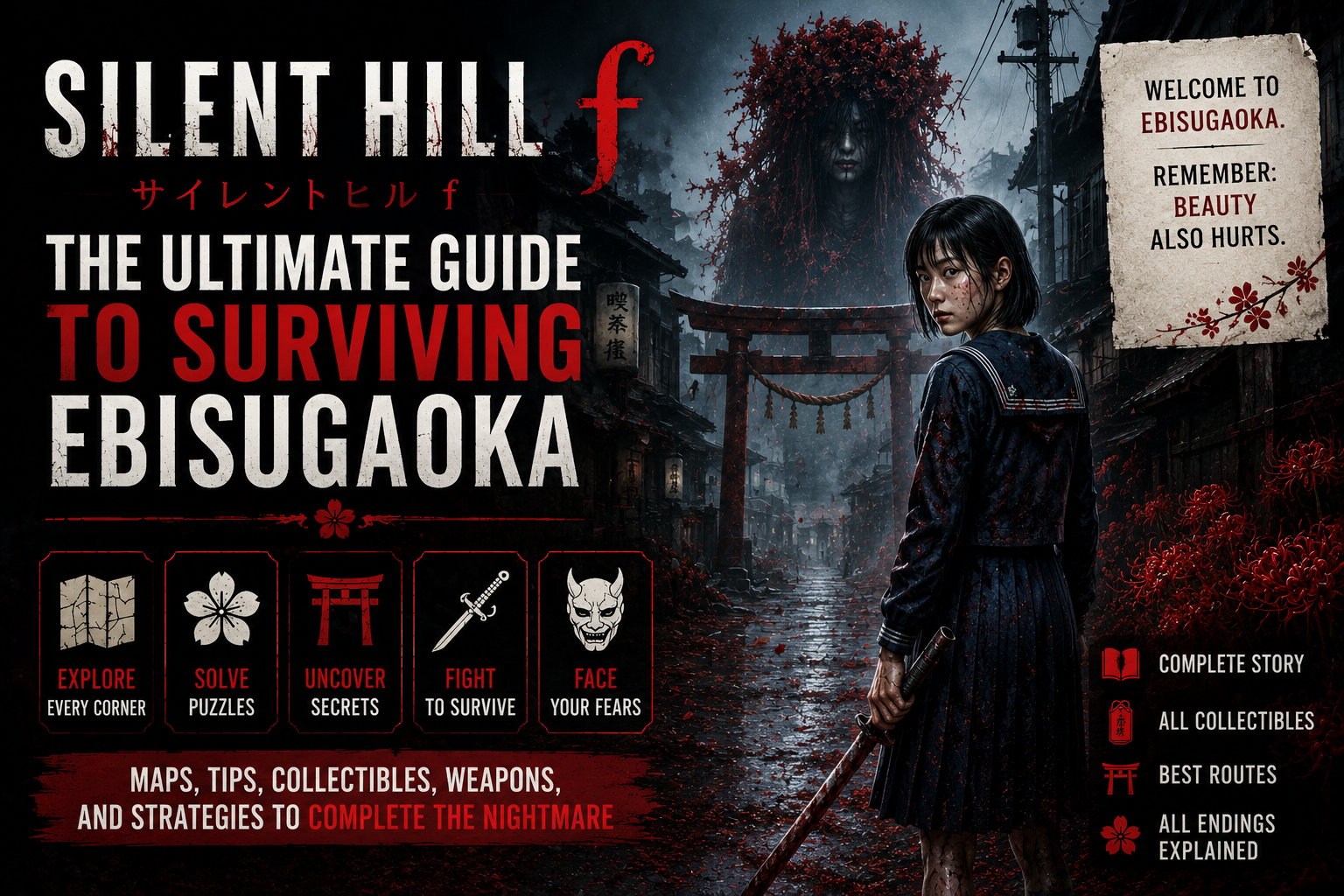
Complete guide · Combat, sanity, and endings
Silent Hill f: the definitive guide to surviving Ebisugaoka
Everything you need to beat the game: how to master melee combat without firearms, manage health, stamina, and sanity, solve every puzzle, defeat the bosses of the Dark Shrine, and unlock all five endings.
Fact sheet
| Developer | NeoBards Entertainment |
| Publisher | Konami Digital Entertainment |
| Release date | September 25, 2025 |
| Platforms | PlayStation 5, Xbox Series X|S, PC |
| Genre | Survival horror |
| Game mode | Single player |
| Direction | Al Yang |
| Production | Albert Lee (senior producer), Motoi Okamoto (franchise producer) |
| Writing | Ryukishi07 |
| Music | Akira Yamaoka (Fog World), Kensuke Inage (Otherworld) |
After years of reboots, remakes, and spin-offs of uneven quality, Konami decided to gamble on something radically different to revitalize its most iconic horror franchise: hand a brand-new entry to the Taiwanese studio NeoBards Entertainment and put it in the hands of a writer with no background whatsoever in shooters or traditional action games. Silent Hill f abandons the foggy North America of the classic entries to move the horror to Ebisugaoka, a fictional Japanese village set in the 1960s, and replaces guns and hospital corridors with a high school student, a village consumed by fog, and a melee combat system that openly recalls the «soulslike» genre.
The protagonist, Hinako Shimizu, doesn’t fire a single bullet in the entire game: she survives by dodging, parrying blows with everyday objects turned into weapons, and carefully managing three constantly depleting resources — health, stamina, and sanity — while the narrative digs into her family conflicts, an arranged marriage she doesn’t want, and the secrets the village itself is hiding. This guide brings together everything you need to survive that experience: how combat without firearms works, solutions to the most important puzzles, strategies against every boss in the Dark Shrine, and, notably, how to unlock each of the game’s five endings, one of the aspects that generates the most confusion among players.
It’s worth placing this release within the franchise’s recent trajectory: after years of spin-offs, remakes of mixed quality, and a failed attempt to revive the series through P.T., a cancelled project that left a deep mark on the community, Silent Hill f represents Konami’s boldest gamble in a long time. Rather than fall back on proven formulas, the company chose to entrust the project to a team with a completely different narrative and gameplay sensibility, betting on radical differentiation from what players expected instead of offering a safe continuation. This guide is designed precisely to help navigate that creative risk without dying more times than strictly necessary.
Before continuing, a practical warning: this guide includes concrete puzzle solutions, detailed boss strategies, and a full explanation of the ending system, so it inevitably contains some progression details. If you’d rather discover the game with no strings attached, the sections on technical requirements, editions, and critical reception are completely safe to read without fear of spoilers.
From reveal to Ebisugaoka: the development of Silent Hill f
The road to Silent Hill f began in February 2021, when Konami publicly announced its intention to revive the franchise by collaborating with several outside studios rather than developing every new entry in-house. That announcement took shape in October 2022, when the company officially unveiled several projects tied to the series, including the one that would eventually become this entry. The reveal trailer for Silent Hill f didn’t arrive until March 2025, and in August of that same year Konami held an expanded hands-on media event in Tokyo for outlets such as IGN, Polygon, and GameSpot, an unusual step that reflected the company’s confidence in the project.
The most talked-about decision of the development process was, without a doubt, the choice of Ryukishi07 as lead writer, best known as the creator of the visual novel Higurashi When They Cry. It’s a profile completely removed from the action or shooter games that had dominated much of the series’ previous entries, and that decision was deliberate: Konami has explained on several occasions that it was aiming for «100% Japanese horror,» with the explicit intent of restoring an essence to the franchise that it felt had been diluted after years of entries developed mostly by Western studios. The game’s own setting, the fictional village of Ebisugaoka, was directly inspired by Kanayama, a real district of the town of Gero, in Gifu Prefecture.
The development team was rounded out by director Al Yang, senior producer Albert Lee, franchise producer Motoi Okamoto, artist Kera — responsible for character and monster design — and a music team led by Akira Yamaoka, the franchise’s long-standing composer, in charge of the «Fog World» score, alongside Kensuke Inage handling the soundtrack for the «Otherworld,» with additional contributions from Dai and Xaki. Following its release on September 25, 2025, the game also arrived DRM-free on GOG.com on October 7 of that same year, an unusual move for a release of this scale that was well received by part of the PC audience.
Akira Yamaoka’s involvement deserves a mention of its own, since his musical signature has for years been one of the series’ most recognizable elements since the earliest PlayStation entries. His return to compose the «Fog World» — the relatively recognizable version of the village of Ebisugaoka — builds a direct sonic bridge between this new entry and the franchise’s classic sound legacy, while bringing in Kensuke Inage for the «Otherworld» sections introduces a more modern, dissonant sensibility, consistent with the specifically Japanese aesthetic Konami was aiming for with this project. This blend of continuity and renewal in the sound department reflects, in a way, the same philosophy that guided the rest of the game’s development.
The choice of NeoBards Entertainment as the developing studio wasn’t accidental either. The Taiwanese studio already had prior experience collaborating on horror and action productions for other Japanese companies, which gave Konami the assurance of a technically capable team without needing to divert internal resources that the company had spread across other simultaneous projects tied to revitalizing the Silent Hill brand, including the Silent Hill 2 remake and other productions announced in the same October 2022 package. This strategy of distributing development across several outside studios, coordinated from the top by franchise producer Motoi Okamoto, has allowed Konami to advance on several fronts of the franchise simultaneously without relying on a single overburdened in-house team.
Key fact
Silent Hill f was the first title in the series to fully abandon firearms as a combat option, replacing them with an arsenal of everyday objects — bats, pipes, farming tools — consistent with the rural 1960s setting of Ebisugaoka.
Plot, setting, and characters (no story spoilers)
The story follows Hinako Shimizu, a high school student who watches her hometown, Ebisugaoka, suddenly become wrapped in a thick fog that brings monstrous creatures and a distorted, nightmarish version of the village itself. As Hinako tries to understand what is happening, the plot reveals increasingly personal layers of her life: deep tensions within her family, doubts about her own identity, and, centrally, an arranged marriage to a character named Kotoyuki, tied to the powerful Tsuneki clan, that Hinako wants no part of.
Without giving away specific plot twists, it’s worth noting that Silent Hill f builds its narrative in a way that is very characteristic of the series: nothing is entirely literal, and much of what Hinako experiences and perceives ultimately turns out to be ambiguous or outright subjective, in line with what fans expect from the franchise’s best entries. The game’s multiple-ending structure, explained in detail later in this guide, is directly connected to that narrative ambiguity: each ending offers a different interpretation of the events experienced by the protagonist.
Hinako Shimizu: a protagonist without firearms
Voiced in Japanese by Konatsu Kato and in English by Suzie Yeung, Hinako is a protagonist deliberately far removed from the seasoned soldiers, police officers, or investigators who usually led the series. She’s a teenager with no combat training, and that vulnerability translates directly into the gameplay design: she can’t fight in melee without a weapon in hand, and much of her arsenal consists of improvised objects that degrade with use, reinforcing the sense of constant fragility the series has pursued since its origins.
The red capsules: the piece that reframes the whole story
Without giving away the specifics of how it’s revealed, it’s worth noting that multiple playthroughs and alternate endings point toward a very different reading of everything Hinako goes through: the events of the adventure themselves could be interpreted as a psychotic episode induced by red capsules that the protagonist consumes at some point in the story. This deliberate ambiguity between the supernatural and the psychological is precisely the ground where the Silent Hill series has always felt most at home, and Silent Hill f exploits it fully through its multiple-ending structure, where each outcome offers a different piece of that same interpretive puzzle.
The cast surrounding Hinako
Orbiting the protagonist is a group of characters whose relationship to the village’s reality grows increasingly ambiguous as the story progresses: Shu, Rinko, and Sakuko, her high school friends; Junko, her older sister, with whom she has a tension-filled relationship; and a masked figure known as the Fox Mask, directly tied to Kotoyuki and the Tsuneki clan, who serves as the game’s central antagonistic threat. Several of these characters reappear, in distorted and threatening forms, as part of the very bestiary of monsters Hinako must face in the Dark Shrine, a narrative device the series had already explored in previous entries but which carries an especially strong symbolic weight here.
This reappearance of people close to Hinako as deformed monsters isn’t a simple shock device: it functions as a direct manifestation of the emotional conflicts the protagonist carries toward each of them, a design principle the Silent Hill series has been exploring since its second entry and which here is transplanted into the very specific context of rural Japanese folklore and the family and social pressures that define Hinako’s life in Ebisugaoka. Paying attention to the visual details of each of these transformations, without needing to fully understand them the first time around, tends to reward those who complete the game more than once and compare the different pieces of information each ending offers.
Melee combat without firearms: how it works
The combat system is, alongside the setting, the element that most sets Silent Hill f apart from the rest of the series. Instead of the usual pistols and shotguns, Hinako relies exclusively on improvised melee weapons, with a combat structure that openly recalls the formula popularized by «soulslike» games: dodges with tight timing windows, parries that demand precise timing, light and heavy attacks that combine into different sequences, and a weapon-degradation system that forces you to rotate your available arsenal instead of always clinging to the same tool.
In addition to conventional melee combat, Hinako has access to a special resource known as the focus attack, activated by holding down the controller’s left trigger to charge it. This attack directly consumes the protagonist’s sanity meter, but in exchange deals considerably more damage than normal attacks and staggers the enemy it hits. It’s a high-risk, high-reward resource: if the enemy manages to interrupt the charge before it completes, both Hinako and the monster itself take damage, so it’s best saved for the right moment rather than triggered automatically in every fight.
The three-meter system: health, stamina, and sanity
Unlike most action games, Silent Hill f manages three simultaneous resources instead of just one. Health works as you’d expect, dropping with every hit taken and recoverable through healing items. Stamina is consumed by dodging, attacking, and running, limiting how many actions in a row you can chain before needing a defensive pause. Sanity, meanwhile, is the system’s most distinctive resource: it drains from using focus attacks, from certain tense narrative events, and, in some cases, simply from prolonged exposure to the most hostile areas of the Otherworld, and managing it affects both combat performance and, as the development team itself has explained, certain narrative and atmospheric elements of the game.
Of the three meters, stamina is probably the one that ruins the most runs for players coming from other action genres, since running out of stamina in the middle of a dodge sequence leaves you completely exposed at a critical moment. The practical solution is to avoid chaining more than two or three actions in a row without leaving a small margin for recovery, especially against enemies that combine several consecutive attacks: it’s better to dodge a hit, take a step back, and assess the situation before immediately launching into a counterattack that could leave you without stamina right when you need it most.
Weapon degradation: why rotating your arsenal matters
An element that surprises many players used to other action games is that Hinako’s melee weapons degrade with continued use, progressively losing effectiveness until they’re practically useless. This forces a much more active approach to inventory management than in most games in the genre: instead of clinging to your favorite weapon for the whole playthrough, it’s best to alternate between the different tools available based on their wear, saving weapons in better condition for the more demanding fights, such as boss encounters, and using the more worn ones against lower-risk common enemies.
This degradation system also serves a narrative purpose beyond the purely mechanical: it constantly reinforces the sense that Hinako is not a seasoned warrior with an inexhaustible arsenal, but a teenager defending herself with whatever she finds at hand, and that this very material breaks, bends, or dulls after prolonged use, just as it would in a real situation. Accepting that fragility as part of the design, rather than getting frustrated by it, helps you enjoy the game’s overall gameplay proposition more fully.
The Faith system and omamori
Hinako’s progression revolves around two interconnected systems. The first is Faith, a currency that accumulates by offering items at the shrines scattered throughout the village and is used to unlock permanent upgrades to health, stamina, sanity, or the number of omamori slots, as long as you also have the specific Ema tablets required for each particular upgrade. The second are the omamori themselves, protective charms that grant special passive or active abilities, obtained both by finding them directly around the world and by getting them at random from the shrines themselves. Equipping the right combination of omamori for the situation — resistance to a specific type of damage, sanity regeneration, increased focus damage — is one of the most important strategic decisions at every stage of the game.
When deciding where to invest accumulated Faith, the general recommendation is to prioritize the health meter first during the early hours of the game, since a larger health margin forgives more mistakes while you’re still learning each enemy’s attack patterns. Once dodge and counterattack timing starts to feel more natural, redirecting upgrades toward stamina or additional omamori slots tends to provide more practical benefit than continuing to invest exclusively in health, since by then you’ll be taking fewer hits anyway.
Pro tip
Praying at shrines doesn’t just let you save your game: it’s also the only time you can spend Faith and Ema tablets on permanent upgrades. Before leaving any area with a shrine, check whether you have enough resources for an upgrade before moving on, since it’s not always clear when the next prayer point will show up.
Essential tips for survival
Combat: master the dodge and counterattack before anything else
The single most valuable trick in the entire combat system is mastering the timing of the dodge and, above all, the counterattack: a well-executed counterattack deals considerable damage and staggers the enemy, and mastering this mechanic radically changes the perceived difficulty of the rest of the game. On Story difficulty, the most accessible option available, most common enemies fall to a heavy attack followed by three light hits, a combination worth automating as soon as possible. Timing heavy attacks to land right as the enemy closes in, rather than throwing them out blindly, also noticeably improves their effectiveness.
It’s worth spending time practicing this timing against the game’s early enemies, who are deliberately slower and more predictable than the ones you’ll face later. Treating those first few hours as a kind of extended combat tutorial, rather than simply running from encounter to encounter, lays a solid foundation that especially pays off during the Final Path, where the margin for error shrinks considerably and boss attack patterns demand a much more precise read than common enemies do.
Not every fight is worth having
Even though combat is central to the experience, not every encounter is mandatory or advisable. Fighting every enemy you come across wears down weapons needlessly and consumes healing resources you might need later, so fleeing encounters with several enemies at once is often the smarter move. Certain enemies, such as the Ara-abare, can resurrect after being defeated, which turns any attempt to eliminate them for good into a waste of time and resources: in those cases, evasion is the only genuinely worthwhile strategy.
Identifying which encounters are worth avoiding becomes more intuitive with practice, but as a general rule, any room with more than two enemies visible at once, or any narrow corridor where you don’t have room to dodge comfortably, is a sign that it’s probably better to route around the obstacle than face it head-on. Level design itself almost always offers an alternate route to bypass these enemy groups without needing to fight, so briefly exploring the edges of each room before committing to a fight can save you valuable resources for the more demanding stretches that come later.
Exploration and resource management
Although Silent Hill f’s level design is mostly linear, thoroughly exploring each area before moving on rewards you with healing items, sanity restoratives, consumables that permanently boost stats, and better weapons than what you’d get by simply following the main path. Keep in mind, too, that some achievements and collectibles can be missed if you don’t explore thoroughly before closing off certain areas, which may force you to replay the corresponding chapter or wait for a New Game Plus run to get them. Checking the map frequently helps you memorize each area’s layout and spot at a glance which paths you’ve already explored and which are still pending.
An important note on inventory management: both healing items and weapons take up limited space, so before any stretch you know will be especially demanding, it’s worth reviewing what you’re carrying and discarding anything clearly redundant. The documents and notes you find scattered around the world deserve a special mention: they don’t take up meaningful inventory space and are logged automatically once read, so there’s no reason not to read every single one as soon as you find them, beyond the extra narrative context they provide about Ebisugaoka’s past and the Shimizu family itself.
Managing sanity
Items like ramune or holy water restore sanity directly, and it’s worth always carrying some in reserve before especially hostile areas or before a boss fight where you’ll likely need to rely on focus attacks. Avoid spending sanity unnecessarily on common enemies you can just as easily defeat with standard melee combat, saving focus attacks for the encounters where they truly make a meaningful difference.
It’s worth mentioning that, unlike health, the sanity meter isn’t always as visually obvious during calm exploration, so it’s worth actively checking it from the menu before entering a new area rather than waiting for a flashy indicator to warn you it’s running low. Entering an important fight with your sanity already depleted seriously limits your ability to fall back on the focus attack right when you might need it most, so treating sanity with the same priority as health, rather than as a secondary resource, is one of the habits that sets smoother playthroughs apart.
Adjust your omamori for each stretch, not once and for all
A common mistake among new players is equipping a combination of omamori at the start of the game and never touching it again for hours. The system is designed for exactly the opposite: before entering an area you know will be especially hostile — the Final Path of the Dark Shrine is the clearest example — check which omamori you have available and prioritize the ones that reinforce your specific weaknesses for that stretch, whether that’s resistance to a type of damage, sanity regeneration, or focus damage bonuses. Switching your loadout frequently, rather than keeping a generic setup for the entire game, has a direct and noticeable impact on the perceived difficulty of each area.
Choose your difficulty wisely
For a first playthrough, Story difficulty is the option recommended almost unanimously by the community: it reduces the frustration that comes from a combat system that, while not excessively complex, does require some practice to handle confidently. The higher difficulties are designed for those who already know the game or for a second run in New Game Plus, where familiarity with each enemy’s patterns offsets the increased demands.
Make the most of the focus attack
The focus attack, which consumes sanity in exchange for a considerably more powerful hit than the rest of Hinako’s arsenal, is one of the most underused tools among first-time players, who tend to save it solely for emergencies instead of working it into their regular combat routine. Using it right after a successful counterattack, when the enemy is already staggered and can’t respond, lets you maximize the damage of each activation without risking a hit while you execute it. Against Final Path bosses, saving at least one or two focus charges for the final stretch of the fight, when their attack pattern usually becomes more aggressive and desperate, often makes the difference between a narrow win and an avoidable loss.
Check your item menu before every major fight
Before entering any room that hints at an upcoming major fight — something level design usually signals through changes in lighting or ambient music — take a moment to review your full inventory from the pause menu. Reassigning healing items and sanity restoratives to quick-access slots, instead of having to dig through the full menu in the middle of a fight, saves seconds that can prove decisive against the game’s more aggressive enemies. This quick pre-check, which takes barely a few seconds, is one of the habits that makes the biggest difference between a smooth playthrough and one marked by avoidable deaths caused by simple inventory disorganization.
Full walkthrough: Ebisugaoka and the Dark Shrine
Spoiler warning
This section details the game’s full structure and mentions the location of every boss. If you’d rather discover the walkthrough without any prior preparation, you can skip straight to the endings section or the technical requirements section further below.
The campaign constantly alternates between two types of environment with very distinct visual and gameplay identities: stretches set in the village of Ebisugaoka as it was before the fog, more focused on exploration, dialogue, and environmental puzzle-solving; and stretches set in the Dark Shrine, the distorted, nightmarish version of the village, where the vast majority of the game’s combat and bosses are concentrated. This alternation repeats throughout the fifteen sections that make up the full adventure.
This alternating-block structure isn’t just a pacing decision: it reinforces the game’s own narrative ambiguity, since it’s never entirely clear to what extent the Ebisugaoka sections represent the protagonist’s objective reality or are already, in themselves, a version filtered through her own altered perception. Keeping that double reading in mind helps you more fully enjoy the twists that appear as the story progresses, without needing to take every scene as a literal, unquestionable fact.
Ebisugaoka Part 1
The introductory section presents Hinako and the first signs that something is deeply wrong in the village. It functions as an extended tutorial for the basic exploration mechanics and the first narrative clues about the protagonist’s family.
Dark Shrine Path
The first incursion into the Otherworld introduces the melee combat system and the first hostile creatures, including the appearance of the Ara-abare, a mass of flesh and vegetation armed with a whip and a large blade that, as mentioned earlier, can resurrect after being defeated: the most efficient strategy here is to avoid it rather than attempt to eliminate it for good.
Ebisugaoka Part 2: the rice paddies
An exploration stretch through the farmland surrounding the village, with several environmental puzzles tied to the era’s farming equipment and new clues about Hinako’s relationship with her family. It’s also one of the first areas where the game begins to subtly drop hints about the ambiguity between what Hinako perceives and what’s actually happening around her, without it yet being obvious to a player approaching the game for the first time.
Dark Shrine Corridors
This stretch houses the fight against the Sakuko-like Entity, a monster armed with a club and a sickle that literally tries to «purify» Hinako during the fight. Keep your distance after each exchange of blows and take advantage of the openings it leaves after its slower attacks to counter safely.
Ebisugaoka Part 3: the road to school
A transitional stretch connecting the residential area to Ebisugaoka’s high school, with new interactions with Hinako’s friends that provide additional context about the family tensions the protagonist is going through.
Ebisugaoka High School
An exploration stretch through the school’s facilities, with several environmental puzzles tied to the building itself and new documentary clues about the village’s and the Shimizu family’s past. Since it’s a multi-story building with corridors that look very similar to one another, it’s worth paying attention to specific decorative details in each classroom — posters, chalkboards, furniture — to avoid losing your bearings while making your way through the school in search of unexplored rooms.
Dark Shrine Worship Hall
This is where the Birthing Monster awaits, a slow, crawling mass of flesh that constantly spawns additional enemies for the duration of the fight. The priority in this encounter is controlling the number of active secondary enemies rather than focusing exclusively on the main boss, since letting them pile up can quickly overwhelm your resources.
Ebisugaoka Part 4: Sugisato Forest
An exploration stretch through the forest surrounding the village, with a notably more isolated and oppressive atmosphere than the previous urban sections, and several optional items relevant to the omamori upgrade system. The lower density of man-made structures in this area makes it easier to get disoriented, so checking the map more often than usual helps avoid needlessly retracing the same paths.
Dark Shrine Main Hall
This stretch pits Hinako against the Rinko-like Entity, armed with burning chains that demand mastering both dodging and constant positioning to avoid getting caught in its attack radius. Moving sideways instead of retreating in a straight line usually gives you more room to maneuver against its chain lunges.
Ebisugaoka Part 5: the road to the Shimizu residence
A short transitional stretch that deliberately ramps up the narrative tension before arriving at the protagonist’s family home, with several additional clues about the background of the arranged marriage to Kotoyuki.
Shimizu Residence
One of the most narratively intense stretches of the game, culminating in a symbolic confrontation against hostile versions of Hinako’s own parents, a direct manifestation of the protagonist’s personal trauma rather than a conventional boss in the traditional sense.
Dark Shrine Treasure Hall
An area focused mainly on optional exploration and gathering additional items and omamori, with a notably lower density of mandatory combat than the rest of the Dark Shrine’s sections. Making the most of this section before moving on is especially worthwhile, since it sits right before the game’s final stretch: any omamori or upgrade material you pick up here arrives just in time to make a real difference in the boss fights waiting ahead.
Getting the most out of each area before moving on
A pattern that repeats across most sections of the game, both in Ebisugaoka and in the Dark Shrine, is that each area rewards an initial exploratory pass before you chase the next story-marked objective. This is especially true in the village-set sections, where you’ll usually find optional interactions with Hinako’s friends and narrative items that deepen the family background without being strictly necessary to progress. Before triggering the next story beat, check the map for areas still not marked as explored, since it’s common for a door closed at the start of an area to open later with an item found in a different room.
Ebisugaoka Part 6: the corrupted village
The village, now nearly entirely overtaken by the Otherworld’s corruption, becomes the setting for the last stretch before the finale. Exploration here especially rewards those looking to gather the last items and upgrades before facing the game’s most demanding sections.
Dark Shrine Final Path
The last major location concentrates the most important encounters in the entire game, including the bosses directly tied to each of the five available endings, detailed in their own section later in this guide. Arriving at this stretch with reserves of healing items, sanity restoratives, and weapons in good condition is the single most important preparation of the entire playthrough.
Pro tip
Before entering the Dark Shrine’s Final Path, check which key items you’ve picked up throughout the playthrough: some endings require a specific item — the Impure Sacred Sword, among others — that’s easy to overlook if you haven’t thoroughly explored the earlier areas.
Common enemies: how to handle them before reaching a boss
Before diving into the details of each boss, it’s worth devoting a section to the regular enemies populating the Dark Shrine, since efficiently handling these encounters is, in practice, what determines whether you reach each boss with weapons in good shape and resources to spare or completely drained. The basic enemies you meet in the early areas of the Dark Shrine follow relatively simple attack patterns and rarely pose a real threat if approached with the dodge-and-counter combination described in the essential tips section, but their true danger appears when they group up or show up in tight spaces where it’s hard to keep the distance you need to dodge comfortably.
In the game’s more advanced areas, variants start appearing with more erratic attack patterns or longer reach than the early enemies, forcing you to adjust the dodge timing you’d already automated. Against these variants, patience is once again the most valuable tool: retreating into a narrow corridor where they can only reach you one at a time is usually more effective than trying to stand your ground in an open room where they can easily surround you. As already mentioned, fleeing an encounter that offers nothing relevant — no items, no narrative progression — remains, in most cases, the most cost-effective decision.
It’s also worth paying attention to the sound design when facing common enemies, since Silent Hill f uses audio as a warning tool far more deliberately than other games in the genre. Certain ambient sounds — dragging footsteps, distorted breathing, a subtle shift in the background music — often signal an enemy’s approach before it’s visible on screen, and learning to recognize these cues gives you a considerable edge in deciding whether to route around an area or brace for an imminent fight. Playing with headphones, if possible, makes a noticeable difference here, since it lets you pinpoint the approximate direction a threat is coming from before it’s on top of you.
Another thing worth keeping in mind is that some common enemies react differently depending on which weapon you have equipped at the time: a longer-reach weapon, like a rod or a staff, lets you keep enemies that try to close distance quickly at bay, while shorter weapons are more effective against single targets in tight spaces where the extra reach offers no real advantage. Switching weapons based on the context of the encounter, instead of always sticking with the same one out of habit, is one of the tactical decisions that separates wasting resources needlessly from clearing a stretch with your inventory practically intact.
Final Path bosses: how to beat each one
The Dark Shrine’s Final Path houses the game’s most important fights, each one tied to a specific ending. Below is a breakdown of each encounter and which ending it unlocks.
How to prepare before this area
Before entering the Final Path, it’s worth taking full stock of your progress: check how many healing items and sanity restoratives you’re carrying, what condition your main weapons are in, and, above all, which omamori you have equipped. Since this area concentrates several fights in a row without many chances to restock in between, it’s better to arrive with resources to spare and use them up during the final stretch itself than to risk running short on healing in the middle of one of the campaign’s most demanding fights.
Shiromuku
A faceless being dressed in a traditional Japanese wedding costume that leads to the «Go Home and Rest» ending, the default outcome of a first playthrough. Its attacks are relatively slow but cover a wide area: prioritize sideways dodges over retreating straight back, and take advantage of the gaps between its combos to slip in light attacks.
As the first truly demanding boss of the Final Path, Shiromuku also functions as a kind of exam on everything learned up to that point: if you manage to get through it without fully draining your healing item stock, that’s a good sign you already have a solid grasp of the combat fundamentals and can approach the rest of the final stretch with some confidence. If, on the other hand, the fight feels like an uphill battle, it may be worth briefly retreating to an already-explored area of the Dark Shrine for extra resources before continuing, rather than forcing your way forward with a depleted inventory.
Tsukumogami
A multi-armed monster that demands much more precise timing and positioning than the rest of the final stretch’s encounters, and which leads to «The Fox’s Wedding» ending. Each of its arms can attack independently, so keep constantly moving instead of standing still dodging one attack at a time.
A strategy that tends to work well against Tsukumogami is visually identifying which specific arm is about to attack and moving perpendicular to its trajectory, rather than trying to anticipate the entire set of limbs at once, which is practically impossible to read accurately. Open spaces favor the player slightly in this fight compared to narrow corridors, since they let you keep more maneuvering room between dodges without getting cornered against a wall or a piece of the environment.
Shichibi: the main final boss
Fast, elusive, and hard to corner, Shichibi is the final boss that requires having obtained the Impure Sacred Sword during earlier exploration. It’s by far the most demanding fight in the entire campaign in terms of reflexes and stamina management: avoid chasing it aggressively when it pulls away, since that’s usually an invitation for a counterattack, and save focus attacks for the brief moments it’s left exposed after finishing one of its own combos.
If you die repeatedly against Shichibi, take a short break before trying again: its movement patterns are memorizable with a calm mind, but the tension built up from several failed attempts in a row tends to lead to misreading its feints and wasting stamina on unnecessary dodges. Arriving at this fight with as many healing items and sanity restoratives as possible is, without question, the most important preparation of the entire playthrough, since there’s no chance to restock once the fight has begun.
Kyubi
Exclusive to a second playthrough in New Game Plus, Kyubi combines an almost occult power with a much faster combat pace than the rest of the game’s bosses, and leads to the «Ebisugaoka in Silence» ending. As content designed for players who already know the combat system inside out, this encounter assumes you’ve already mastered dodge and counterattack timing with no room left for learning on the fly.
Since this fight comes up on a second run, it’s a good time to make use of your accumulated permanent Faith upgrades and the adjusted difficulty options New Game Plus offers: if Kyubi’s pace feels overwhelming even after mastering the rest of the game, temporarily lowering the combat difficulty specifically for this encounter is a perfectly legitimate option that doesn’t penalize the rest of your progress or the ending you’re pursuing.
Silent Hill f’s five endings, explained
One of the aspects that generates the most confusion among players is how to unlock each of the game’s five endings, since the conditions aren’t always obvious on a first playthrough. Below is a summary of each outcome and its general unlock condition, without going into the specific narrative details of each one.
Before getting into the details of each one, it’s worth explaining why this system matters so much to the game’s overall experience. Unlike other entries in the series, where alternate endings usually hinge on specific choices that are easy to miss, Silent Hill f builds its ending system as an additional interpretive layer over the plot itself: each outcome doesn’t just change Hinako’s fate, it reframes the events you’ve already lived through during the playthrough in a different light. For that reason, much of the community recommends watching at least two or three different endings before forming a final opinion on the game’s full story.
«Go Home and Rest»
The default ending, available only during a first playthrough and accessible without needing to meet any special condition beyond completing the main story. It’s the natural entry point for any player approaching the game for the first time.
«The Fox’s Wedding»
Requires having made certain narrative choices throughout the playthrough related to Hinako’s attitude toward her arranged marriage and toward the Fox Mask figure, culminating in the fight against Tsukumogami described in the previous section. Since this ending depends on an accumulation of choices made at different points in the playthrough, rather than a single easy-to-spot decision, it’s worth consciously paying attention to how you respond to Kotoyuki and the Fox Mask every time the story gives you the chance to do so.
«The Fox Wets Its Tail»
An alternate outcome tied to different choices than the ones leading to «The Fox’s Wedding,» which delves into a different interpretation of the relationship between Hinako and the Tsuneki clan throughout the story. Those specifically pursuing this ending usually recommend paying attention to the optional conversations with Junko throughout the playthrough, since Hinako’s attitude toward her older sister appears to noticeably influence which variant of the Tsuneki-clan-linked ending ends up unlocking.
«Ebisugaoka in Silence»
Exclusive to New Game Plus, this ending requires having already completed the game at least once and culminates in the fight against Kyubi. It offers an additional narrative perspective that only makes full sense after having already seen one of the other endings.
«The Great Space Invasion!»
The game’s secret, humorous ending, meant as a lighthearted wink that deliberately contrasts with the oppressive tone of the rest of the campaign. It requires meeting a very specific and unintuitive condition that the community itself has gradually documented since launch, and functions more as an easter egg than a serious narrative outcome.
Why the series keeps betting on multiple endings
Multiple endings aren’t new to this entry: they’ve been part of the franchise’s DNA practically since its first appearance on PlayStation, where the player’s decisions and actions during the playthrough determined which of the available outcomes unlocked upon completing the story. Silent Hill f recovers and expands on that tradition, combining it with the New Game Plus structure to offer one of the most elaborate ending structures the series has had to date, with five outcomes ranging from the most conventional narrative resolution to the purely comedic wink aimed at those who have already seen everything else.
For those wondering in what order to see the different endings, a reasonable approach is to start with «Go Home and Rest» on the first playthrough, since it’s the default outcome and demands the least in terms of specific choices throughout the adventure. From there, using New Game Plus to chase the endings tied to the Tsuneki clan first — «The Fox’s Wedding» and «The Fox Wets Its Tail» — lets you directly compare two different interpretations of the story’s central relationship, leaving «Ebisugaoka in Silence» and the secret ending for the end of the journey, once you already have a full picture of the story from several angles.
Pro tip
If your goal is to see every ending, you don’t need to replay the whole game each time: the New Game Plus system itself preserves much of your progress and access to key decisions, which considerably speeds up getting the remaining endings after your first playthrough.
Silent Hill f versus the rest of the series: comparison table
| Aspect | Silent Hill 2 (original / remake) | Silent Hill f |
|---|---|---|
| Protagonist | James Sunderland | Hinako Shimizu |
| Setting | The town of Silent Hill, USA | Ebisugaoka, Japan, 1960s |
| Combat | Firearms and basic melee | Melee only, no firearms |
| Resources managed | Health and ammo | Health, stamina, and sanity |
| Saving | Fixed save points | Praying at shrines |
| Endings | Multiple, based on decisions and actions | Five endings, including one secret |
The comparison makes clear just how far Silent Hill f departs from the mold set by the series’ most beloved entries without breaking from its core identity: narrative ambiguity, multiple endings, and the exploration of personal trauma through horror are all still present, but the gameplay vehicle for getting there is radically different, replacing the vulnerability of a poorly-armed protagonist with a pistol with the vulnerability of a protagonist who simply has no firearms at all.
For players coming to Silent Hill f after finishing the Silent Hill 2 remake, the contrast in exploration pacing itself is especially striking: while that title kept a more open level design with more room to deliberately get lost, Silent Hill f opts for a more linear, guided structure, offsetting that linearity with the density of optional content spread across each area and with the sheer complexity of its multiple-ending system, which adds a layer of replayability the second entry’s remake didn’t offer in the same way.
PC technical requirements
| Requirement | Minimum | Recommended |
|---|---|---|
| Operating system | Windows 11 (64-bit) | Windows 11 (64-bit) |
| Processor | Intel Core i5-8400 | Intel Core i7-9700 |
| RAM | 16 GB | 16 GB |
| Graphics card | NVIDIA GeForce GTX 1070 Ti | NVIDIA GeForce RTX 2080 |
| Storage | 50 GB (SSD recommended) | 50 GB (SSD required) |
Compared with other major recent survival horror releases, Silent Hill f keeps relatively moderate requirements, especially when it comes to storage space needed. The point most worth keeping in mind is the use of an SSD: although the game can technically be installed on a traditional mechanical hard drive, hitting the recommended performance configuration specifically requires a solid-state drive, not just a powerful graphics card.
Editions and pricing
Silent Hill f launched with two main editions. The standard edition is priced at $69.99 (€79.99 in the European Union, £69.99 in the United Kingdom) and includes only the base game, along with a set of pre-order bonuses: the white sailor-style school uniform outfit, the Peony omamori, and a consumable item pack that includes dried Abura-age, Holy Water, and a first-aid kit.
The deluxe edition, priced at $79.99 (€89.99, £79.99), adds a digital artbook, a digital soundtrack selection featuring highlights from the game’s original score, the Pink Rabbit outfit, and, in addition to the same pre-order bonuses as the standard edition, forty-eight hours of early access before the official release. Keep in mind that the deluxe edition is digital-only, while the standard edition is available both digitally and physically, though the physical version only came to PlayStation 5 and Xbox Series X|S, not PC.
When deciding which edition to buy, the practical recommendation is simple: if your priority is simply playing the campaign, the standard edition covers that need perfectly, since none of the deluxe edition’s extra content affects the length or difficulty of the main story. The deluxe edition makes the most sense for those who value the forty-eight-hour early access or the extra material like the artbook and soundtrack selection, while those who prefer a physical collector’s item will need to turn to the specific store bonuses mentioned below, since Konami doesn’t offer a collector’s edition of its own.
Key fact
Silent Hill f doesn’t have an official Konami collector’s edition. However, some retailers independently offered limited physical bonuses, such as an exclusive steelbook through Amazon UK and several exclusive extras from Japanese stores, including acrylic stands, bromide prints, and wallpapers.
Critical reception
Silent Hill f launched to a solidly positive reception. On Metacritic, the PC version sits at 85 out of 100, the PlayStation 5 version reaches 84, and the Xbox Series X|S version comes in at 82. On OpenCritic, 88% of the reviews collected recommend the game, figures that establish this entry as one of the best-reviewed in the franchise in years. The game was also included on Metacritic’s list of the twenty best PlayStation games of 2025, and took home the Game of the Year award at the 2026 Famitsu Dengeki Game Awards.
Critics have consistently praised the game’s atmosphere, its visual presentation, its soundtrack, and, especially, the studio’s willingness to innovate within a formula as established as the series’ own, taking a risk with a combat system and a setting completely different from what was expected. Not all assessments have been unanimous: part of the critical response has pointed to some repetitiveness in the combat system during the game’s middle sections, a weak point several reviews attribute to the relative simplicity of the available combo tree compared with other, more established soulslike titles.
The consensus reached around the game’s art direction is especially notable, an area where practically no review has found grounds for complaint. The recreation of Ebisugaoka as a 1960s Japanese village, combined with the grotesque, folklore-laden transformations of the Dark Shrine, has been repeatedly singled out as one of the greatest visual achievements in the entire franchise, comparable in ambition to the leap Silent Hill 2 itself represented for horror games at the time.
Commercial performance has matched the strong critical reception: Silent Hill f sold one million copies on its first day on sale, becoming the fastest-launching entry in the series’ history. By April 2026, seven months after launch, that figure had reached two million units sold, cementing the title as a clear commercial success for Konami after years of uneven results for the franchise.
This commercial success is especially significant considering how risky it was, on paper, to move the gameplay formula so far from a series with such a defined, and at times demanding, fan base when it comes to changes in direction. The fact that Silent Hill f has managed to draw in both longtime franchise fans and a broader audience interested in the resurgence of Japanese survival horror suggests that Konami’s bet on prioritizing the project’s cultural identity over mechanical continuity with previous entries has been, at the very least, a sound strategic move for the brand’s medium-term future.
Key fact
Silent Hill f’s success has extended beyond the video game itself: on October 30, 2025, a novelization written by Shiro Kuro was published through Kadokawa Corporation, and on March 25, 2026, a manga adaptation was announced, serialized starting April 23 of that same year, featuring an alternate ending written specifically for the adaptation by Ryukishi07 alongside Norimitsu Kaihō.
Final verdict
Silent Hill f pulls off something few horror franchises with this much history manage: reinventing itself completely without betraying what made it memorable. By moving the action to a 1960s Japanese village, betting on a protagonist with no combat training, and stripping the series of the firearms that had accompanied it since its origins, NeoBards Entertainment and Ryukishi07 have built an entry that feels at once deeply faithful to the franchise’s spirit and radically different in how it plays minute to minute.
The result isn’t without rough edges — the combat system itself does lose some freshness around the midpoint of the campaign, as part of the critical response has noted — but the whole thing holds together thanks to an outstanding atmosphere, a boss roster loaded with symbolism, and one of the most ambitious multiple-ending structures the series has offered in years. With more than two million copies sold in barely seven months and industry recognition through the Game of the Year award at the Famitsu Dengeki Game Awards, Silent Hill f proves there’s still room for creative risk within one of horror’s longest-running franchises.
Pros An original melee combat system for the series, with well-integrated soulslike influences A 1960s Japanese setting executed with enormous care A five-ending structure that rewards exploration and replayability Soundtrack and art direction on par with the series’ best entries Moderate PC requirements compared with other recent releases | Cons Combat loses some variety during the campaign’s middle stretches No official Konami collector’s edition exists The deluxe edition is digital-only Some collectibles can be missed without thorough exploration The secret ending’s condition is unintuitive without checking a guide |
Frequently asked questions
Does Silent Hill f have firearms?
No. It’s the first mainline entry in the series to do away with firearms entirely as a combat option, replacing them with an arsenal of improvised melee weapons consistent with the rural 1960s setting.
Do I need to have played other Silent Hill entries to understand the story?
No. Silent Hill f is a fully self-contained story, with no direct narrative connection to the rest of the series beyond sharing a thematic universe and certain recurring symbolic elements of the franchise.
How many endings does the game have?
Five in total: «Go Home and Rest» (first playthrough only), «The Fox’s Wedding,» «The Fox Wets Its Tail,» «Ebisugaoka in Silence» (exclusive to New Game Plus), and the secret, humorous ending «The Great Space Invasion!»
What difficulty should I start on if it’s my first time with the game?
Story difficulty is the recommended option for a first playthrough, since it reduces the demands of the combat system without eliminating the overall tension of the experience.
What is the focus attack and when should I use it?
It’s a special charged attack that consumes sanity and deals heavy damage while staggering the enemy it hits. It’s best saved for bosses or especially dangerous enemies, since interrupting its charge before it completes damages both Hinako and the enemy.
Is it worth fighting every enemy that appears?
No. Some enemies, such as the Ara-abare, can resurrect after being defeated, and fighting large groups wears down weapons and consumes resources unnecessarily. Fleeing is, in many cases, the more efficient choice.
How much storage space do I need on PC?
Roughly 50 GB, for both the minimum and recommended configurations, though an SSD is strongly recommended to reach optimal performance.
Is there a physical edition for PC?
No. Silent Hill f’s physical edition is only available for PlayStation 5 and Xbox Series X|S; on PC the game is digital-only, in both its standard and deluxe editions.
Do I need to finish the game to access New Game Plus?
Yes. New Game Plus unlocks after completing the campaign for the first time, and grants access to both the exclusive «Ebisugaoka in Silence» ending and additional difficulty options designed for players who already know the combat system.
How long is the main campaign?
A playthrough focused on the main story, without straying too far into optional content, runs between twelve and sixteen hours depending on the difficulty chosen and the time spent exploring each area. Hunting down every collectible and completing the optional content can extend that considerably.
Can weapons be repaired, or do they only get replaced?
Weapon degradation mainly forces you to rotate between different pieces of your available arsenal rather than relying on constant repairs, so it’s worth collecting as many alternative weapons as possible while exploring each area so you don’t run out of viable options in combat.
Is it worth playing on high difficulties on your first playthrough?
Not recommended. The community agrees almost unanimously that Story difficulty is the sensible choice for a first encounter with the game, leaving the higher difficulties for a second run in New Game Plus, where familiarity with combat patterns offsets the increased demands.
Does the game have Spanish voice acting?
Silent Hill f includes localized text in several languages, including Spanish, but voice acting is only available in Japanese and English. Playing with Japanese voices and English subtitles tends to be the preferred option among those seeking the experience closest to the project’s original direction.
Can I change the difficulty once I’ve started the game?
Yes, the game lets you adjust combat difficulty and puzzle difficulty independently at any time from the options menu, with no need to restart the playthrough or lose progress made up to that point.
What happens if I die to a boss many times in a row?
There’s no permanent penalty for dying: the game returns you to the last save point at a shrine, with your inventory and Faith upgrades intact. If a particular boss is giving you a hard time, it’s usually worth backtracking to the previous area for extra resources and omamori you might have overlooked, rather than repeatedly retrying the fight with the same limited gear.
Silent Hill f proves that, even after decades of history, a horror franchise can reinvent itself from the ground up without losing what made it unforgettable. Amid the fog of Ebisugaoka, the symbolic weight of every Dark Shrine boss, and the uncertainty of which ending awaits at the end of the road, Hinako Shimizu builds one of the most complete Japanese horror experiences the series has delivered in years, for lifelong fans and newcomers to Silent Hill alike.